NCERT Exemplar Solutions
Class 6 - Mathematics - Unit 9: Symmetry and Practical Geometry - Problems and SolutionsQuestion 87
Class 6 - Mathematics - Unit 9: Symmetry and Practical Geometry - Problems and Solutions
Question. 87
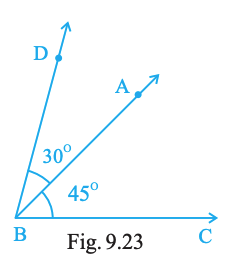
Draw an angle ABC of measure 45°, using ruler and compasses. Now draw an angle DBA of measure 30°, using ruler and compasses as shown in Fig. 9.23. What is the measure of ∠DBC?
Answer:
∠DBC = 75°.
Detailed Answer with Explanation:
Step-by-step Explanation (Very Simple)
We are given:
(angle ABC = 45^circ)
(angle DBA = 30^circ)
We need to find the size of (angle DBC) (the angle from the ray (BD) to the ray (BC), both with vertex at (B)).
Think of the three rays from point B
- Ray (BA)
- Ray (BC) such that (angle ABC = 45^circ)
- Ray (BD) such that (angle DBA = 30^circ)
Move around point (B) in the same direction:
- From (BD) to (BA): this turn is (30^circ).
- From (BA) to (BC): this turn is (45^circ).
Add the two small turns
(angle DBA = 30^circ)
(angle ABC = 45^circ)
(angle DBC = angle DBA + angle ABC)
(angle DBC = 30^circ + 45^circ)
(angle DBC = 75^circ)
Answer: (angle DBC = 75^circ).
(Optional) How to construct the figure with ruler & compass
- Draw (angle ABC = 45^circ):
- Draw a base line (BA).
- At point (B), construct a right angle ((90^circ)) using perpendicular lines.
- Bisect the (90^circ) angle to get (45^circ) and mark the ray (BC).
- Draw (angle DBA = 30^circ):
- First construct (60^circ) at (B) (by forming an equilateral triangle with compass).
- Bisect the (60^circ) angle to get (30^circ) and mark the ray (BD) on that side of (BA) shown in the figure.
- Read (angle DBC): This is the total turn from (BD) to (BC), which we calculated as (75^circ).