NCERT Exemplar Solutions
Class 6 - MathematicsUnit 9: Symmetry and Practical Geometry
Class 6 - Mathematics
Multiple Choice Questions
Question. 1
In the following figures, the figure that is not symmetric with respect to any line is:
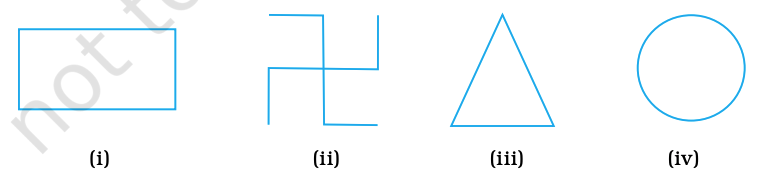
(i)
(ii)
(iii)
(iv)
Open
Question. 2
The number of lines of symmetry in a scalene triangle is
0
1
2
3
Open
Question. 3
The number of lines of symmetry in a circle is
0
2
4
more than 4
Open
Question. 4
Which of the following letters does not have the vertical line of symmetry?
M
H
E
V
Open
Question. 5
Which of the following letters have both horizontal and vertical lines of symmetry?
X
E
M
K
Open
Question. 6
Which of the following letters does not have any line of symmetry?
M
S
K
H
Open
Question. 7
Which of the following letters has only one line of symmetry?
H
X
Z
T
Open
Question. 8
The instrument to measure an angle is a
Ruler
Protractor
Divider
Compasses
Open
Question. 9
The instrument to draw a circle is
Ruler
Protractor
Divider
Compasses
Open
Question. 10
Number of set squares in the geometry box is
0
1
2
3
Open
Question. 11
The number of lines of symmetry in a ruler is
0
1
2
4
Open
Question. 12
The number of lines of symmetry in a divider is
0
1
2
3
Open
Question. 13
The number of lines of symmetry in compasses is
0
1
2
3
Open
Question. 14
The number of lines of symmetry in a protractor is
0
1
2
more than 2
Open
Question. 15
The number of lines of symmetry in a 45°–45°–90° set-square is
0
1
2
3
Open
Question. 16
The number of lines of symmetry in a 30°–60°–90° set-square is
0
1
2
3
Open
Question. 17
The instrument in the geometry box having the shape of a triangle is called a
Protractor
Compasses
Divider
Set-square
Open
Fill in the Blanks
Question. 18
The distance of the image of a point (or an object) from the line of symmetry (mirror) is _____ as that of the point (object) from the line (mirror).
Answer:
The distance of the image is same as that of the object from the mirror.
Open
Question. 19
The number of lines of symmetry in a picture of Taj Mahal is ____.
Answer:
one.
Open
Question. 20
The number of lines of symmetry in a rectangle and a rhombus are _____ (equal/unequal).
Answer:
equal.
Open
Question. 21
The number of lines of symmetry in a rectangle and a square are _____ (equal/unequal).
Answer:
unequal.
Open
Question. 22
If a line segment of length 5 cm is reflected in a line of symmetry (mirror), then its reflection (image) is a _____ of length _____.
Answer:
a Line segment of length 5 cm.
Open
Question. 23
If an angle of measure \(80^\circ\) is reflected in a line of symmetry, then the reflection is an _____ of measure _____.
Answer:
an Angle of measure \(80^\circ\).
Open
Question. 24
The image of a point lying on a line \(l\) with respect to the line of symmetry \(l\) lies on _____.
Answer:
l.
Open
Question. 25
In Fig. 9.10, if B is the image of the point A with respect to the line \(l\) and P is any point lying on \(l\), then the lengths of line segments PA and PB are _____.
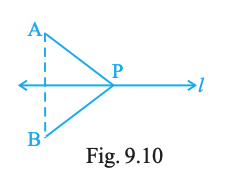
Answer:
equal.
Open
Question. 26
The number of lines of symmetry in Fig. 9.11 is ____.
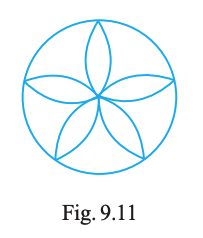
Answer:
5.
Open
Question. 27
The common properties in the two set-squares of a geometry box are that they have a _____ angle and they are of the shape of a _____.
Answer:
right angle and a triangle.
Open
Question. 28
The digits having only two lines of symmetry are _____ and _____.
Answer:
0 and 8.
Open
Question. 29
The digit having only one line of symmetry is ____.
Answer:
3.
Open
Question. 30
The number of digits having no line of symmetry is ____.
Answer:
7 (digits: 1, 2, 4, 5, 6, 7, 9).
Open
Question. 31
The number of capital letters of the English alphabets having only vertical line of symmetry is ____.
Answer:
7 (A, M, U, V, W, Y, T).
Open
Question. 32
The number of capital letters of the English alphabets having only horizontal line of symmetry is ____.
Answer:
5 (B, C, D, E, K).
Open
Question. 33
The number of capital letters of the English alphabets having both horizontal and vertical lines of symmetry is ____.
Answer:
4 (H, I, O, X).
Open
Question. 34
The number of capital letters of the English alphabets having no line of symmetry is ____.
Answer:
10 (F, G, J, L, N, P, Q, R, S, Z).
Open
Question. 35
The line of symmetry of a line segment is the _____ bisector of the line segment.
Answer:
perpendicular bisector.
Open
Question. 36
The number of lines of symmetry in a regular hexagon is ____.
Answer:
6.
Open
Question. 37
The number of lines of symmetry in a regular polygon of \(n\) sides is ____.
Answer:
n.
Open
Question. 38
A protractor has _____ line/lines of symmetry.
Answer:
one.
Open
Question. 39
A \(30^\circ\)–\(60^\circ\)–\(90^\circ\) set-square has _____ line/lines of symmetry.
Answer:
no.
Open
Question. 40
A \(45^\circ\)–\(45^\circ\)–\(90^\circ\) set-square has _____ line/lines of symmetry.
Answer:
one.
Open
Question. 42
A rectangle is symmetrical about the lines joining the _____ of the opposite sides.
Answer:
mid points.
Open
True or False Questions
Question. 43
A right triangle can have at most one line of symmetry.
Answer:
Open
Question. 46
If an isosceles triangle has more than one line of symmetry, then it need not be an equilateral triangle.
Answer:
Open
Question. 47
If a rectangle has more than two lines of symmetry, then it must be a square.
Answer:
Open
Question. 48
With ruler and compasses, we can bisect any given line segment.
Answer:
Open
Question. 49
Only one perpendicular bisector can be drawn to a given line segment.
Answer:
Open
Question. 50
Two perpendiculars can be drawn to a given line from a point not lying on it.
Answer:
Open
Question. 51
With a given centre and a given radius, only one circle can be drawn.
Answer:
Open
Question. 52
Using only the two set-squares of the geometry box, an angle of 40° can be drawn.
Answer:
Open
Question. 53
Using only the two set-squares of the geometry box, an angle of 15° can be drawn.
Answer:
Open
Question. 54
If an isosceles triangle has more than one line of symmetry, then it must be an equilateral triangle.
Answer:
Open
Question. 55
A square and a rectangle have the same number of lines of symmetry.
Answer:
Open
Question. 57
A 45°-45°-90° set-square and a protractor have the same number of lines of symmetry.
Answer:
Open
Question. 58
It is possible to draw two bisectors of a given angle.
Answer:
Open
Question. 60
Infinitely many perpendiculars can be drawn to a given ray.
Answer:
Open
Question. 61
Infinitely many perpendicular bisectors can be drawn to a given ray.
Answer:
Open
Problems and Solutions
Question. 62
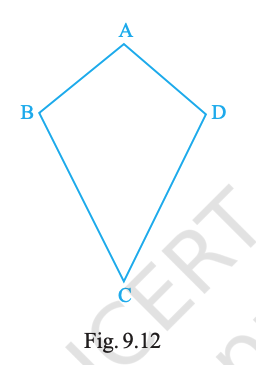
Is there any line of symmetry in the Fig. 9.12? If yes, draw all the lines of symmetry.
Answer:
Yes, one line of symmetry — the line through A and C.
Open
Question. 63
In Fig. 9.13, PQRS is a rectangle. State the lines of symmetry of the rectangle.
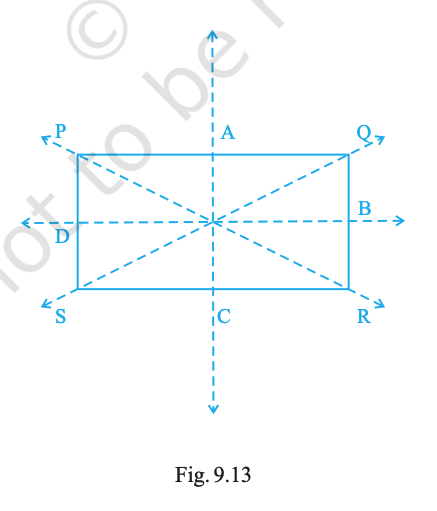
Answer:
AC and BD.
Open
Question. 64
Write all the capital letters of the English alphabets which have more than one lines of symmetry.
Answer:
H, I, O, X
Open
Question. 65
Write the letters of the word ‘MATHEMATICS’ which have no line of symmetry.
Answer:
S
Open
Question. 66
Write the number of lines of symmetry in each letter of the word ‘SYMMETRY’.
Answer:
S–0, Y–1, M–1, M–1, E–1, T–1, R–0, Y–1
Open
Question. 67
Match the following:
| Shape | Number of lines of symmetry |
|---|---|
| (i) Isosceles triangle | (a) 6 |
| (ii) Square | (b) 5 |
| (iii) Kite | (c) 4 |
| (iv) Equilateral triangle | (d) 3 |
| (v) Rectangle | (e) 2 |
| (vi) Regular hexagon | (f) 1 |
| (vii) Scalene triangle | (g) 0 |
Answer:
(i)→(f), (ii)→(c), (iii)→(f), (iv)→(d), (v)→(e), (vi)→(a), (vii)→(g)
Open
Question. 68
Open your geometry box. There are some drawing tools. Observe them and complete the following table:
| Name of the tool | Number of lines of symmetry |
|---|---|
| (i) The Ruler | _____ |
| (ii) The Divider | _____ |
| (iii) The Compasses | _____ |
| (iv) The Protractor | _____ |
| (v) Triangular piece with two equal sides | _____ |
| (vi) Triangular piece with unequal sides | _____ |
Answer:
| Name of the tool | Number of lines of symmetry |
|---|---|
| (i) The Ruler | 2 |
| (ii) The Divider | 1 |
| (iii) The Compasses | 0 |
| (iv) The Protractor | 1 |
| (v) Triangular piece with two equal sides | 1 |
| (vi) Triangular piece with unequal sides | 0 |
Open
Question. 69
Draw the images of points A and B in line l of Fig. 9.14 and name them as A′ and B′ respectively. Measure AB and A′B′. Are they equal?
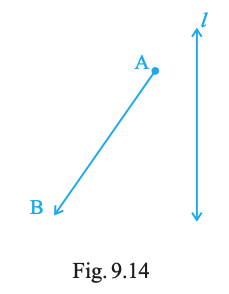
Answer:
Yes, AB = A′B′.
Open
Question. 70
In Fig. 9.15, the point C is the image of point A in line l and line segment BC intersects the line l at P.
(a) Is the image of P in line l the point P itself?
(b) Is PA = PC?
(c) Is PA + PB = PC + PB?
(d) Is P that point on line l from which the sum of the distances of points A and B is minimum?
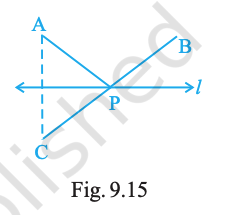
Answer:
(a) Yes (b) Yes (c) Yes (d) Yes
Open
Question. 71
Complete the figure so that line l becomes the line of symmetry of the whole figure (Fig. 9.16).
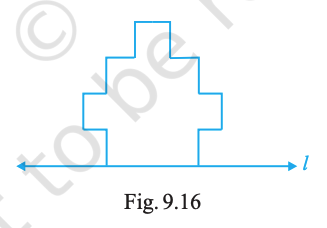
Answer:
Reflect the given half across line l to obtain its mirror image; the completed figure is symmetric about l.
Open
Question. 72
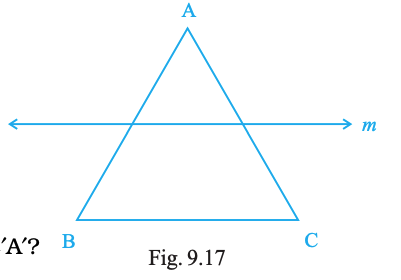
Draw the images of the points A, B and C in the line m (Fig. 9.17). Name them as A′, B′ and C′, respectively and join them in pairs. Measure AB, BC, CA, A′B′, B′C′ and C′A′. Is AB = A′B′, BC = B′C′ and CA = C′A′?
Answer:
Yes, Yes, Yes.
Open
Question. 73
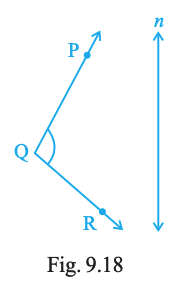
Draw the images P′, Q′ and R′ of the points P, Q and R, respectively in the line n (Fig. 9.18). Join P′Q′ and Q′R′ to form an angle P′Q′R′. Measure ∠PQR and ∠P′Q′R′. Are the two angles equal?
Answer:
Yes, the two angles are equal.
Open
Question. 74
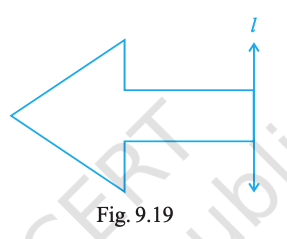
Complete Fig. 9.19 by taking l as the line of symmetry of the whole figure.
Answer:
Draw the mirror image of the given half across the line l to complete the symmetric figure.
Open
Question. 75
Draw a line segment of length 7 cm. Draw its perpendicular bisector, using ruler and compasses.
Answer:
Construction: (1) Draw segment AB = 7 cm. (2) With centres A and B and radius > 3.5 cm, draw arcs above and below AB to intersect at P and Q. (3) Join PQ to get the perpendicular bisector of AB.
Open
Question. 76
Draw a line segment of length 6.5 cm and divide it into four equal parts, using ruler and compasses.
Answer:
Construction: (1) Draw AB = 6.5 cm. (2) Construct its perpendicular bisector to get midpoint M → AM = MB = 3.25 cm. (3) Bisect AM and MB again to obtain points that divide AB into four equal parts of 1.625 cm each.
Open
Question. 77
Draw an angle of 140° with the help of a protractor and bisect it using ruler and compasses.
Answer:
Construction: (1) Draw ∠XOY = 140° with protractor. (2) With centres X and Y on the arms and same radius, draw intersecting arcs at P. (3) Join OP; OP bisects the angle to 70° each.
Open
Question. 78
Draw an angle of 65° and draw an angle equal to this angle, using ruler and compasses.
Answer:
Construction: (1) Draw ∠ABC = 65° (protractor). (2) At point P elsewhere, draw a ray PQ. (3) With centre B take arc cutting BA and BC at E and F; copy the same radius at P to cut PQ at R. (4) With centres E and F distances, reproduce intersection on PR to get point S; join PS to form ∠QPS equal to 65°.
Open
Question. 79
Draw an angle of 80° using a protractor and divide it into four equal parts, using ruler and compasses. Check your construction by measurement.
Answer:
Construction: (1) Draw 80°. (2) Bisect to 40°. (3) Bisect each 40° again to obtain four equal 20° angles. Verify with protractor.
Open
Question. 80
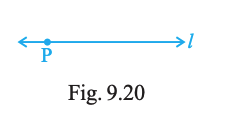
Copy Fig. 9.20 on your notebook and draw a perpendicular to l through P, using (i) set squares (ii) protractor (iii) ruler and compasses. How many such perpendiculars are you able to draw?
Answer:
One perpendicular (unique through P).
Open
Question. 81
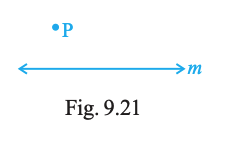
Copy Fig. 9.21 on your notebook and draw a perpendicular from P to line m, using (i) set squares (ii) Protractor (iii) ruler and compasses. How many such perpendiculars are you able to draw?
Answer:
One perpendicular.
Open
Question. 82
Draw a circle of radius 6 cm using ruler and compasses. Draw one of its diameters. Draw the perpendicular bisector of this diameter. Does this perpendicular bisector contain another diameter of the circle?
Answer:
Yes, the perpendicular bisector of a diameter passes through the centre and forms another diameter of the circle.
Open
Question. 83
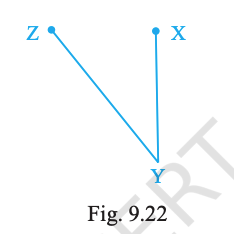
Bisect ∠XYZ of Fig. 9.22
Answer:
Construction: Draw arcs from X and Z cutting each other at P. Join YP. Then ∠XYZ is bisected into two equal parts.
Open
Question. 84
Draw an angle of 60° using ruler and compasses and divide it into four equal parts. Measure each part.
Answer:
Each part = 15°.
Open
Question. 85
Bisect a straight angle, using ruler and compasses. Measure each part.
Answer:
Straight angle = 180°. Each bisected part = 90°.
Open
Question. 86
Bisect a right angle, using ruler and compasses. Measure each part. Bisect each of these parts. What will be the measure of each of these parts?
Answer:
Right angle = 90° → bisected into two 45°. Each 45° further bisected into two 22.5°. Final parts = 22.5°.
Open
Question. 87
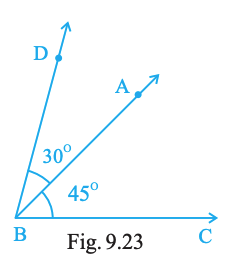
Draw an angle ABC of measure 45°, using ruler and compasses. Now draw an angle DBA of measure 30°, using ruler and compasses as shown in Fig. 9.23. What is the measure of ∠DBC?
Answer:
∠DBC = 75°.
Open
Question. 88
Draw a line segment of length 6 cm. Construct its perpendicular bisector. Measure the two parts of the line segment.
Answer:
Each part = 3 cm.
Open
Question. 89
Draw a line segment of length 10 cm. Divide it into four equal parts. Measure each of these parts.
Answer:
Each part = 2.5 cm.