NCERT Exemplar Solutions
Class 6 - Mathematics - Unit 6: Mensuration - Matching Shapes with PerimetersQuestion 7
Class 6 - Mathematics - Unit 6: Mensuration - Matching Shapes with Perimeters
Question. 7
7. Match the shapes (each side measures 2 cm) in Column I with the corresponding perimeters in Column II:
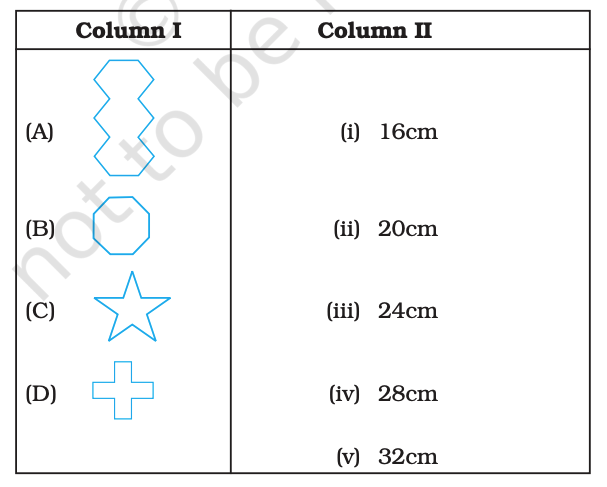
Answer:
(A) → (iv) 28 cm
(B) → (ii) 20 cm
(C) → (v) 32 cm
(D) → (iii) 24 cm
Detailed Answer with Explanation:
Key idea: For any shape made of equal sides, the perimeter is the total length around the shape.
Since each side is 2 cm, we use:
( ext{Perimeter} = ext{(number of sides)} imes ext{(length of one side)})
( ext{Perimeter} = ext{(number of sides)} imes 2 ext{cm})
(A) Count the outer sides carefully. There are 14 sides.
( ext{Perimeter} = 14 imes 2 ext{cm})
( ext{Perimeter} = 28 ext{cm})
(B) This shape has 10 sides (a decagon).
( ext{Perimeter} = 10 imes 2 ext{cm})
( ext{Perimeter} = 20 ext{cm})
(C) In the star, count all the small equal edges on the outside. There are 16 sides.
( ext{Perimeter} = 16 imes 2 ext{cm})
( ext{Perimeter} = 32 ext{cm})
(D) For the plus (+) shape, follow the outer boundary and count. There are 12 sides.
( ext{Perimeter} = 12 imes 2 ext{cm})
( ext{Perimeter} = 24 ext{cm})
Matchings:
(A) → 28 cm (B) → 20 cm (C) → 32 cm (D) → 24 cm