NCERT Exemplar Solutions
Class 6 - Mathematics - Unit 6: MensurationMultiple Choice Questions
Class 6 - Mathematics - Unit 6: Mensuration
Question. 1
Following figures are formed by joining six unit squares. Which figure has the smallest perimeter in Fig. 6.4?
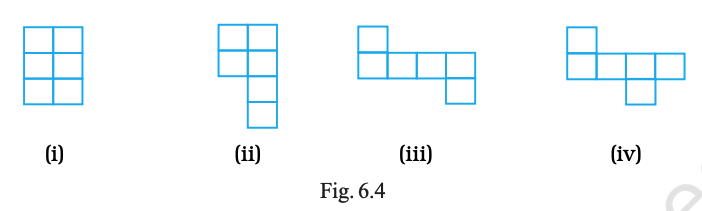
(ii)
(iii)
(iv)
(i)
Open
Question. 2
A square shaped park ABCD of side 100 m has two equal rectangular flower beds each of size 10 m × 5 m (Fig. 6.5). Length of the boundary of the remaining park is
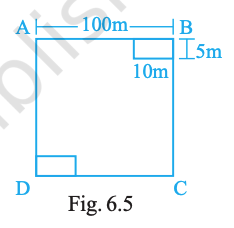
360 m
400 m
340 m
460 m
Open
Question. 3
The side of a square is 10 cm. How many times will the new perimeter become if the side of the square is doubled?
2 times
4 times
6 times
8 times
Open
Question. 4
Length and breadth of a rectangular sheet of paper are 20 cm and 10 cm, respectively. A rectangular piece 5 cm × 2 cm is cut from the sheet as shown in Fig. 6.6. Which statement is correct for the remaining sheet?
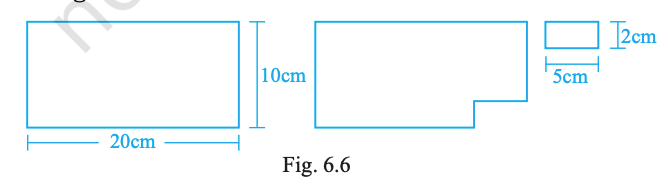
Perimeter remains same but area changes.
Area remains the same but perimeter changes.
Both area and perimeter are changing.
Both area and perimeter remain the same.
Open
Question. 5
Two regular hexagons of perimeter 30 cm each are joined as shown in Fig. 6.7. The perimeter of the new figure is
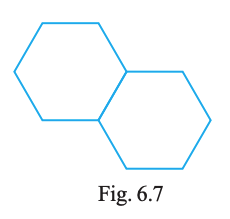
65 cm
60 cm
55 cm
50 cm
Open
Question. 6
In Fig. 6.8 which of the following is a regular polygon?
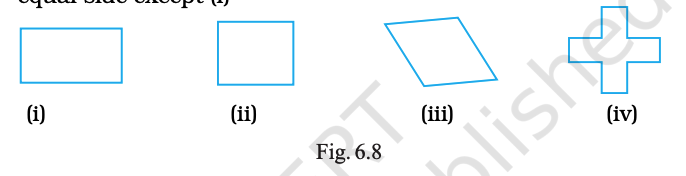
(i)
(ii)
(iii)
(iv)