NCERT Exemplar Solutions
Class 6 - Mathematics - Unit 6: Mensuration - Problems and SolutionsQuestion 28
Class 6 - Mathematics - Unit 6: Mensuration - Problems and Solutions
Question. 28
Three squares are joined together as shown in Fig. 6.14. Their sides are 4 cm, 10 cm and 3 cm. Find the perimeter of the figure.
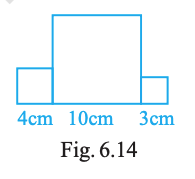
Answer:
Perimeter of the figure = 54 cm
Detailed Answer with Explanation:
Step 1: Understand the figure
Three squares are joined edge to edge. The side lengths are 4 cm, 10 cm, and 3 cm. When shapes are joined, some edges become “inside” the figure (shared edges) and do not count in the outer boundary.
Step 2: Perimeter if they were separate
Perimeter of a square = 4 × (side).
For side 4 cm:
(4 imes 4 = 16 ext{cm})
For side 10 cm:
(4 imes 10 = 40 ext{cm})
For side 3 cm:
(4 imes 3 = 12 ext{cm})
Total if separate:
(16 + 40 + 12 = 68 ext{cm})
Step 3: Identify shared edges
When the squares are joined, some edges are common (shared). These shared parts are inside the figure, so they should not be counted on the outside boundary. The total shared length (from the way they touch) is:
(7 ext{cm})
Step 4: Correct for double counting
In the total of 68 cm, each shared edge was counted twice (once for each square). So we must subtract the shared length two times:
Subtract amount = (2 imes 7 = 14 ext{cm})
Step 5: Final perimeter
(68 - 14 = 54 ext{cm})
Therefore, the perimeter of the figure is (54 ext{cm}).