NCERT Exemplar Solutions
Class 6 - Mathematics - Unit 9: Symmetry and Practical Geometry - Problems and SolutionsQuestion 72
Class 6 - Mathematics - Unit 9: Symmetry and Practical Geometry - Problems and Solutions
Question. 72
Draw the images of the points A, B and C in the line m (Fig. 9.17). Name them as A′, B′ and C′, respectively and join them in pairs. Measure AB, BC, CA, A′B′, B′C′ and C′A′. Is AB = A′B′, BC = B′C′ and CA = C′A′?
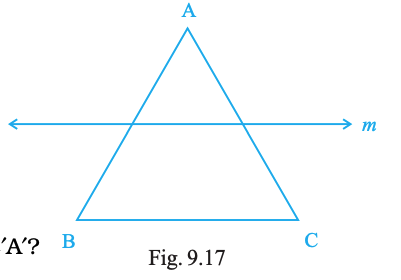
Answer:
Yes, Yes, Yes.
Detailed Answer with Explanation:
Explanation (Very Simple Steps)
We have three points A, B, C and a line m. We will draw their images in line m and name them A′, B′, C′. Then we will compare the lengths.
What you need
- Ruler (scale)
- Compass
- Pencil
- Protractor (optional)
Step 1: Reflect point A in line m
- Keep the compass point on A. Draw a small arc that cuts the line m at two points.
- Without changing the compass width, place the compass point on each cut point on m and draw two arcs on the other side of m so that they meet.
- The meeting point of these arcs is the image A′.
- Check: The line segment AA′ is perpendicular to m, and the line m is the midline of AA′.
Step 2: Reflect point B in line m
- Repeat the same steps for B to get its image B′.
Step 3: Reflect point C in line m
- Repeat the same steps for C to get its image C′.
Step 4: Join the points to make the two triangles
- Join A–B, B–C, and C–A to make triangle ABC.
- Join A′–B′, B′–C′, and C′–A′ to make triangle A′B′C′.
Step 5: Measure the sides
- Measure AB, BC, CA.
- Measure A′B′, B′C′, C′A′.
What do we observe?
The reflection (mirror image) in a line keeps distances the same. This means the length between any two original points is equal to the length between their images.
( AB = A′B′ )
( BC = B′C′ )
( CA = C′A′ )
Why is this true? (Idea)
A reflection in a line is an isometry (a distance-preserving transformation). The line m acts like a mirror. Each point and its image are on opposite sides of m, the segment joining them is perpendicular to m, and m cuts that segment exactly in the middle. So all side lengths stay the same after reflection.
Final Answer
Yes, Yes, Yes. We find that:
( AB = A′B′ )
( BC = B′C′ )
( CA = C′A′ )