NCERT Exemplar Solutions
Class 6 - Mathematics - Unit 9: Symmetry and Practical Geometry - Problems and SolutionsQuestion 81
Class 6 - Mathematics - Unit 9: Symmetry and Practical Geometry - Problems and Solutions
Question. 81
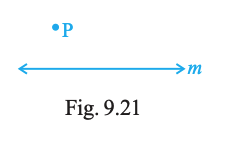
Copy Fig. 9.21 on your notebook and draw a perpendicular from P to line m, using (i) set squares (ii) Protractor (iii) ruler and compasses. How many such perpendiculars are you able to draw?
Answer:
One perpendicular.
Detailed Answer with Explanation:
Q81. Draw a perpendicular from point P to line m using (i) set squares (ii) protractor (iii) ruler & compasses. How many such perpendiculars can be drawn?
Key Idea (What is a perpendicular?)
Two lines are perpendicular if they meet to form a right angle.
( ext{Right angle} = 90^circ )
Method (i): Using Set Squares
- Place the longer edge of the set square along line m. Make sure it does not move.
- Keep a ruler (or another set square) pressed firmly against the short edge of your set square so the set square can slide along the ruler.
- Slide the set square along the ruler until one edge passes through point P.
- Draw the line through P along that edge. This line will meet m at a right angle.
- Mark the meeting point as X. Write the right-angle mark at X.
( angle PXM = 90^circ )
Method (ii): Using a Protractor
- Through point P, draw a light helper line that crosses line m. Mark the crossing point as X.
- Place the protractor at point X with the baseline along line m.
- From m, count to 90° on the protractor and make a small dot on that mark.
- Join point X to that dot to draw the 90° line.
- Extend this 90° line so that it passes through P (adjust your helper line if needed). This is the required perpendicular.
( ext{At } X: quad angle( ext{new line},, m) = 90^circ )
Method (iii): Using Ruler & Compasses
- Open the compass to a comfortable width (not too small). With center P, draw an arc that cuts line m at two points. Mark them as A and B.
- Keep the compass opening the same. With center A, draw a small arc below line m.
- With center B, draw another small arc (same opening) so it intersects the first arc. Mark the intersection as C.
- Draw the line PC. This line will meet m at a right angle.
- Mark the foot of the perpendicular as X where the line meets m.
Why this works: Points A and B are the same distance from X. Drawing equal arcs from A and B locates point C so that triangle AXB is isosceles and the line through the midpoint is a right angle.
( AX = BX )
( Rightarrow ) line through midpoint and vertex is perpendicular
( angle PXM = 90^circ )
Check Your Work
- Use a set square or protractor at point X to verify the angle is 90°.
- The shortest distance from P to line m is along the perpendicular. Your drawn line should look like the shortest path from P to m.
( ext{Shortest distance from a point to a line} = ext{perpendicular segment} )
Answer (How many perpendiculars?)
Only one perpendicular can be drawn from a point not on a line to that line.
This is a unique construction in Euclidean geometry.
( ext{From point } P otin m, exists! ext{line } PX perp m )