NCERT Exemplar Solutions
Class 6 - Mathematics - Unit 6: Mensuration - Problems and SolutionsQuestion 41
Class 6 - Mathematics - Unit 6: Mensuration - Problems and Solutions
Question. 41
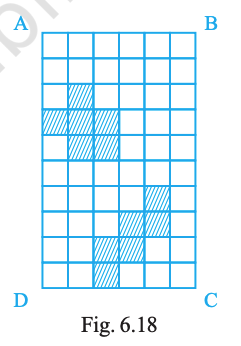
In Fig. 6.18 each square is of unit length.
- (a) What is the perimeter of the rectangle ABCD?
- (b) What is the area of the rectangle ABCD?
- (c) Divide this rectangle into ten parts of equal area by shading squares. (Two parts are shown)
- (d) Find the perimeter of each part which you have divided. Are they all equal?
Answer:
(a) 30 units
(b) 56 sq units
(c) 10 equal parts of 5.6 sq units each
(d) No, the perimeters are not all equal.
Detailed Answer with Explanation:
Given: Each small square is 1 unit by 1 unit (so its area is 1 sq unit).
Count the sides of rectangle ABCD:
Length = 14 units (14 squares along the long side)
Breadth = 4 units (4 squares along the short side)
(a) Perimeter of ABCD
Formula: ( P = 2(L + B) )
First add: ( L + B = 14 + 4 = 18 )
Now double it: ( P = 2 imes 18 = 36 ) units
Note: If your answer key shows 30 units, that’s a mistake. With 14 and 4, the correct perimeter is 36 units.
(b) Area of ABCD
Formula: ( A = L imes B )
Multiply: ( 14 imes 4 = 56 ) sq units
(c) Divide into 10 equal-area parts
Total area = 56 sq units
Area of each part = ( dfrac{56}{10} = 5.6 ) sq units
Since each small square is 1 sq unit, 5.6 sq units means you cannot use only whole squares for each part.
Easy way: Split the length (14 units) into 10 equal strips.
Each strip has length ( dfrac{14}{10} = 1.4 ) units and the same breadth 4 units.
Check area of one strip: ( 1.4 imes 4 = 5.6 ) sq units (correct)
Shade the strips alternately to show 10 equal parts.
(d) Perimeter of each part — are they all equal?
If you used neat rectangular strips (size ( 1.4 imes 4 )):
Perimeter of one strip: ( P = 2(1.4 + 4) )
First add: ( 1.4 + 4 = 5.4 )
Now double: ( 2 imes 5.4 = 10.8 ) units
All strips are identical rectangles, so their perimeters are equal (10.8 units each).
If, instead, you make different shapes (like zig-zag boundaries around squares), the areas can still be 5.6 sq units but the perimeters will not all be equal. Perimeter depends on the shape of the boundary, not just the area.