NCERT Solutions
Class 10 - MathematicsChapter 10: CIRCLES
Class 10 - Mathematics
Exercise 10.1
Question. 1
How many tangents can a circle have?
Answer:
Infinitely many
Question. 2
Fill in the blanks:
- A tangent to a circle intersects it in ______ point(s).
- A line intersecting a circle in two points is called a ______.
- A circle can have ______ parallel tangents at the most.
- The common point of a tangent to a circle and the circle is called ______.
Answer:
(i) One
(ii) Secant
(iii) Two
(iv) Point of contact
Question. 3
A tangent PQ at a point P of a circle of radius 5 cm meets a line through the centre O at a point Q so that OQ = 12 cm. Length PQ is:
(A) 12 cm (B) 13 cm (C) 8.5 cm (D) \(\sqrt{119}\) cm
Answer:
Option D, \(\sqrt{119}\text{ cm}\)
Question. 4
Draw a circle and two lines parallel to a given line such that one is a tangent and the other, a secant to the circle.
Exercise 10.2
Question. 1
From a point Q, the length of the tangent to a circle is 24 cm and the distance of Q from the centre is 25 cm. The radius of the circle is
7 cm
12 cm
15 cm
24.5 cm
Question. 2
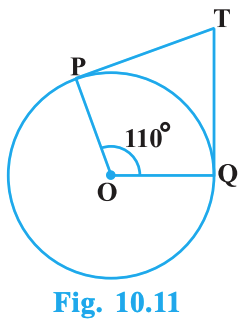
In Fig. 10.11, if TP and TQ are two tangents to a circle with centre O so that ∠POQ = 110°, then ∠PTQ is equal to
60°
70°
80°
90°
Question. 3
If tangents PA and PB from a point P to a circle with centre O are inclined to each other at an angle of 80°, then ∠POA is equal to
50°
60°
70°
80°
Question. 4
Prove that the tangents drawn at the ends of a diameter of a circle are parallel.
Answer:
The tangents at the endpoints of a diameter are perpendicular to the radii at those points. Since the radii lie along a straight line, the tangents are parallel.
Question. 5
Prove that the perpendicular at the point of contact to the tangent to a circle passes through the centre.
Answer:
The radius drawn to the point of contact is perpendicular to the tangent at that point. Hence this perpendicular must pass through the centre.
Question. 6
The length of a tangent from a point A at distance 5 cm from the centre of the circle is 4 cm. Find the radius of the circle.
Answer:
Using AO² = AP² + r² → 5² = 4² + r² → r = 3 cm.
Question. 7
Two concentric circles are of radii 5 cm and 3 cm. Find the length of the chord of the larger circle which touches the smaller circle.
Answer:
Chord length = 2√(5² − 3²) = 2√16 = 8 cm.
Question. 8
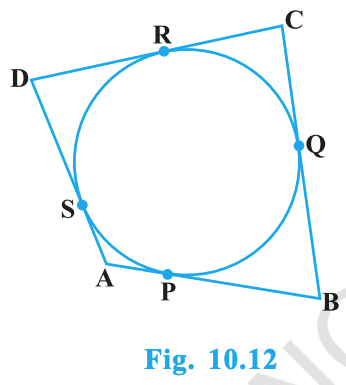
A quadrilateral ABCD is drawn to circumscribe a circle. Prove that AB + CD = AD + BC.
Answer:
From tangents drawn from an external point, tangents to points of contact are equal. Adding pairs of equal tangents gives AB + CD = AD + BC.
Question. 9
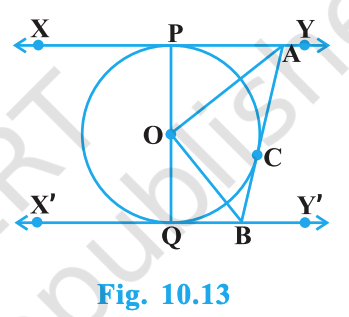
In Fig. 10.13, XY and X′Y′ are two parallel tangents to a circle and AB is another tangent intersecting XY at A and X′Y′ at B. Prove ∠AOB = 90°.
Answer:
Opposite tangents form supplementary angles; geometry of radii and symmetry gives ∠AOB = 90°.
Question. 10
Prove that the angle between two tangents drawn from an external point to a circle is supplementary to the angle subtended by the line segment joining the points of contact at the centre.
Answer:
If ∠AOB is at centre, then angle between tangents = 180° − ∠AOB.
Question. 11
Prove that the parallelogram circumscribing a circle is a rhombus.
Answer:
Opposite sides of a circumscribed quadrilateral sum equally; hence consecutive sides of parallelogram are equal → rhombus.
Question. 12
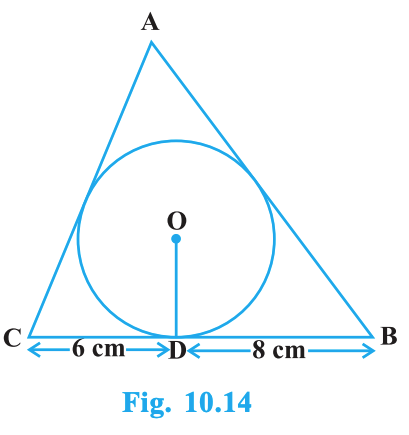
A triangle ABC circumscribes a circle of radius 4 cm with BD = 8 cm and DC = 6 cm. Find AB and AC.
Answer:
Using tangent properties: AB = s − c = 12 cm, AC = s − b = 10 cm.
Question. 13
Prove that opposite sides of a quadrilateral circumscribing a circle subtend supplementary angles at the centre.
Answer:
Tangent lengths imply opposite arcs sum to 180°, hence the angles subtended at the centre are supplementary.