NCERT Solutions
Class 10 - MathematicsChapter 2: POLYNOMIALS
Class 10 - Mathematics
Complete NCERT Solutions for problems given in POLYNOMIALS chapter in Class 10 Mathematics.
EXERCISE 2.1
Question. 1
The graphs of \( y = p(x) \) are given in Fig. 2.10 for some polynomials \(p(x)\). Find the number of zeroes of \(p(x)\) in each case.
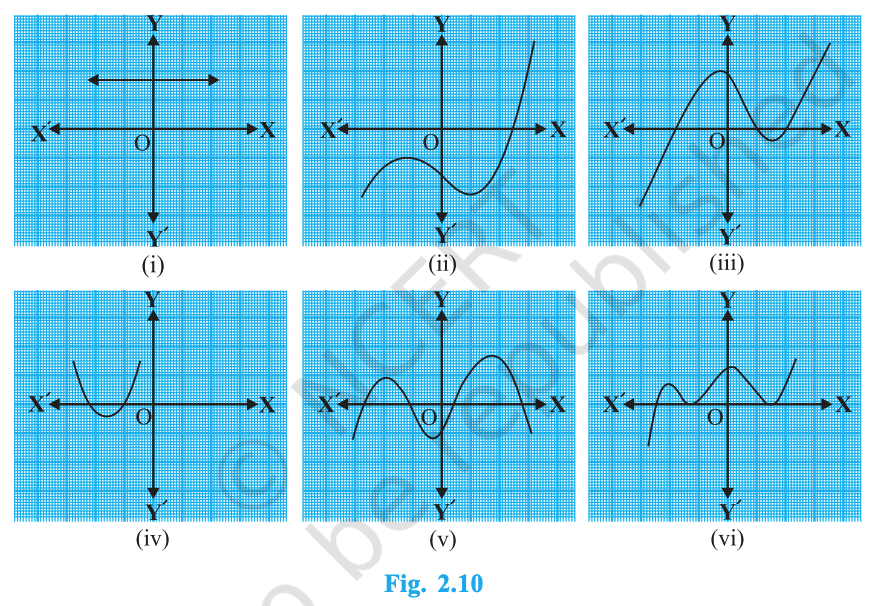
Answer:
(i) No zeroes
(ii) 1
(iii) 3
(iv) 2
(v) 4
(vi) 3
EXERCISE 2.2
Question. 1
Find the zeroes of the following quadratic polynomials and verify the relationship between the zeroes and the coefficients.
(i) \(x^2 - 2x - 8\)
(ii) \(4s^2 - 4s + 1\)
(iii) \(6x^2 - 3 - 7x\)
(iv) \(4u^2 + 8u\)
(v) \(t^2 - 15\)
(vi) \(3x^2 - x - 4\)
Open
Question. 2
Find a quadratic polynomial each with the given numbers as the sum and product of its zeroes respectively.
(i) \(\dfrac{1}{4}, -1\)
(ii) \(\sqrt{2}, \dfrac{1}{3}\)
(iii) \(0, \sqrt{5}\)
(iv) \(1, 1\)
(v) \(-\dfrac{1}{4}, \dfrac{1}{4}\)
(vi) \(4, 1\)