NCERT Solutions
Class 10 - MathematicsChapter 8: INTRODUCTION TO TRIGONOMETRY
Class 10 - Mathematics
Exercise 8.1
Question. 1
In ΔABC, right-angled at B, AB = 24 cm, BC = 7 cm. Determine:
(i) sin A, cos A
(ii) sin C, cos C
Answer:
(i) sin A = \(\dfrac{7}{25}\), cos A = \(\dfrac{24}{25}\)
(ii) sin C = \(\dfrac{24}{25}\), cos C = \(\dfrac{7}{25}\)
Open
Question. 2
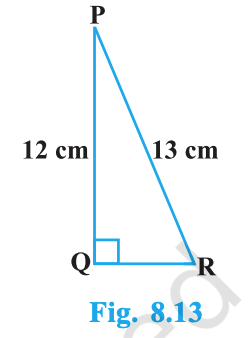
In Fig. 8.13, find tan P − cot R.
Answer:
0
Open
Question. 3
If sin A = \(\dfrac{3}{4}\), calculate cos A and tan A.
Answer:
cos A = \(\dfrac{\sqrt{7}}{4}\), tan A = \(\dfrac{3}{\sqrt{7}}\)
Open
Question. 4
Given 15 cot A = 8, find sin A and sec A.
Answer:
sin A = \(\dfrac{15}{17}\), sec A = \(\dfrac{17}{8}\)
Open
Question. 5
Given sec θ = \(\dfrac{13}{12}\), calculate all other trigonometric ratios.
Answer:
sin θ = \(\dfrac{5}{13}\), cos θ = \(\dfrac{12}{13}\), tan θ = \(\dfrac{5}{12}\), cot θ = \(\dfrac{12}{5}\), cosec θ = \(\dfrac{13}{5}\)
Open
Question. 6
If ∠A and ∠B are acute angles such that cos A = cos B, then show that ∠A = ∠B.
Open
Question. 7
If cot θ = \(\dfrac{7}{8}\), evaluate:
(i) \(\dfrac{(1 + \sin θ)(1 - \sin θ)}{(1 + \cos θ)(1 - \cos θ)}\)
(ii) cot² θ
Answer:
(i) \(\dfrac{49}{64}\)
(ii) \(\dfrac{49}{64}\)
Open
Question. 8
If 3 cot A = 4, check whether \(\dfrac{1 - \tan^2 A}{1 + \tan^2 A} = \cos^2 A - \sin^2 A\) or not.
Answer:
Yes
Open
Question. 9
In triangle ABC, right-angled at B, if tan A = \(\dfrac{1}{\sqrt{3}}\), find:
(i) sin A cos C + cos A sin C
(ii) cos A cos C − sin A sin C
Answer:
(i) 1
(ii) 0
Open
Question. 10
In ΔPQR, right-angled at Q, PR + QR = 25 cm and PQ = 5 cm. Determine sin P, cos P and tan P.
Answer:
sin P = \(\dfrac{12}{13}\)
cos P = \(\dfrac{5}{13}\)
tan P = \(\dfrac{12}{5}\)
Open
Question. 11
State whether the following are true or false. Justify your answer:
(i) The value of tan A is always less than 1.
(ii) sec A = \(\dfrac{12}{5}\) for some value of angle A.
(iii) cos A is the abbreviation used for the cosecant of angle A.
(iv) cot A is the product of cot and A.
(v) sin θ = \(\dfrac{4}{3}\) for some angle θ.
Answer:
(i) False
(ii) True
(iii) False
(iv) False
(v) False
Open
Exercise 8.2
Question. 1
Evaluate the following:
- \(\sin 60^\circ \cos 30^\circ + \sin 30^\circ \cos 60^\circ\)
- \(2 \tan^2 45^\circ + \cos^2 30^\circ - \sin^2 60^\circ\)
- \(\dfrac{\cos 45^\circ}{\sec 30^\circ + \text{cosec } 30^\circ}\)
- \(\dfrac{\sin 30^\circ + \tan 45^\circ - \text{cosec } 60^\circ}{\sec 30^\circ + \cos 60^\circ + \cot 45^\circ}\)
- \(\dfrac{5 \cos^2 60^\circ + 4 \sec^2 30^\circ - \tan^2 45^\circ}{\sin^2 30^\circ + \cos^2 30^\circ}\)
Answer:
(i) \(1\)
(ii) \(2\)
(iii) \(\dfrac{3\sqrt{2} - \sqrt{6}}{8}\)
(iv) \(\dfrac{43 - 24\sqrt{3}}{11}\)
(v) \(\dfrac{67}{12}\)
Open
Question. 2
Choose the correct option and justify your choice:
- \(\dfrac{2 \tan 30^\circ}{1 + \tan^2 30^\circ} =\)
(A) \(\sin 60^\circ\) (B) \(\cos 60^\circ\) (C) \(\tan 60^\circ\) (D) \(\sin 30^\circ\) - \(\dfrac{1 - \tan^2 45^\circ}{1 + \tan^2 45^\circ} =\)
(A) \(\tan 90^\circ\) (B) 1 (C) \(\sin 45^\circ\) (D) 0 - \(\sin 2A = 2 \sin A\) is true when \(A =\)
(A) \(0^\circ\) (B) \(30^\circ\) (C) \(45^\circ\) (D) \(60^\circ\) - \(\dfrac{2 \tan 30^\circ}{1 - \tan^2 30^\circ} =\)
(A) \(\cos 60^\circ\) (B) \(\sin 60^\circ\) (C) \(\tan 60^\circ\) (D) \(\sin 30^\circ\)
Answer:
(i) A
(ii) D
(iii) A
(iv) C
Open
Question. 3
If \(\tan (A + B) = \sqrt{3}\) and \(\tan (A - B) = \dfrac{1}{\sqrt{3}}\); \(0^\circ < A + B \leq 90^\circ\), \(A > B\), find \(A\) and \(B\).
Answer:
\(\angle A = 45^\circ,\ \angle B = 15^\circ\)
Open
Question. 4
State whether the following are true or false. Justify your answer.
- \(\sin (A + B) = \sin A + \sin B\).
- The value of \(\sin \theta\) increases as \(\theta\) increases.
- The value of \(\cos \theta\) increases as \(\theta\) increases.
- \(\sin \theta = \cos \theta\) for all values of \(\theta\).
- \(\cot A\) is not defined for \(A = 0^\circ\).
Answer:
(i) False
(ii) True
(iii) False
(iv) False
(v) True
Open
Exercise 8.3
Question. 1
Express the trigonometric ratios sin A, sec A and tan A in terms of cot A.
Answer:
\( \sin A = \dfrac{1}{\sqrt{1 + \cot^2 A}} \)
\( \tan A = \dfrac{1}{\cot A} \)
\( \sec A = \dfrac{\sqrt{1 + \cot^2 A}}{\cot A} \)
Open
Question. 2
Write all the other trigonometric ratios of \(\angle A\) in terms of sec A.
Answer:
\( \sin A = \dfrac{\sqrt{\sec^2 A - 1}}{\sec A} \)
\( \cos A = \dfrac{1}{\sec A} \)
\( \tan A = \sqrt{\sec^2 A - 1} \)
\( \cot A = \dfrac{1}{\sqrt{\sec^2 A - 1}} \)
\( \text{cosec } A = \dfrac{\sec A}{\sqrt{\sec^2 A - 1}} \)
Open
Question. 3
Choose the correct option. Justify your choice:
- \(9 \sec^2 A - 9 \tan^2 A =\)
(A) 1 (B) 9 (C) 8 (D) 0 - \((1 + \tan \theta + \sec \theta)(1 + \cot \theta - \text{cosec } \theta) =\)
(A) 0 (B) 1 (C) 2 (D) -1 - \((\sec A + \tan A)(1 - \sin A) =\)
(A) \sec A (B) \sin A (C) \text{cosec } A (D) \cos A - \(\dfrac{1 + \tan^2 A}{1 + \cot^2 A} =\)
(A) \sec^2 A (B) -1 (C) \cot^2 A (D) \tan^2 A
Answer:
(i) B
(ii) C
(iii) D
(iv) D
Open
Question. 4
Prove the following identities, where the angles involved are acute angles for which the expressions are defined:
- \((\text{cosec } \theta - \cot \theta)^2 = \dfrac{1 - \cos \theta}{1 + \cos \theta}\)
- \(\dfrac{\cos A}{1 + \sin A} + \dfrac{1 + \sin A}{\cos A} = 2 \sec A\)
- \(\dfrac{\tan \theta}{1 - \cot \theta} + \dfrac{\cot \theta}{1 - \tan \theta} = 1 + \sec \theta \text{cosec } \theta\)
- \(\dfrac{1 + \sec A}{\sec A} = \dfrac{\sin^2 A}{1 - \cos A}\)
- \(\dfrac{\cos A - \sin A + 1}{\cos A + \sin A - 1} = \text{cosec } A + \cot A\)
- \(\sqrt{\dfrac{1 + \sin A}{1 - \sin A}} = \sec A + \tan A\)
- \(\dfrac{\sin \theta - 2 \sin^3 \theta}{2 \cos^3 \theta - \cos \theta} = \tan \theta\)
- \((\sin A + \text{cosec} A)^2 + (\cos A + \sec A)^2 = 7 + \tan^2 A + \cot^2 A\)
- \((\text{cosec } A - \sin A)(\sec A - \cos A) = \dfrac{1}{\tan A + \cot A}\)
- \(\dfrac{1 + \tan^2 A}{1 + \cot^2 A} = \left( \dfrac{1 - \tan A}{1 - \cot A} \right)^2 = \tan^2 A\)