NCERT Solutions
Class 10 - MathematicsChapter 5: ARITHMETIC PROGRESSIONS
Class 10 - Mathematics
Exercise 5.1
Question. 1
In which of the following situations, does the list of numbers involved make an arithmetic progression, and why?
(i) The taxi fare after each km when the fare is ₹ 15 for the first km and ₹ 8 for each additional km.
(ii) The amount of air present in a cylinder when a vacuum pump removes \(\dfrac{1}{4}\) of the air remaining in the cylinder at a time.
(iii) The cost of digging a well after every metre of digging, when it costs ₹ 150 for the first metre and rises by ₹ 50 for each subsequent metre.
(iv) The amount of money in the account every year, when ₹ 10000 is deposited at compound interest at 8% per annum.
Answer:
(i) Yes. The total fare after each km is \(15, 23, 31, \ldots\), which forms an AP because each succeeding term is obtained by adding 8 to the preceding term.
(ii) No. The volumes of air are \(V, \dfrac{3V}{4}, \left(\dfrac{3}{4}\right)^2 V, \ldots\), which form a geometric progression, not an AP.
(iii) Yes. The costs are \(150, 200, 250, \ldots\), which form an AP with common difference 50.
(iv) No. The amounts are \(10000\left(1 + \dfrac{8}{100}\right), 10000\left(1 + \dfrac{8}{100}\right)^2, 10000\left(1 + \dfrac{8}{100}\right)^3, \ldots\), which form a geometric progression, not an AP.
Open
Question. 2
Write first four terms of the AP, when the first term \(a\) and the common difference \(d\) are given as follows:
(i) \(a = 10,\ d = 10\)
(ii) \(a = -2,\ d = 0\)
(iii) \(a = 4,\ d = -3\)
(iv) \(a = -1,\ d = \dfrac{1}{2}\)
(v) \(a = -1.25,\ d = 0.25\)
Answer:
(i) \(10, 20, 30, 40\)
(ii) \(-2, -2, -2, -2\)
(iii) \(4, 1, -2, -5\)
(iv) \(-1, -\tfrac{1}{2}, 0, \tfrac{1}{2}\)
(v) \(-1.25, -1.50, -1.75, -2.00\)
Open
Question. 3
For the following APs, write the first term and the common difference:
(i) \(3, 1, -1, -3, \ldots\)
(ii) \(-5, -1, 3, 7, \ldots\)
(iii) \(\tfrac{1}{3}, \tfrac{5}{3}, \tfrac{9}{3}, \tfrac{13}{3}, \ldots\)
(iv) \(0.6, 1.7, 2.8, 3.9, \ldots\)
Answer:
(i) First term \(a = 3\), common difference \(d = -2\).
(ii) First term \(a = -5\), common difference \(d = 4\).
(iii) First term \(a = \tfrac{1}{3}\), common difference \(d = \tfrac{4}{3}\).
(iv) First term \(a = 0.6\), common difference \(d = 1.1\).
Open
Question. 4
Which of the following are APs? If they form an AP, find the common difference \(d\) and write three more terms.
(i) \(2, 4, 8, 16, \ldots\)
(ii) \(2, \tfrac{5}{2}, 3, \tfrac{7}{2}, \ldots\)
(iii) \(-1.2, -3.2, -5.2, -7.2, \ldots\)
(iv) \(-10, -6, -2, 2, \ldots\)
(v) \(3, 3 + \sqrt{2}, 3 + 2\sqrt{2}, 3 + 3\sqrt{2}, \ldots\)
(vi) \(0.2, 0.22, 0.222, 0.2222, \ldots\)
(vii) \(0, -4, -8, -12, \ldots\)
(viii) \(\tfrac{1}{2}, -\tfrac{1}{2}, \tfrac{1}{2}, -\tfrac{1}{2}, \ldots\)
(ix) \(1, 3, 9, 27, \ldots\)
(x) \(a, 2a, 3a, 4a, \ldots\)
(xi) \(a, a^2, a^3, a^4, \ldots\)
(xii) \(\sqrt{2}, \sqrt{8}, \sqrt{18}, \sqrt{32}, \ldots\)
(xiii) \(\sqrt{3}, \sqrt{6}, \sqrt{9}, \sqrt{12}, \ldots\)
(xiv) \(1^2, 3^2, 5^2, 7^2, \ldots\)
(xv) \(1^2, 5^2, 7^2, 73, \ldots\)
Answer:
(i) No.
(ii) Yes, it is an AP with \(d = \tfrac{1}{2}\); next three terms are \(4, \tfrac{9}{2}, 5\).
(iii) Yes, it is an AP with \(d = -2\); next three terms are \(-9.2, -11.2, -13.2\).
(iv) Yes, it is an AP with \(d = 4\); next three terms are \(6, 10, 14\).
(v) Yes, it is an AP with \(d = \sqrt{2}\); next three terms are \(3 + 4\sqrt{2}, 3 + 5\sqrt{2}, 3 + 6\sqrt{2}\).
(vi) No.
(vii) Yes, it is an AP with \(d = -4\); next three terms are \(-16, -20, -24\).
(viii) No.
(ix) No.
(x) Yes, it is an AP with \(d = a\); next three terms are \(5a, 6a, 7a\).
(xi) No.
(xii) Yes, it is an AP with \(d = \sqrt{2}\); next three terms are \(\sqrt{50}, \sqrt{72}, \sqrt{98}\).
(xiii) No.
(xiv) No.
(xv) Yes, it is an AP with \(d = 24\); next three terms are \(97, 121, 145\).
Open
Exercise 5.2
Question. 1
Fill in the blanks in the following table, given that \( a \) is the first term, \( d \) the common difference and \( a_n \) the n-th term of the AP:
| a | d | n | \( a_n \) | |
|---|---|---|---|---|
| (i) | 7 | 3 | 8 | ... |
| (ii) | -18 | ... | 10 | 0 |
| (iii) | ... | -3 | 18 | -5 |
| (iv) | -18.9 | 2.5 | ... | 3.6 |
| (v) | 3.5 | 0 | 105 | ... |
Answer:
(i) \( a_n = 28 \)
(ii) \( d = 2 \)
(iii) \( a = 46 \)
(iv) \( n = 10 \)
(v) \( a_n = 3.5 \)
Open
Question. 2
Choose the correct choice in the following and justify:
30th term of the AP: 10, 7, 4, ... is
(A) 97 (B) 77 (C) -77 (D) -87
11th term of the AP: -3, -1/2, 2, ... is
(A) 28 (B) 22 (C) -38 (D) -48 1/2
Answer:
(i) Option (C)
(ii) Option (B)
Open
Question. 3
In the following APs, find the missing terms in the boxes:
2, □, 26
□, 13, □, 3
5, □, □, 9 1/2
-4, □, □, □, 6
□, 38, □, □, -22
Answer:
(i) 14
(ii) 18, 8
(iii) 6 1/2, 8
(iv) -2, 0, 2, 4
(v) 53, 23, 8, -7
Open
Question. 4
Which term of the AP: 3, 8, 13, 18, ... is 78?
Answer:
16th term
Open
Question. 5
Find the number of terms in each of the following APs:
7, 13, 19, ..., 205
18, 15 1/2, 13, ..., -47
Answer:
(i) 34
(ii) 27
Open
Question. 6
Check whether -150 is a term of the AP: 11, 8, 5, 2, ...
Answer:
No
Open
Question. 7
Find the 31st term of an AP whose 11th term is 38 and the 16th term is 73.
Answer:
178
Open
Question. 8
An AP consists of 50 terms of which the 3rd term is 12 and the last term is 106. Find the 29th term.
Answer:
64
Open
Question. 9
If the 3rd and the 9th terms of an AP are 4 and -8 respectively, which term of this AP is zero?
Answer:
5th term
Open
Question. 10
The 17th term of an AP exceeds its 10th term by 7. Find the common difference.
Answer:
1
Open
Question. 11
Which term of the AP: 3, 15, 27, 39, ... will be 132 more than its 54th term?
Answer:
65th term
Open
Question. 12
Two APs have the same common difference. The difference between their 100th terms is 100. What is the difference between their 1000th terms?
Answer:
100
Open
Question. 13
How many three-digit numbers are divisible by 7?
Answer:
128
Open
Question. 14
How many multiples of 4 lie between 10 and 250?
Answer:
60
Open
Question. 15
For what value of \( n \), are the n-th terms of two APs 63, 65, 67, ... and 3, 10, 17, ... equal?
Answer:
13
Open
Question. 16
Determine the AP whose third term is 16 and the 7th term exceeds the 5th term by 12.
Answer:
4, 10, 16, 22, ...
Open
Question. 17
Find the 20th term from the last term of the AP: 3, 8, 13, ..., 253.
Answer:
20th term from the last term is 158.
Open
Question. 18
The sum of the 4th and 8th terms of an AP is 24 and the sum of the 6th and 10th terms is 44. Find the first three terms of the AP.
Answer:
-13, -8, -3
Open
Question. 19
Subba Rao started work in 1995 at an annual salary of Rs 5000 and received an increment of Rs 200 each year. In which year did his income reach Rs 7000?
Answer:
11th year
Open
Question. 20
Ramkali saved Rs 5 in the first week of a year and then increased her weekly savings by Rs 1.75. If in the n-th week, her weekly savings become Rs 20.75, find \( n \).
Answer:
10
Open
Exercise 5.3
Question. 1
Find the sum of the following APs:
- 2, 7, 12, …, to 10 terms.
- −37, −33, −29, …, to 12 terms.
- 0.6, 1.7, 2.8, …, to 100 terms.
- \(\dfrac{1}{15}\), \(\dfrac{1}{12}\), \(\dfrac{1}{10}\), …, to 11 terms.
Answer:
(i) \(245\)
(ii) \(-180\)
(iii) \(5505\)
(iv) \(\dfrac{33}{20}\)
Open
Question. 2
Find the sums given below:
- 7 + 10\(\dfrac{1}{2}\) + 14 + … + 84
- 34 + 32 + 30 + … + 10
- −5 + (−8) + (−11) + … + (−230)
Answer:
(i) \(1046\dfrac{1}{2}\)
(ii) \(286\)
(iii) \(-8930\)
Open
Question. 3
In an AP:
- given \(a = 5\), \(d = 3\), \(a_n = 50\), find \(n\) and \(S_n\).
- given \(a = 7\), \(a_{13} = 35\), find \(d\) and \(S_{13}\).
- given \(a_{12} = 37\), \(d = 3\), find \(a\) and \(S_{12}\).
- given \(a_3 = 15\), \(S_{10} = 125\), find \(d\) and \(a_{10}\).
- given \(d = 5\), \(S_9 = 75\), find \(a\) and \(a_9\).
- given \(a = 2\), \(d = 8\), \(S_n = 90\), find \(n\) and \(a_n\).
- given \(a = 8\), \(a_n = 62\), \(S_n = 210\), find \(n\) and \(d\).
- given \(a_n = 4\), \(d = 2\), \(S_n = -14\), find \(n\) and \(a\).
- given \(a = 3\), \(n = 8\), \(S_n = 192\), find \(d\).
- given \(l = 28\), \(S_n = 144\), and there are total 9 terms. Find \(a\).
Answer:
(i) \(n = 16,\ S_n = 440\)
(ii) \(d = \dfrac{7}{3},\ S_{13} = 273\)
(iii) \(a = 4,\ S_{12} = 246\)
(iv) \(d = -1,\ a_{10} = 8\)
(v) \(a = -\dfrac{35}{3},\ a_9 = \dfrac{85}{3}\)
(vi) \(n = 5,\ a_n = 34\)
(vii) \(n = 6,\ d = \dfrac{54}{5}\)
(viii) \(n = 7,\ a = -8\)
(ix) \(d = 6\)
(x) \(a = 4\)
Open
Question. 4
How many terms of the AP \(9, 17, 25, \ldots\) must be taken to give a sum of 636?
Answer:
12.
By putting \(a = 9\), \(d = 8\), \(S = 636\) in the formula \(S = \dfrac{n}{2}[2a + (n - 1)d]\), we get the quadratic equation \(4n^2 + 5n - 636 = 0\).
On solving, we get \(n = -\dfrac{53}{4}, 12\). Out of these two roots only one root \(12\) is admissible.
Open
Question. 5
The first term of an AP is 5, the last term is 45 and the sum is 400. Find the number of terms and the common difference.
Answer:
\(n = 16,\ d = \dfrac{8}{3}\)
Open
Question. 6
The first and the last terms of an AP are 17 and 350 respectively. If the common difference is 9, how many terms are there and what is their sum?
Answer:
\(n = 38,\ S = 6973\)
Open
Question. 7
Find the sum of first 22 terms of an AP in which \(d = 7\) and the 22nd term is 149.
Answer:
Sum = \(1661\)
Open
Question. 8
Find the sum of first 51 terms of an AP whose second and third terms are 14 and 18 respectively.
Answer:
\(S_{51} = 5610\)
Open
Question. 9
If the sum of first 7 terms of an AP is 49 and that of 17 terms is 289, find the sum of first \(n\) terms.
Answer:
\(S_n = n^2\)
Open
Question. 10
Show that \(a_1, a_2, \ldots, a_n, \ldots\) form an AP where \(a_n\) is defined as below :
(i) \(a_n = 3 + 4n\)
(ii) \(a_n = 9 - 5n\)
Also find the sum of the first 15 terms in each case.
Answer:
(i) \(S_{15} = 525\)
(ii) \(S_{15} = -465\)
Open
Question. 11
The sum of the first terms of an AP is given as:
\(S_1 = 3,\ S_2 = 4\). Find:
\(a_2 = S_2 - S_1\), \(S_3\), \(a_3 = S_3 - S_2\), \(a_{10} = S_{10} - S_9\), and \(a_n = S_n - S_{n-1}\).
Answer:
\(S_1 = 3,\ S_2 = 4\)
\(a_2 = S_2 - S_1 = 1\)
\(S_3 = 3\)
\(a_3 = S_3 - S_2 = -1\)
\(a_{10} = S_{10} - S_9 = -15\)
\(a_n = S_n - S_{n-1} = 5 - 2n\)
Open
Question. 12
Find the sum of the first 40 positive integers divisible by 6.
Answer:
\(4920\)
Open
Question. 13
Find the sum of the first 15 multiples of 8.
Answer:
\(960\)
Open
Question. 14
Find the sum of the odd numbers between 0 and 50.
Answer:
\(625\)
Open
Question. 15
A contract on a construction job specifies a penalty for delay of completion beyond a certain date as follows: Rs 200 for the first day, Rs 250 for the second day, Rs 300 for the third day, etc., the penalty for each succeeding day being Rs 50 more than for the preceding day. How much money has the contractor to pay as penalty if he has delayed the work by 30 days?
Answer:
Rs \(27750\)
Open
Question. 16
A sum of Rs 700 is to be used to give seven cash prizes to students of a school for their overall academic performance. If each prize is Rs 20 less than its preceding prize, find the value of each of the prizes.
Answer:
The prize amounts are 160, 140, 120, 100, 80, 60, 40.
Open
Question. 17
In a school, students thought of planting trees in and around the school to reduce air pollution. It was decided that the number of trees, that each section of each class will plant, will be the same as the class, in which they are studying, e.g., a section of Class I will plant 1 tree, a section of Class II will plant 2 trees and so on till Class XII. There are three sections of each class. How many trees will be planted by the students?
Answer:
\(234\)
Open
Question. 18
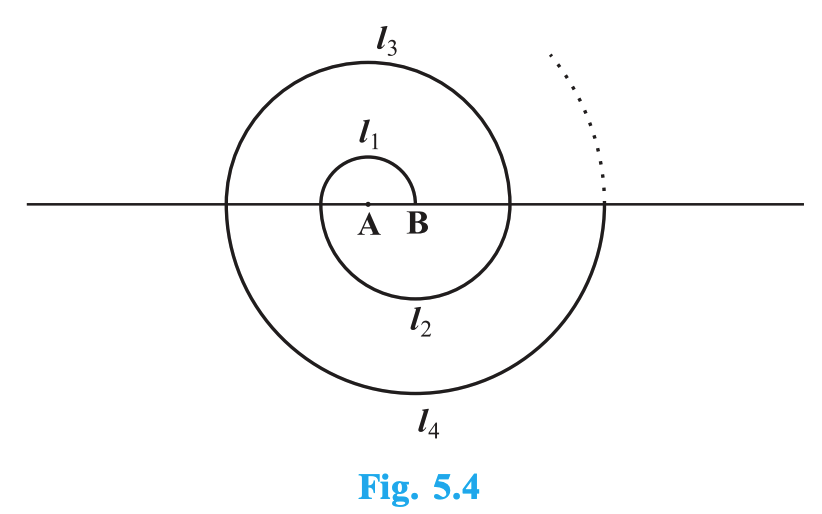
A spiral is made up of successive semicircles, with centres alternately at A and B, starting with centre at A, of radii 0.5 cm, 1.0 cm, 1.5 cm, 2.0 cm, . . . as shown in Fig. 5.4. What is the total length of such a spiral made up of thirteen consecutive semicircles? (Take \(\pi = \dfrac{22}{7}\))
Answer:
\(143\text{ cm}\)
Open
Question. 19
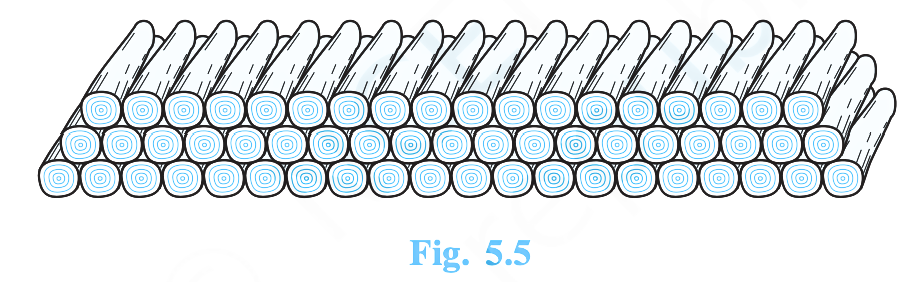
200 logs are stacked so that the bottom row contains 20 logs, the next contains 19, then 18, and so on. In how many rows are the 200 logs placed and how many logs are in the top row?
Answer:
16 rows, 5 logs in the top row.
Open
Question. 20
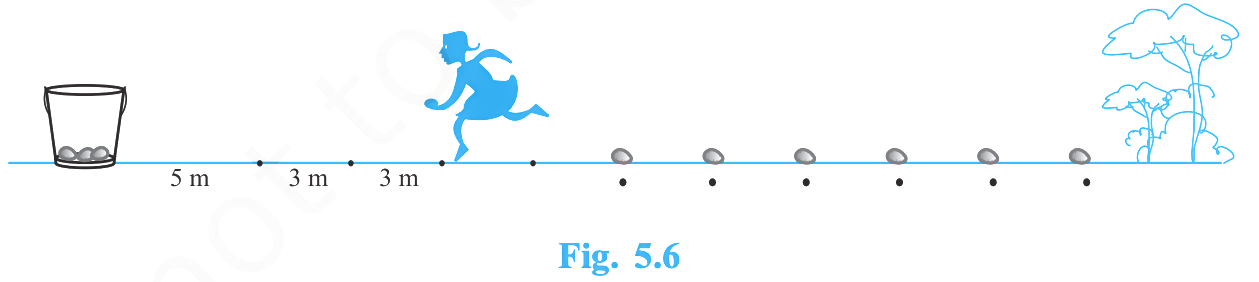
In a potato race, a bucket is placed at the starting point. The first potato is 5 m away, and each subsequent potato is 3 m apart in a straight line. There are ten potatoes. A competitor picks each potato one at a time, returns to the bucket, and continues. Find the total distance the competitor runs.
Answer:
\(370\text{ m}\)
Open
Exercise 5.4 (Optional)
Question. 1
Which term of the AP: 121, 117, 113, …, is its first negative term?
Hint: Find \(n\) for \(a_n < 0\).
Answer:
32nd term
Open
Question. 2
The sum of the third and the seventh terms of an AP is 6 and their product is 8. Find the sum of first sixteen terms of the AP.
Answer:
\(S_{16} = 20, 76\)
Open
Question. 3
A ladder has rungs 25 cm apart (see Fig. 5.7). The rungs decrease uniformly in length from 45 cm at the bottom to 25 cm at the top. If the top and the bottom rungs are \(2\dfrac{1}{2}\) m apart, what is the length of the wood required for the rungs?
Hint: Number of rungs \(= \dfrac{250}{25} + 1\).
Answer:
385 cm
Open
Question. 4
The houses of a row are numbered consecutively from 1 to 49. Show that there is a value of \(x\) such that the sum of the numbers of the houses preceding the house numbered \(x\) is equal to the sum of the numbers of the houses following it. Find this value of \(x\).
Hint: \(S_{x-1} = S_{49} - S_x\).
Answer:
35
Open
Question. 5
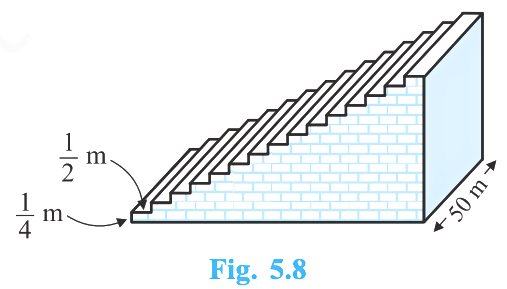
A small terrace at a football ground comprises of 15 steps each of which is 50 m long and built of solid concrete. Each step has a rise of \(\dfrac{1}{4}\) m and a tread of \(\dfrac{1}{2}\) m (see Fig. 5.8). Calculate the total volume of concrete required to build the terrace.
Hint: Volume of concrete required to build the first step \(= \dfrac{1}{4} \times \dfrac{1}{2} \times 50\,\text{m}^3\).
Answer:
\(750\,\text{m}^3\)