NCERT Solutions
Class 10 - MathematicsChapter 7: COORDINATE GEOMETRY
Class 10 - Mathematics
Exercise 7.1
Question. 1
Find the distance between the following pairs of points:
- (2, 3), (4, 1)
- (−5, 7), (−1, 3)
- (a, b), (−a, −b)
Answer:
(1) \(2\sqrt{2}\)
(2) \(4\sqrt{2}\)
(3) \(2\sqrt{a^2 + b^2}\)
Open
Question. 2
Find the distance between the points (0, 0) and (36, 15). Can you now find the distance between the two towns A and B discussed in Section 7.2?
Answer:
39; 39 km
Open
Question. 3
Determine if the points (1, 5), (2, 3) and (−2, −11) are collinear.
Answer:
No
Open
Question. 4
Check whether (5, −2), (6, 4) and (7, −2) are the vertices of an isosceles triangle.
Answer:
Yes
Open
Question. 5
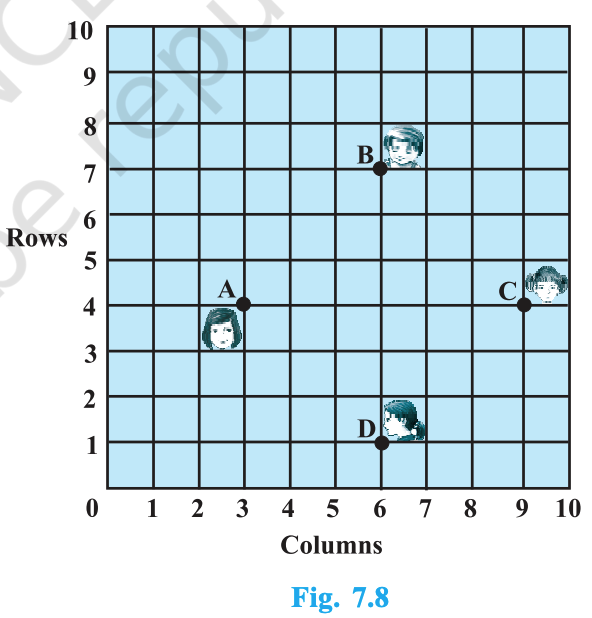
In a classroom, 4 friends are seated at the points A, B, C and D as shown in Fig. 7.8. Champa and Chameli walk into the class and after observing for a few minutes Champa asks Chameli, “Don’t you think ABCD is a square?” Chameli disagrees. Using the distance formula, find which of them is correct.
Answer:
Champa is correct.
Open
Question. 6
Name the type of quadrilateral formed, if any, by the following points, and give reasons for your answer:
- (−1, −2), (1, 0), (−1, 2), (−3, 0)
- (−3, 5), (3, 1), (0, 3), (−1, −4)
- (4, 5), (7, 6), (4, 3), (1, 2)
Answer:
(i) Square
(ii) No quadrilateral
(iii) Parallelogram
Open
Question. 7
Find the point on the x-axis which is equidistant from (2, −5) and (−2, 9).
Answer:
(−7, 0)
Open
Question. 8
Find the values of y for which the distance between the points P(2, −3) and Q(10, y) is 10 units.
Answer:
−9, 3
Open
Question. 9
If Q(0, 1) is equidistant from P(5, −3) and R(x, 6), find the values of x. Also find the distances QR and PR.
Answer:
x = ±4
QR = \(\sqrt{41}\)
PR = \(\sqrt{82}, 9\sqrt{2}\)
Open
Question. 10
Find a relation between x and y such that the point (x, y) is equidistant from the point (3, 6) and (−3, 4).
Answer:
\(3x + y - 5 = 0\)
Open
Exercise 7.2
Question. 1
Find the coordinates of the point which divides the join of (−1, 7) and (4, −3) in the ratio 2 : 3.
Answer:
(1, 3)
Open
Question. 2
Find the coordinates of the points of trisection of the line segment joining (4, −1) and (−2, −3).
Answer:
\(\left(2, -\dfrac{5}{3}\right)\) and \(\left(0, -\dfrac{7}{3}\right)\)
Open
Question. 3
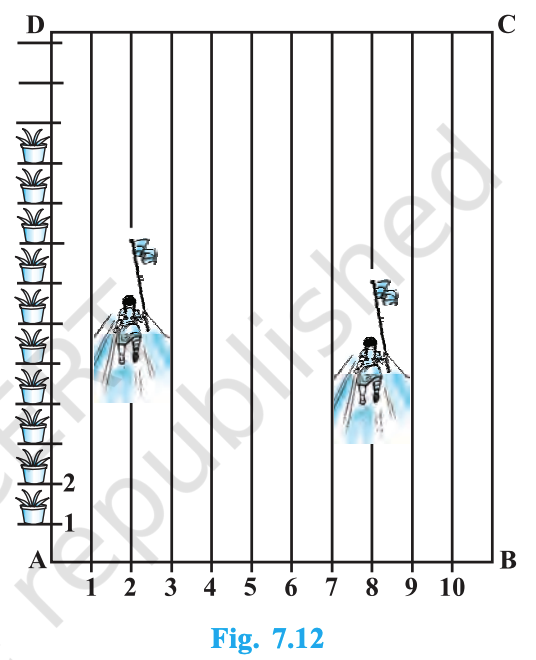
To conduct Sports Day activities, in your rectangular shaped school ground ABCD, lines have been drawn with chalk powder at a distance of 1 m each. 100 flower pots have been placed at a distance of 1 m from each other along AD, as shown in Fig. 7.12. Niharika runs \(\tfrac{1}{4}\)th the distance AD on the 2nd line and posts a green flag. Preet runs \(\tfrac{1}{5}\)th the distance AD on the eighth line and posts a red flag. What is the distance between both the flags? If Rashmi has to post a blue flag exactly halfway between the line segment joining the two flags, where should she post her flag?
Answer:
Distance between the flags = \(\sqrt{61}\) m.
Rashmi should post the blue flag on the 5th line at a distance of 22.5 m.
Open
Question. 4
Find the ratio in which the line segment joining the points (−3, 10) and (6, −8) is divided by (−1, 6).
Answer:
2 : 7
Open
Question. 5
Find the ratio in which the line segment joining A(1, −5) and B(−4, 5) is divided by the x-axis. Also find the coordinates of the point of division.
Answer:
Ratio = 1 : 1
Point of division = \(\left(-\dfrac{3}{2}, 0\right)\)
Open
Question. 6
If (1, 2), (4, y), (x, 6) and (3, 5) are the vertices of a parallelogram taken in order, find x and y.
Answer:
\(x = 6,\ y = 3\)
Open
Question. 7
Find the coordinates of a point A, where AB is the diameter of a circle whose centre is (2, −3) and B is (1, 4).
Answer:
A = (3, −10)
Open
Question. 8
If A and B are (−2, −2) and (2, −4), respectively, find the coordinates of P such that \(AP = \dfrac{3}{7} AB\) and P lies on the line segment AB.
Answer:
P = \(\left(-\dfrac{2}{7}, -\dfrac{20}{7}\right)\)
Open
Question. 9
Find the coordinates of the points which divide the line segment joining A(−2, 2) and B(2, 8) into four equal parts.
Answer:
\(\left(-1, \dfrac{7}{2}\right), (0, 5), \left(1, \dfrac{13}{2}\right)\)
Open
Question. 10
Find the area of a rhombus if its vertices are (3, 0), (4, 5), (−1, 4) and (−2, −1) taken in order. (Hint: Area of a rhombus \(= \dfrac{1}{2}\) × product of its diagonals.)
Answer:
24 sq. units