NCERT Solutions
Class 10 - Mathematics - Chapter 6: TRIANGLES - Exercise 6.3Question 6
Class 10 - Mathematics - Chapter 6: TRIANGLES - Exercise 6.3
Question. 6
In Fig. 6.37, if \(\triangle ABE \cong \triangle ACD\), show that \(\triangle ADE \sim \triangle ABC\).
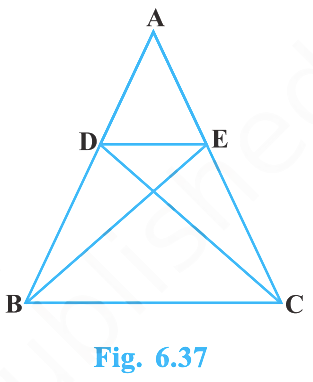
Detailed Answer with Explanation:
Given: \(\triangle ABE \cong \triangle ACD\). Points D and E lie on sides \(AB\) and \(AC\) respectively.
To prove: \(\triangle ADE \sim \triangle ABC\).
Step 1: Use congruence to get equal sides
From \(\triangle ABE \cong \triangle ACD\), we have by CPCT (Corresponding Parts of Congruent Triangles):
\[AB = AC, \quad AE = AD.\]
Step 2: Form a pair of equal ratios
Using these equalities:
\[\frac{AD}{AB} = \frac{AE}{AC}. \tag{1}\]
Step 3: Compare the included angle
The angle between \(AD\) and \(AE\) is \(\angle DAE\).
The angle between \(AB\) and \(AC\) is \(\angle BAC\).
Since D lies on \(AB\) and E lies on \(AC\), rays \(AD\) and \(AB\) are the same line, and rays \(AE\) and \(AC\) are the same line. Therefore,
\[\angle DAE = \angle BAC. \tag{2}\]
Step 4: Apply SAS similarity
From (1), the ratios of two pairs of corresponding sides are equal, and from (2), the included angle is equal. So, by the SAS similarity criterion:
\[\triangle ADE \sim \triangle ABC.\]
Hence proved.