NCERT Exemplar Solutions
Class 6 - Mathematics - Unit 2: GeometryFill in the Blanks
Class 6 - Mathematics - Unit 2: Geometry
Question. 17
An angle greater than 180° and less than a complete angle is called ______.
Answer:
Reflex angle
Open
Question. 19
A pair of opposite sides of a trapezium are ______.
Answer:
parallel
Open
Question. 20
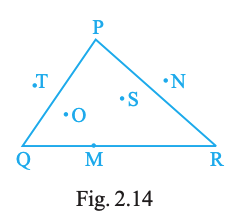
In Fig. 2.14, points lying in the interior of the triangle PQR are _____, that in the exterior are _____ and that on the triangle itself are _____.
Answer:
Interior: O, S, Exterior: T, N, On triangle: P, Q, R, M
Open
Question. 21
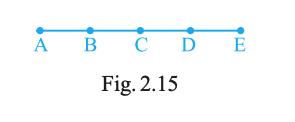
21. In Fig. 2.15, points A, B, C, D and E are collinear such that AB = BC = CD = DE. Then
(a) AD = AB + _____
(b) AD = AC + _____
(c) mid point of AE is _____
(d) mid point of CE is _____
(e) AE = _____ × AB
Answer:
(a) AD = AB + BC + CD
(b) AD = AC + CD
(c) Midpoint of AE is C
(d) Midpoint of CE is D
(e) AE = 4 × AB
Open
Question. 22
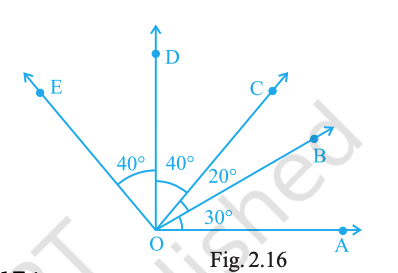
22. In Fig. 2.16,
(a) ∠AOD is a/an _____ angle
(b) ∠COA is a/an _____ angle
(c) ∠AOE is a/an _____ angle
Answer:
(a) ∠AOD is a/an right angle
(b) ∠COA is a/an acute angle
(c) ∠AOE is a/an straight angle
Open
Question. 23
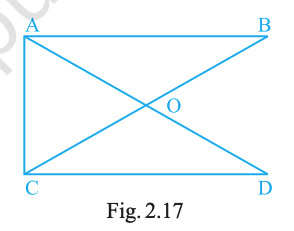
The number of triangles in Fig. 2.17 is _____. Their names are __________________.
Answer:
Number of triangles = 8. Names: △AOB, △BOC, △COD, △DOA, △ABC, △BCD, △CDA, △DAB.
Open
Question. 24
Number of angles less than 180° in Fig. 2.17 is _____ and their names are _____.

Answer:
Number = 8. Names: ∠AOB, ∠BOC, ∠COD, ∠DOA, ∠OAB, ∠OBC, ∠OCD, ∠ODA.
Open
Question. 25
The number of straight angles in Fig. 2.17 is ____.
Answer:
2
Open
Question. 26
The number of right angles in a straight angle is ____ and that in a complete angle is ____.
Answer:
In straight angle: 2, In complete angle: 4
Open
Question. 27
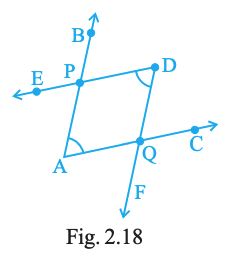
The number of common points in the two angles marked in Fig. 2.18 is ____.
Answer:
2
Open
Question. 28
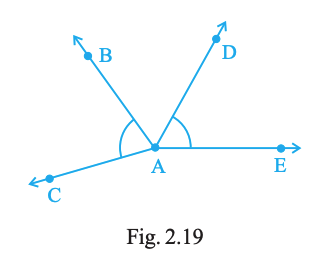
The number of common points in the two angles marked in Fig. 2.19 is ____.
Answer:
1
Open
Question. 29
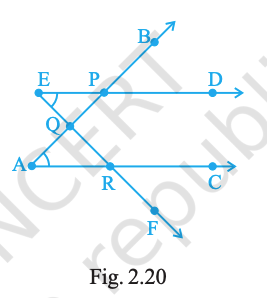
The number of common points in the two angles marked in Fig. 2.20 is ____.
Answer:
3
Open
Question. 30
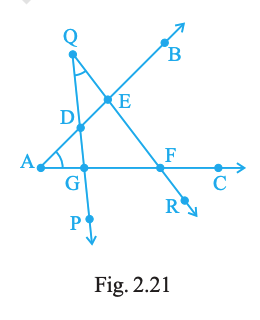
The number of common points in the two angles marked in Fig. 2.21 is ____.
Answer:
4
Open
Question. 31
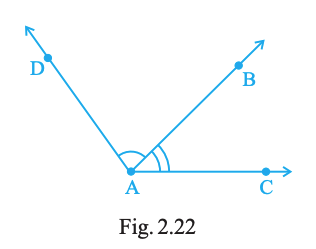
The common part between the two angles BAC and DAB in Fig. 2.22 is ____.
Answer:
Ray AB