NCERT Exemplar Solutions
Class 6 - Mathematics - Unit 2: GeometryMultiple Choice Questions
Class 6 - Mathematics - Unit 2: Geometry
Question. 1
Number of lines passing through five points such that no three of them are collinear is
10
5
20
8
Open
Question. 2
The number of diagonals in a septagon is
21
42
7
14
Open
Question. 3
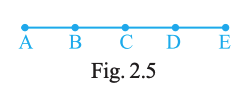
Number of line segments in Fig. 2.5 is
5
10
15
20
Open
Question. 4
Measures of the two angles between hour and minute hands of a clock at 9 O’clock are
60°, 300°
270°, 90°
75°, 285°
30°, 330°
Open
Question. 5
If a bicycle wheel has 48 spokes, then the angle between a pair of two consecutive spokes is
5\(\tfrac{1}{2}\)
7\(\tfrac{1}{2}\)
\(\tfrac{2}{11}\)
\(\tfrac{2}{15}\)
Open
Question. 6
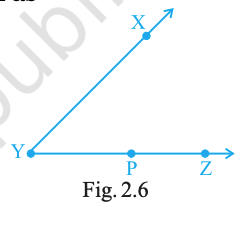
In Fig. 2.6, \(\angle XYZ\) cannot be written as
\(\angle Y\)
\(\angle ZXY\)
\(\angle ZYX\)
\(\angle XYP\)
Open
Question. 7
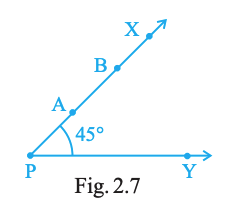
In Fig. 2.7, if point A is shifted to point B along the ray PX such that PB = 2PA, then the measure of \(\angle BPY\) is
greater than 45°
45°
less than 45°
90°
Open
Question. 9
The number of obtuse angles in Fig. 2.9 is
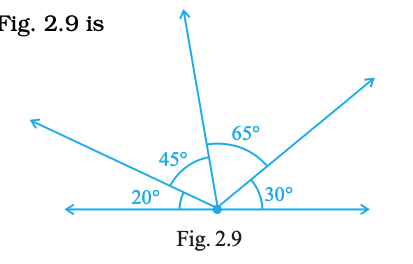
2
3
4
5
Open
Question. 10
The number of triangles in Fig. 2.10 is
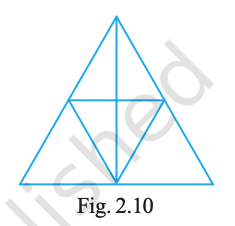
10
12
13
14
Open
Question. 11
If the sum of two angles is greater than 180°, then which of the following is not possible for the two angles?
One obtuse angle and one acute angle
One reflex angle and one acute angle
Two obtuse angles
Two right angles
Open
Question. 12
If the sum of two angles is equal to an obtuse angle, then which of the following is not possible?
One obtuse angle and one acute angle
One right angle and one acute angle
Two acute angles
Two right angles
Open
Question. 13
A polygon has prime number of sides. Its number of sides is equal to the sum of the two least consecutive primes. The number of diagonals of the polygon is
4
5
7
10
Open
Question. 14
In Fig. 2.11, AB = BC and AD = BD = DC. The number of isosceles triangles in the figure is
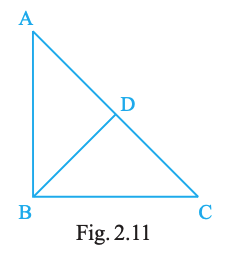
1
2
3
4
Open
Question. 15
In Fig. 2.12, \(\angle BAC = 90°\) and AD ⟂ BC. The number of right triangles in the figure is
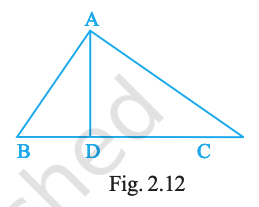
1
2
3
4
Open
Question. 16
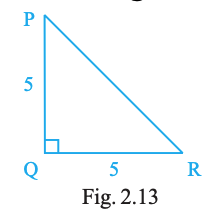
In Fig. 2.13, PQ ⟂ RQ, PQ = 5 cm and QR = 5 cm. Then \(\triangle PQR\) is
a right triangle but not isosceles
an isosceles right triangle
isosceles but not a right triangle
neither isosceles nor right triangle