NCERT Exemplar Solutions
Class 6 - Mathematics - Unit 2: Geometry - Multiple Choice QuestionsQuestion 14
Class 6 - Mathematics - Unit 2: Geometry - Multiple Choice Questions
Question. 14
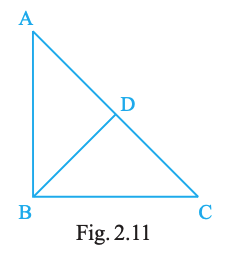
In Fig. 2.11, AB = BC and AD = BD = DC. The number of isosceles triangles in the figure is
(A)
1
(B)
2
(C)
3
(D)
4
Detailed Answer with Explanation:
Idea: Use the equal lengths to find triangles having two equal sides.
Step 1: From the figure, points A, B, C lie on one straight line.
So there is no triangle formed only by A, B, C. Hence, \(\triangle ABC\) does not exist.
Step 2: Note the given equalities, written one per line:
\(AB = BC\)
\(AD = BD\)
\(BD = CD\)
\(AD = CD\)
Step 3: Count isosceles triangles using point D.
- \(\triangle ABD:\) here \(AD = BD\). So it is isosceles.
- \(\triangle BCD:\) here \(BD = CD\). So it is isosceles.
- \(\triangle ACD:\) here \(AD = CD\). So it is isosceles.
Step 4: Check if there are any others.
Any triangle not using D would need A, B, C, but they are collinear, so no triangle there.
Conclusion: Exactly 3 isosceles triangles: \(\triangle ABD,\ \triangle BCD,\ \triangle ACD\).
Answer: 3.