NCERT Exemplar Solutions
Class 6 - Mathematics - Unit 2: Geometry - Problems and SolutionsQuestion 47
Class 6 - Mathematics - Unit 2: Geometry - Problems and Solutions
Question. 47
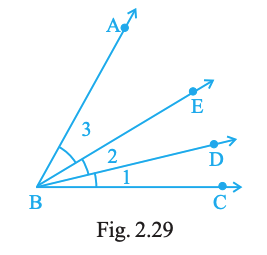
Name the following angles of Fig. 2.29, using three letters:
(a) ∠1 (b) ∠2 (c) ∠3 (d) ∠1+∠2 (e) ∠2+∠3 (f) ∠1+∠2+∠3 (g) ∠CBA − ∠1
Answer:
(a) ∠CBD (b) ∠DBE (c) ∠EBA
(d) ∠CBE (e) ∠DBA (f) ∠CBA (g) ∠DBA
Detailed Answer with Explanation:
Key idea: To name an angle with three letters, the middle letter is the vertex. Here, the vertex is B. The first and last letters sit on the two arms forming the angle.
- (a) \(\angle 1\):
Arms used: \(\overrightarrow{BC}\) and \(\overrightarrow{BD}\).
Start on \(C\), vertex at \(B\), end at \(D\): \(\angle \mathbf{CBD}\).
- (b) \(\angle 2\):
Arms used: \(\overrightarrow{BD}\) and \(\overrightarrow{BE}\).
Start on \(D\), vertex at \(B\), end at \(E\): \(\angle \mathbf{DBE}\).
- (c) \(\angle 3\):
Arms used: \(\overrightarrow{BE}\) and \(\overrightarrow{BA}\).
Start on \(E\), vertex at \(B\), end at \(A\): \(\angle \mathbf{EBA}\).
- (d) \(\angle 1 + \angle 2\):
Combine (a) and (b): from \(\overrightarrow{BC}\) to \(\overrightarrow{BE}\) passing through \(\overrightarrow{BD}\).
Start on \(C\), vertex at \(B\), end at \(E\): \(\angle \mathbf{CBE}\).
- (e) \(\angle 2 + \angle 3\):
Combine (b) and (c): from \(\overrightarrow{BD}\) to \(\overrightarrow{BA}\) passing through \(\overrightarrow{BE}\).
Start on \(D\), vertex at \(B\), end at \(A\): \(\angle \mathbf{DBA}\).
- (f) \(\angle 1 + \angle 2 + \angle 3\):
Combine all three: from \(\overrightarrow{BC}\) to \(\overrightarrow{BA}\).
Start on \(C\), vertex at \(B\), end at \(A\): \(\angle \mathbf{CBA}\).
- (g) \(\angle CBA - \angle 1\):
Whole \(\angle CBA\) is from \(\overrightarrow{BC}\) to \(\overrightarrow{BA}\).
Subtract \(\angle 1\) (from \(\overrightarrow{BC}\) to \(\overrightarrow{BD}\)).
Remaining part: from \(\overrightarrow{BD}\) to \(\overrightarrow{BA}\) = \(\angle \mathbf{DBA}\).
Notes: The vertex letter B must stay in the middle. Sums of adjacent angles “extend” across the common arm. Subtraction removes the smaller adjacent part from the larger angle.