NCERT Exemplar Solutions
Class 10 - MathematicsCHAPTER 11: Area Related To Circles
Class 10 - Mathematics
Exercise 11.1
Question. 1
If the sum of the areas of two circles with radii \(R_1\) and \(R_2\) is equal to the area of a circle of radius \(R\), then
\(R_1 + R_2 = R\)
\(R_1^2 + R_2^2 = R^2\)
\(R_1 + R_2 < R\)
\(R_1^2 + R_2^2 < R^2\)
Open
Question. 2
If the sum of the circumferences of two circles with radii \(R_1\) and \(R_2\) is equal to the circumference of a circle of radius \(R\), then
\(R_1 + R_2 = R\)
\(R_1 + R_2 > R\)
\(R_1 + R_2 < R\)
Nothing definite can be said about the relation among \(R_1, R_2\) and \(R\).
Open
Question. 3
If the circumference of a circle and the perimeter of a square are equal, then
Area of the circle = Area of the square
Area of the circle > Area of the square
Area of the circle < Area of the square
Nothing definite can be said about the relation between the areas
Open
Question. 4
Area of the largest triangle that can be inscribed in a semicircle of radius \(r\) is
\(r^2\) sq. units
\(\dfrac{1}{2}r^2\) sq. units
\(2r^2\) sq. units
\(\sqrt{2}\, r^2\) sq. units
Open
Question. 5
If the perimeter of a circle is equal to that of a square, then the ratio of their areas (circle : square) is
\(22:7\)
\(14:11\)
\(7:22\)
\(11:14\)
Open
Question. 6
It is proposed to build a single circular park equal in area to the sum of areas of two circular parks of diameters 16 m and 12 m. The radius of the new park would be
10 m
15 m
20 m
24 m
Open
Question. 7
The area of the circle that can be inscribed in a square of side 6 cm is
\(36\pi\,\text{cm}^2\)
\(18\pi\,\text{cm}^2\)
\(12\pi\,\text{cm}^2\)
\(9\pi\,\text{cm}^2\)
Open
Question. 8
The area of the square that can be inscribed in a circle of radius 8 cm is
\(256\,\text{cm}^2\)
\(128\,\text{cm}^2\)
\(64\sqrt{2}\,\text{cm}^2\)
\(64\,\text{cm}^2\)
Open
Question. 9
The radius of a circle whose circumference is equal to the sum of the circumferences of the two circles of diameters 36 cm and 20 cm is
56 cm
42 cm
28 cm
16 cm
Open
Question. 10
The diameter of a circle whose area is equal to the sum of the areas of the two circles of radii 24 cm and 7 cm is
31 cm
25 cm
62 cm
50 cm
Open
Exercise 11.2
Question. 1
Is the area of the circle inscribed in a square of side a cm equal to \(\pi a^2\) cm²?
Answer:
Open
Question. 2
Will it be true to say that the perimeter of a square circumscribing a circle of radius a cm is \(8a\) cm?
Answer:
Open
Question. 3
In Fig. 11.3, a square is inscribed in a circle of diameter \(d\) and another square circumscribes the circle. Is the area of the outer square four times the area of the inner square?
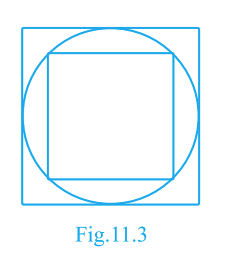
Answer:
Open
Question. 4
Is it true that the area of a segment of a circle is less than the area of its corresponding sector? Why?
Answer:
Open
Question. 5
Is it true that the distance travelled by a circular wheel of diameter \(d\) cm in one revolution is \(2\pi d\) cm? Why?
Answer:
Open
Question. 6
In covering a distance \(s\) metres, a circular wheel of radius \(r\) metres makes \(\dfrac{s}{2\pi r}\) revolutions. Is this statement true? Why?
Answer:
Open
Question. 7
The numerical value of the area of a circle is greater than the numerical value of its circumference. Is this statement true? Why?
Answer:
Open
Question. 8
If the length of an arc of a circle of radius \(r\) equals that of an arc of a circle of radius \(2r\), then the angle of the sector of the first circle is double the angle of the sector of the second circle. Is this statement false? Why?
Answer:
Open
Question. 9
The areas of two sectors of two different circles with equal corresponding arc lengths are equal. Is this statement true? Why?
Answer:
Open
Question. 10
The areas of two sectors of two different circles are equal. Is it necessary that their corresponding arc lengths are equal? Why?
Answer:
Open
Question. 11
Is the area of the largest circle that can be drawn inside a rectangle of length \(a\) cm and breadth \(b\) cm (\(a>b\)) equal to \(\pi b^2\) cm²? Why?
Answer:
Open
Question. 12
Circumferences of two circles are equal. Is it necessary that their areas are equal? Why?
Answer:
Open
Question. 13
Areas of two circles are equal. Is it necessary that their circumferences are equal? Why?
Answer:
Open
Question. 14
Is it true to say that the area of a square inscribed in a circle of diameter \(p\) cm is \(p^2\) cm²? Why?
Answer:
Open
Exercise 11.3
Question. 1
Find the radius of a circle whose circumference is equal to the sum of the circumferences of two circles of radii 15 cm and 18 cm.
Answer:
33 cm
Open
Question. 2
In Fig. 11.5, a square of diagonal 8 cm is inscribed in a circle. Find the area of the shaded region (circle minus square).
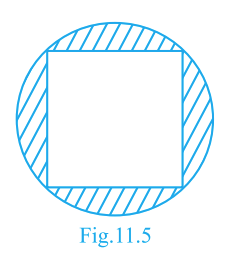
Answer:
\(16\pi - 32\;\text{cm}^2\) (≈ 18.27 cm² if \(\pi=3.14\))
Open
Question. 3
Find the area of a sector of a circle of radius 28 cm and central angle \(45^\circ\).
Answer:
\(98\pi\;\text{cm}^2\) (≈ 307.88 cm²)
Open
Question. 4
The radius of a motorcycle wheel is 35 cm. How many revolutions per minute must it make to keep a speed of 66 km/h?
Answer:
500 rpm
Open
Question. 5
A cow is tied with a rope 14 m long at the corner of a rectangular field of dimensions 20 m × 16 m. Find the area it can graze.
Answer:
\(49\pi\;\text{m}^2\) (≈ 153.94 m²)
Open
Question. 6
Find the area of the flower bed with semicircular ends shown in Fig. 11.6. The overall length is 38 cm and the overall width is 10 cm.
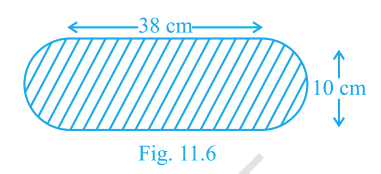
Answer:
\(280 + 25\pi\;\text{cm}^2\) (≈ 358.50 cm²)
Open
Question. 7
In Fig. 11.7, AB is a diameter of the circle, AC = 6 cm and BC = 8 cm. Find the area of the shaded region (use \(\pi = 3.14\)).
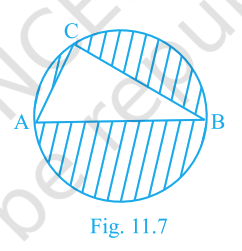
Answer:
54.5 cm²
Open
Question. 8
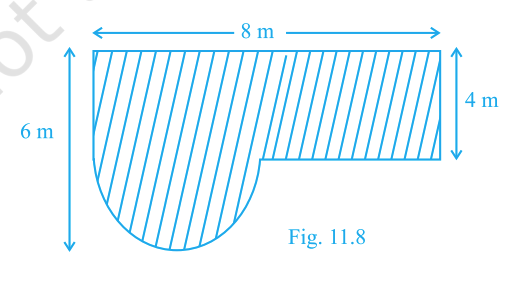
Find the area of the shaded field shown in Fig. 11.8. (Top width 8 m, left height 6 m with a semicircular bulge, right height 4 m with a semicircular bulge.)
Answer:
\(32 + 6.5\pi\;\text{m}^2\) (≈ 52.42 m²)
Open
Question. 9
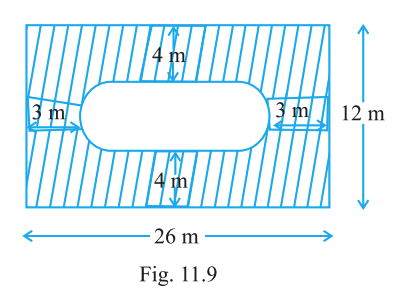
Find the area of the shaded region in Fig. 11.9 (outer rectangle 26 m × 12 m; inner 'stadium' has total length 20 m and width 4 m).
Answer:
\(248 - 4\pi\;\text{m}^2\) (≈ 235.43 m²)
Open
Question. 10
Find the area of the minor segment of a circle of radius 14 cm when the angle of the corresponding sector is \(60^\circ\).
Answer:
\(\dfrac{98\pi}{3} - 49\sqrt{3}\;\text{cm}^2\) (≈ 21.99 cm²)
Open
Question. 11
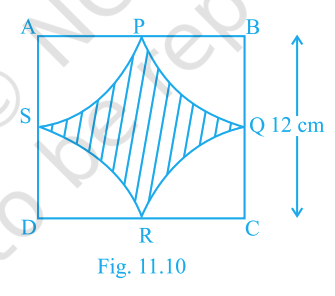
In Fig. 11.10 (square of side 12 cm), arcs with centres at \(A,B,C,D\) and radius 6 cm pass through the midpoints of adjacent sides, forming a central shaded region. Find the shaded area (use \(\pi=3.14\)).
Answer:
\(144 - 36\pi\;\text{cm}^2\;\approx 30.96\,\text{cm}^2\)
Open
Question. 12
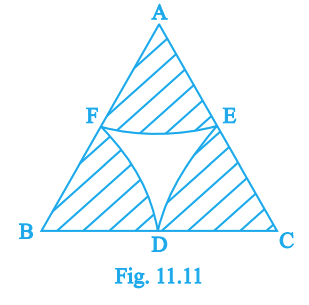
In Fig. 11.11, an equilateral triangle \(ABC\) of side 10 cm has arcs centred at \(A,B,C\) that meet sides at their midpoints \(D,E,F\). Find the area of the shaded central region (use \(\pi=3.14\)).
Answer:
\(25\sqrt{3} - \dfrac{25\pi}{2}\;\text{cm}^2\) (≈ 3.04 cm²)
Open
Question. 13
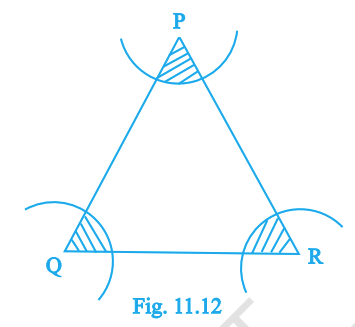
In Fig. 11.12, arcs are drawn with radii 14 cm and with centres at the triangle’s vertices \(P, Q, R\). Find the area of the shaded regions near the vertices.
Answer:
\(98\pi\;\text{cm}^2\) (≈ 307.88 cm²)
Open
Question. 14
A circular park is surrounded by a road 21 m wide. If the park’s radius is 105 m, find the area of the road.
Answer:
\(4851\pi\;\text{m}^2\) (≈ 15{,}226.1 m²)
Open
Question. 16
A piece of wire 20 cm long is bent into an arc of a circle subtending an angle of \(60^\circ\) at the centre. Find the radius of the circle.
Answer:
\(\dfrac{60}{\pi}\;\text{cm}\) (≈ 19.10 cm)
Open
Exercise 11.4
Question. 1
The area of a circular playground is \(22176\,\text{m}^2\). Find the cost of fencing this ground at the rate of Rs 50 per metre.
Answer:
Rs 26,400
Open
Question. 2
Diameters of the front and rear wheels of a tractor are 80 cm and 2 m, respectively. How many revolutions will the rear wheel make in the distance in which the front wheel makes 1400 revolutions?
Answer:
560 revolutions
Open
Question. 3
Sides of a triangular field are 15 m, 16 m and 17 m. From the three corners, a cow, a buffalo and a horse are tied with ropes of length 7 m each to graze the field. Find the area of the field which cannot be grazed by the three animals.
Answer:
\(24\sqrt{21} - \dfrac{49\pi}{2}\,\text{m}^2 \;\approx\; 33.0\,\text{m}^2\)
Open
Question. 4
Find the area of the segment of a circle of radius 12 cm whose corresponding sector has a central angle of \(60^\circ\) (Use \(\pi=3.14\)).
Answer:
\(\approx 13.01\,\text{cm}^2\)
Open
Question. 5
A circular pond is 17.5 m in diameter. It is surrounded by a 2 m wide path. Find the cost of constructing the path at the rate of Rs 25 per m2.
Answer:
Cost = \(975\pi\) Rs \(\approx\) Rs 3,064
Open
Question. 6
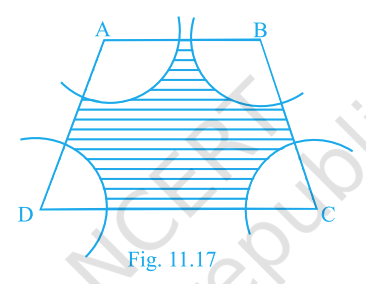
In the trapezium ABCD, \(AB\parallel DC\), \(AB=18\,\text{cm}\), \(DC=32\,\text{cm}\) and the distance between them is \(14\,\text{cm}\). Arcs of equal radii 7 cm with centres A, B, C and D are drawn as in the figure. Find the area of the shaded region.
Answer:
\(350 - 49\pi\,\text{cm}^2 \;\approx\; 196.1\,\text{cm}^2\)
Open
Question. 7
Three circles each of radius 3.5 cm are drawn so that each touches the other two. Find the area enclosed between these circles.
Answer:
\(\dfrac{49\sqrt{3}}{4} - \dfrac{49\pi}{8}\,\text{cm}^2 \;\approx\; 1.97\,\text{cm}^2\)
Open
Question. 8
Find the area of the sector of a circle of radius 5 cm if the corresponding arc length is 3.5 cm.
Answer:
\(8.75\,\text{cm}^2\)
Open
Question. 9
Four circular cardboard pieces of radius 7 cm are placed on a paper so that each piece touches the other two. Find the area of the portion enclosed between these pieces.
Answer:
\(196 - 49\pi\,\text{cm}^2 \;\approx\; 42.06\,\text{cm}^2\)
Open
Question. 10
On a square cardboard sheet of area \(784\,\text{cm}^2\), four congruent circular plates of maximum size are placed such that each plate touches two others and each side of the square is tangent to two plates. Find the area of the square sheet not covered by the plates.
Answer:
\(784 - 196\pi\,\text{cm}^2 \;\approx\; 168.25\,\text{cm}^2\)
Open
Question. 11
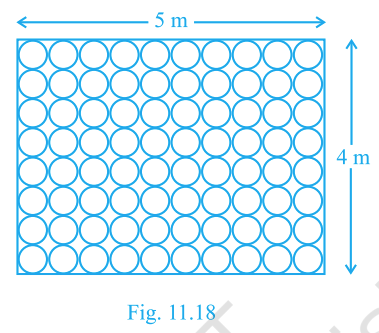
The floor of a room is \(5\,\text{m}\times 4\,\text{m}\) and it is covered with circular tiles of diameter 50 cm laid in a rectangular grid as shown. Find the area of the floor that remains uncovered with tiles.
Answer:
\(200000 - 50000\pi\,\text{cm}^2 \;\approx\; 42{,}920\,\text{cm}^2 = 4.292\,\text{m}^2\)
Open
Question. 12
All the vertices of a rhombus lie on a circle. If the area of the circle is \(1256\,\text{cm}^2\) (use \(\pi=3.14\)), find the area of the rhombus.
Answer:
\(800\,\text{cm}^2\)
Open
Question. 13
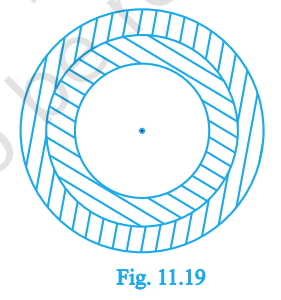
An archery target has three regions formed by three concentric circles whose diameters are in the ratio \(1:2:3\). Find the ratio of the areas of the three regions.
Answer:
\(1 : 3 : 5\)
Open
Question. 14
The length of the minute hand of a clock is 5 cm. Find the area swept by it from 6:05 a.m. to 6:40 a.m.
Answer:
\(\dfrac{175}{12}\,\pi\,\text{cm}^2 \;\approx\; 45.8\,\text{cm}^2\)
Open
Question. 15
The area of a sector of central angle \(200^\circ\) of a circle is \(770\,\text{cm}^2\). Find the length of the corresponding arc.
Answer:
\(\dfrac{70}{3}\,\pi\,\text{cm} \;\approx\; 73.3\,\text{cm}\)
Open
Question. 16
The central angles of two sectors of circles of radii 7 cm and 21 cm are respectively \(120^\circ\) and \(40^\circ\). Find the areas and arc lengths of the two sectors. What do you observe?
Answer:
Areas: \(\dfrac{49\pi}{3}\,\text{cm}^2\) and \(49\pi\,\text{cm}^2\). Arc lengths: both \(\dfrac{14\pi}{3}\,\text{cm}\).
Open
Question. 17
Find the area of the shaded region shown in Fig. 11.20.
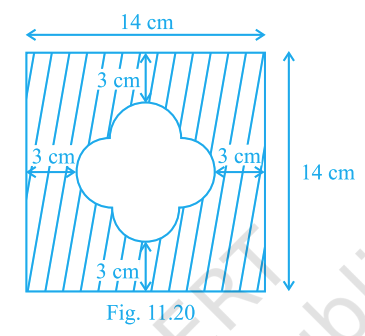
Answer:
\(196 - 18\pi\,\text{cm}^2 \;\approx\; 139.5\,\text{cm}^2\)
Open
Question. 18
A circular wheel of area \(1.54\,\text{m}^2\) rolls a distance of \(176\,\text{m}\). Find the number of revolutions made by the wheel.
Answer:
40 revolutions
Open
Question. 19
A chord of length 5 cm subtends an angle of \(90^\circ\) at the centre. Find the difference between the areas of the two segments formed by the chord.
Answer:
\(\dfrac{25}{4}(\pi+2)\,\text{cm}^2 \;\approx\; 32.14\,\text{cm}^2\)
Open
Question. 20
Find the difference of the areas of a sector of angle \(120^\circ\) and its corresponding major sector of a circle of radius 21 cm.
Answer:
\(147\pi\,\text{cm}^2 \;\approx\; 461.8\,\text{cm}^2\)