NCERT Exemplar Solutions
Class 10 - MathematicsCHAPTER 7: Coordinate Geometry
Class 10 - Mathematics
Exercise 7.1
Question. 1
The distance of the point \(P(2,3)\) from the x-axis is
2
3
1
5
Handwritten Notes
Open
Question. 2
The distance between the points \(A(0,6)\) and \(B(0,-2)\) is
6
8
4
2
Handwritten Notes
Open
Question. 3
The distance of the point \(P(-6,8)\) from the origin is
8
\(2\sqrt{7}\)
10
6
Handwritten Notes
Open
Question. 4
The distance between the points \((0,5)\) and \((-5,0)\) is
5
\(5\sqrt{2}\)
\(2\sqrt{5}\)
10
Handwritten Notes
Open
Question. 5
AOBC is a rectangle whose three vertices are \(A(0,3),\ O(0,0)\) and \(B(5,0)\). The length of its diagonal is
5
3
\(\sqrt{34}\)
4
Handwritten Notes
Open
Question. 6
The perimeter of a triangle with vertices \((0,4),(0,0),(3,0)\) is
5
12
11
\(7+\sqrt{5}\)
Handwritten Notes
Open
Question. 7
The area of a triangle with vertices \(A(3,0),\ B(7,0)\) and \(C(8,4)\) is
14
28
8
6
Handwritten Notes
Open
Question. 8
The points \((-4,0),(4,0)\) and \((0,3)\) are the vertices of a
right triangle
isosceles triangle
equilateral triangle
scalene triangle
Handwritten Notes
Open
Question. 9
The point which divides the line segment joining \((7,-6)\) and \((3,4)\) in ratio \(1:2\) internally lies in the
I quadrant
II quadrant
III quadrant
IV quadrant
Handwritten Notes
Open
Question. 10
The point which lies on the perpendicular bisector of the line segment joining the points \(A(-2,-5)\) and \(B(2,5)\) is
(0, 0)
(0, 2)
(2, 0)
(-2, 0)
Handwritten Notes
Open
Question. 11
The fourth vertex \(D\) of a parallelogram \(ABCD\) whose three vertices are \(A(-2,3),\ B(6,7)\) and \(C(8,3)\) is
(0, 1)
(0, -1)
(-1, 0)
(1, 0)
Handwritten Notes
Open
Question. 12
If the point \(P(2,1)\) lies on the line segment joining points \(A(4,2)\) and \(B(8,4)\), then
\(AP=\dfrac{1}{3}\,AB\)
\(AP=PB\)
\(PB=\dfrac{1}{3}\,AB\)
\(AP=\dfrac{1}{2}\,AB\)
Handwritten Notes
Open
Question. 13
If \(P\big(\dfrac{a}{3},4\big)\) is the mid-point of the line segment joining the points \(Q(-6,5)\) and \(R(-2,3)\), then the value of \(a\) is
-4
-12
12
-6
Handwritten Notes
Open
Question. 14
The perpendicular bisector of the line segment joining the points \(A(1,5)\) and \(B(4,6)\) cuts the y-axis at
(0, 13)
(0, -13)
(0, 12)
(13, 0)
Handwritten Notes
Open
Question. 15
The coordinates of the point which is equidistant from the three vertices of \(\triangle AOB\) as shown in Fig. 7.1 is
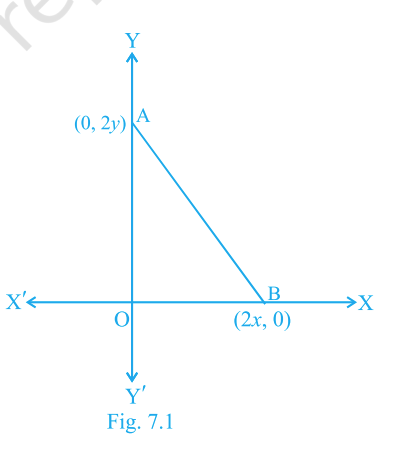
(x, y)
(y, x)
\(\big(\dfrac{x}{2},\dfrac{y}{2}\big)\)
\(\big(\dfrac{y}{2},\dfrac{x}{2}\big)\)
Handwritten Notes
Open
Question. 16
A circle drawn with origin as the centre passes through \(\big(\dfrac{13}{2},0\big)\). The point which does not lie in the interior of the circle is
\(\big(-\dfrac{3}{4},1\big)\)
\(\big(2,\dfrac{7}{3}\big)\)
\(\big(5,-\dfrac{1}{2}\big)\)
\(\big(-6,\dfrac{5}{2}\big)\)
Handwritten Notes
Open
Question. 17
A line intersects the y-axis and x-axis at the points \(P\) and \(Q\), respectively. If \((2,-5)\) is the mid-point of \(PQ\), then the coordinates of \(P\) and \(Q\) are, respectively
(0, -5) and (2, 0)
(0, 10) and (-4, 0)
(0, 4) and (-10, 0)
(0, -10) and (4, 0)
Handwritten Notes
Open
Question. 18
The area of a triangle with vertices \((a,b+c)\), \((b,c+a)\) and \((c,a+b)\) is
\((a+b+c)^2\)
0
\(a+b+c\)
\(abc\)
Handwritten Notes
Open
Question. 19
If the distance between the points \((4,p)\) and \((1,0)\) is 5, then the value of \(p\) is
4 only
\(\pm 4\)
-4 only
0
Handwritten Notes
Open
Question. 20
If the points \(A(1,2)\), \(O(0,0)\) and \(C(a,b)\) are collinear, then
\(a=b\)
\(a=2b\)
\(2a=b\)
\(a=-b\)
Handwritten Notes
Open
Exercise 7.2
Question. 1
\(\triangle ABC\) with vertices \(A(-2,0),\ B(2,0),\ C(0,2)\) is similar to \(\triangle DEF\) with vertices \(D(-4,0),\ E(4,0),\ F(0,4)\).
Answer:
True.
Open
Question. 2
Point \(P(-4,2)\) lies on the line segment joining \(A(-4,6)\) and \(B(-4,-6)\).
Answer:
True.
Open
Question. 3
The points \((0,5),\ (0,-9),\ (3,6)\) are collinear.
Answer:
False.
Open
Question. 4
\(P(0,2)\) is the intersection of the y–axis and the perpendicular bisector of the segment joining \(A(-1,1)\) and \(B(3,3)\).
Answer:
False.
Open
Question. 5
Points \(A(3,1),\ B(12,-2),\ C(0,2)\) cannot be vertices of a triangle.
Answer:
True.
Open
Question. 6
Points \(A(4,3),\ B(6,4),\ C(5,-6),\ D(-3,5)\) are vertices of a parallelogram.
Answer:
False.
Open
Question. 7
A circle has centre at the origin and a point \(P(5,0)\) lies on it. The point \(Q(6,8)\) lies outside the circle.
Answer:
True.
Open
Question. 8
The point \(A(2,7)\) lies on the perpendicular bisector of the segment joining \(P(6,5)\) and \(Q(0,-4)\).
Answer:
False.
Open
Question. 9
The point \(P(5,-3)\) is one of the two trisection points of the segment joining \(A(7,-2)\) and \(B(1,-5)\).
Answer:
True.
Open
Question. 10
Points \(A(-6,10),\ B(-4,6),\ C(3,-8)\) are collinear such that \(AB=\dfrac{2}{9}\,AC\).
Answer:
True.
Open
Question. 11
The point \(P(-2,4)\) lies on a circle of radius 6 and centre \((3,5)\).
Answer:
False.
Open
Question. 12
The points \(A(-1,-2),\ B(4,3),\ C(2,5),\ D(-3,0)\) in that order form a rectangle.
Answer:
True.
Open
Exercise 7.3
Question. 1
Name the type of triangle formed by the points \(A(-5,6),\ B(-4,-2),\ C(7,5)\).
Answer:
Scalene.
Open
Question. 2
Find the point(s) on the x–axis at a distance \(2\sqrt5\) from \((7,-4)\). How many such points are there?
Answer:
(5, 0) and (9, 0) — two points.
Open
Question. 3
What type of quadrilateral is formed by the points \(A(2,-2),\ B(7,3),\ C(11,-1),\ D(6,-6)\) in order?
Answer:
Rectangle.
Open
Question. 4
Find \(a\) if the distance between \(A(-3,-14)\) and \(B(a,-5)\) is \(9\).
Answer:
\(a=-3\)
Open
Question. 5
Find a point equidistant from \(A(-5,4)\) and \(B(-1,6)\). How many such points are there?
Answer:
One example is (-3, 5). There are infinitely many such points (on the perpendicular bisector).
Open
Question. 6
Find the coordinates of the point \(Q\) on the x–axis which lies on the perpendicular bisector of the segment joining \(A(-5,-2)\) and \(B(4,-2)\). Also, name the type of triangle formed by \(Q, A, B\).
Answer:
\(Q = \left(-\dfrac{1}{2}, 0\right)\)
Triangle \(QAB\) is isosceles (\(QA=QB\)).
Open
Question. 7
Find \(m\) if the points \((5,1),\ (-2,-3),\ (8,2m)\) are collinear.
Answer:
\(m=\dfrac{19}{14}\)
Open
Question. 8
If \(A(2,-4)\) is equidistant from \(P(3,8)\) and \(Q(-10,y)\), find \(y\). Also find \(PQ\).
Answer:
\(y=-3\) or \(y=-5\)
\(PQ=\sqrt{290}\) when \(y=-3\); and \(PQ=13\sqrt{2}\) when \(y=-5\).
Open
Question. 9
Find the area of the triangle with vertices \((-8,4),\ (-6,6),\ (-3,9)\).
Answer:
0
Open
Question. 10
In what ratio does the x–axis divide the segment joining \((-4,-6)\) and \((-1,7)\)? Find the coordinates of the point of division.
Answer:
Ratio \(6:7\) (internally), point \(\big(-\dfrac{34}{13},\,0\big)\).
Open
Question. 11
Find the ratio in which the point \(P\big(\dfrac{3}{4},\dfrac{5}{12}\big)\) divides the segment joining \(A\big(\dfrac{1}{2},\dfrac{3}{2}\big)\) and \(B(2,-5)\).
Answer:
\(1:5\) (\(AP:PB\)).
Open
Question. 12
If \(P(9a-2,-b)\) divides the segment joining \(A(3a+1,-3)\) and \(B(8a,5)\) in the ratio \(3:1\), find \(a\) and \(b\).
Answer:
\(a=1,\ b=-3\)
Open
Question. 13
If \((a,b)\) is the midpoint of the segment joining \(A(10,-6)\) and \(B(k,4)\) and \(a-2b=18\), find \(k\) and \(|AB|\).
Answer:
\(k=22\), \(|AB|=2\sqrt{61}\)
Open
Question. 14
The centre of a circle is \((2a,\,a-7)\). If it passes through \((11,-9)\) and has diameter \(10\sqrt2\), find \(a\).
Answer:
\(a=3\) or \(a=5\)
Open
Question. 15
The line segment joining the points \(A(3,2)\) and \(B(5,1)\) is divided at the point \(P\) in the ratio \(1:2\), and \(P\) lies on the line \(3x - 18y + k = 0\). Find the value of \(k\).
Answer:
\(k=19\)
Open
Question. 16
If \(D\big(-\dfrac{1}{2},\dfrac{5}{2}\big),\ E(7,3),\ F\big(\dfrac{7}{2},\dfrac{7}{2}\big)\) are the midpoints of the sides of \(\triangle ABC\), find \(\text{area}(\triangle ABC)\).
Answer:
\(11\) square units.
Open
Question. 17
The points \(A(2,9),\ B(a,5),\ C(5,5)\) are vertices of a triangle right–angled at \(B\). Find \(a\) and the area of \(\triangle ABC\).
Answer:
\(a=2\), area \(=6\).
Open
Question. 18
Find the coordinates of the point \(R\) on the segment joining \(P(-1,3)\) and \(Q(2,5)\) such that \(PR=\dfrac{3}{5}PQ\).
Answer:
\(R\big(\dfrac{4}{5},\dfrac{21}{5}\big)\)
Open
Question. 19
Find \(k\) if the points \(A(k+1,2k),\ B(3k,2k+3),\ C(5k-1,5k)\) are collinear.
Answer:
\(k=2\)
Open
Question. 20
Find the ratio in which the line \(2x+3y-5=0\) divides the segment joining \(B(8,-9)\) and \(C(2,1)\). Also find the coordinates of the point of division.
Answer:
Ratio \(8:1\) (internally, from \(B:C\)). Point \(\big(\dfrac{8}{3},\,-\dfrac{1}{9}\big)\).
Open
Exercise 7.4
Question. 1
If \((-4,\,3)\) and \((4,\,3)\) are two vertices of an equilateral triangle, find the coordinates of the third vertex, given that the origin lies in the interior of the triangle.
Answer:
The third vertex is \(\bigl(0,\;3-4\sqrt{3}\bigr).\)
Open
Question. 2
\(A(6,1),\ B(8,2)\) and \(C(9,4)\) are three vertices of a parallelogram \(ABCD\). If \(E\) is the midpoint of \(DC\), find the area of \(\triangle ADE\).
Answer:
Area \(= \dfrac{3}{4}\) square units.
Open
Question. 3
The points \(A(x_1,y_1),\ B(x_2,y_2)\) and \(C(x_3,y_3)\) are the vertices of \(\triangle ABC\).
(i) The median from \(A\) meets \(BC\) at \(D\). Find \(D\).
(ii) Find the point \(P\) on \(AD\) such that \(AP:PD=2:1\).
(iii) Find points \(Q\) and \(R\) on medians \(BE\) and \(CF\) respectively such that \(BQ:QE=2:1\) and \(CR:RF=2:1\).
(iv) Hence, write the coordinates of the centroid of \(\triangle ABC\).
Answer:
(i) \(D\bigl(\dfrac{x_2+x_3}{2},\;\dfrac{y_2+y_3}{2}\bigr)\).
(ii) \(P\bigl(\dfrac{x_1+x_2+x_3}{3},\;\dfrac{y_1+y_2+y_3}{3}\bigr)\).
(iii) \(Q\) and \(R\) are also \(\bigl(\dfrac{x_1+x_2+x_3}{3},\;\dfrac{y_1+y_2+y_3}{3}\bigr)\).
(iv) Centroid \(G\bigl(\dfrac{x_1+x_2+x_3}{3},\;\dfrac{y_1+y_2+y_3}{3}\bigr)\).
Open
Question. 4
The points \(A(1,-2),\ B(2,3),\ C(a,2)\) and \(D(-4,-3)\) form a parallelogram. Find \(a\) and the height of the parallelogram taking \(AB\) as the base.
Answer:
\(a=-3\) and the height (on base \(AB\)) is \(\dfrac{24}{\sqrt{26}}\).
Open
Question. 5
Students stand on a grid for drill. Points \(A, B, C, D\) are shown below. Is it possible to place Jaspal so that he is equidistant from all four? If yes, give his position.
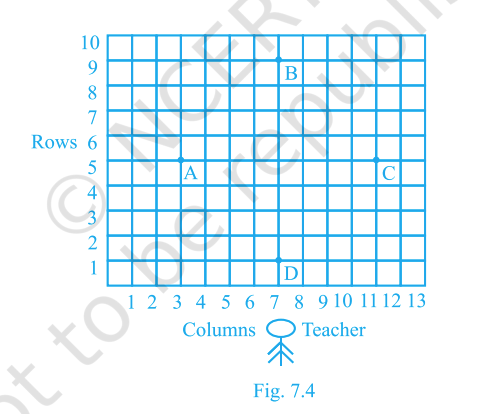
(Use grid coordinates: \(A(3,5),\ B(6,8),\ C(10,5),\ D(7,1)\).)
Answer:
Yes. Jaspal should stand at \(\bigl(6.5,\,4.5\bigr)\).
Open
Question. 6
Ayush travels House \(\to\) Bank \(\to\) School \(\to\) Office along straight segments instead of going directly House \(\to\) Office. If \(H(2,4),\ B(5,8),\ S(13,14),\ O(13,26)\), find the extra distance travelled.
Answer:
Extra distance \(= 27 - \sqrt{605}\;\text{km} \approx 2.404\;\text{km}.\)