NCERT Exemplar Solutions
Class 10 - MathematicsCHAPTER 6: Triangles
Class 10 - Mathematics
Exercise 6.1
Question. 1
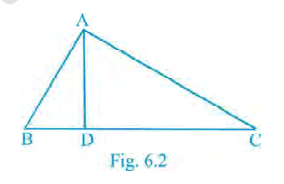
1. In Fig. 6.2, \(\angle BAC = 90^\circ\) and \(AD \perp BC\). Then,
\(BD\cdot CD = BC^2\)
\(AB\cdot AC = BC^2\)
\(BD\cdot CD = AD^2\)
\(AB\cdot AC = AD^2\)
Open
Question. 2
2. The diagonals of a rhombus are 16 cm and 12 cm. The side length is
9 cm
10 cm
8 cm
20 cm
Open
Question. 3
3. If \(\triangle ABC \sim \triangle EDF\) and \(\triangle ABC\) is not similar to \(\triangle DEF\), which is not true?
\(BC\cdot EF = AC\cdot FD\)
\(AB\cdot EF = AC\cdot DE\)
\(BC\cdot DE = AB\cdot EF\)
\(BC\cdot DE = AB\cdot FD\)
Open
Question. 4
4. If in triangles \(ABC\) and \(PQR\),
\(\dfrac{AB}{QR} = \dfrac{BC}{PR} = \dfrac{CA}{PQ}\), then
\(\triangle PQR \sim \triangle CAB\)
\(\triangle PQR \sim \triangle ABC\)
\(\triangle CBA \sim \triangle PQR\)
\(\triangle BCA \sim \triangle PQR\)
Open
Question. 5
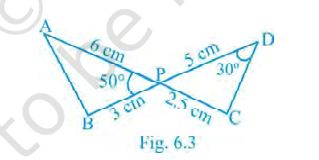
5. In Fig. 6.3, lines \(AC\) and \(BD\) intersect at \(P\). Given \(PA=6\,\text{cm},\; PB=3\,\text{cm},\; PC=2.5\,\text{cm},\; PD=5\,\text{cm},\; \(\angle APB=50^\circ\) and \(\angle CDP=30^\circ\). Find \(\angle PBA\).
50°
30°
60°
100°
Open
Question. 6
6. In triangles \(DEF\) and \(PQR\), if \(\angle D = \angle Q\) and \(\angle R = \angle E\), which is not true?
\(\dfrac{EF}{PR} = \dfrac{DF}{PQ}\)
\(\dfrac{DE}{PQ} = \dfrac{EF}{RP}\)
\(\dfrac{DE}{QR} = \dfrac{DF}{PQ}\)
\(\dfrac{EF}{RP} = \dfrac{DE}{QR}\)
Open
Question. 7
7. In triangles \(ABC\) and \(DEF\), if \(\angle B=\angle E\), \(\angle F=\angle C\) and \(AB=3\,DE\), the triangles are
congruent but not similar
similar but not congruent
neither
congruent as well as similar
Open
Question. 8
8. Given \(\triangle ABC \sim \triangle PQR\) and \(\dfrac{BC}{QR}=\dfrac{1}{3}\), then \(\dfrac{\operatorname{ar}(PRQ)}{\operatorname{ar}(BCA)}\) equals
9
3
\(\dfrac{1}{3}\)
\(\dfrac{1}{9}\)
Open
Question. 9
9. Given \(\triangle ABC \sim \triangle DFE\) with \(\angle A=30^\circ\), \(\angle C=50^\circ\), \(AB=5\,\text{cm}\), \(AC=8\,\text{cm}\) and \(DF=7.5\,\text{cm}\). Which is true?
\(DE=12\,\text{cm},\; \angle F=50^\circ\)
\(DE=12\,\text{cm},\; \angle F=100^\circ\)
\(EF=12\,\text{cm},\; \angle D=100^\circ\)
\(EF=12\,\text{cm},\; \angle D=30^\circ\)
Open
Question. 10
10. If in triangles \(ABC\) and \(DEF\), \(\dfrac{AB}{DE}=\dfrac{BC}{FD}\), then they will be similar when
\(\angle B=\angle E\)
\(\angle A=\angle D\)
\(\angle B=\angle D\)
\(\angle A=\angle F\)
Open
Question. 11
11. If \(\triangle ABC \sim \triangle QRP\) and \(\dfrac{\operatorname{ar}(ABC)}{\operatorname{ar}(PQR)}=\dfrac{9}{4}\), with \(AB=18\,\text{cm}\) and \(BC=15\,\text{cm}\), then \(PR\) equals
10 cm
12 cm
\(\dfrac{20}{3}\) cm
8 cm
Open
Question. 12
12. If \(S\) is a point on side \(PQ\) of \(\triangle PQR\) such that \(PS=QS=RS\), then
\(PR\cdot QR = RS^2\)
\(QS^2 + RS^2 = QR^2\)
\(PR^2 + QR^2 = PQ^2\)
\(PS^2 + RS^2 = PR^2\)
Open
Exercise 6.2
Question. 1
Is the triangle with sides 25 cm, 5 cm and 24 cm a right triangle? Give reasons.
Answer:
No.
Handwritten Notes
Open
Question. 2
It is given that \(\triangle DEF \sim \triangle RPQ\). Is it true that \(\angle D=\angle R\) and \(\angle F=\angle P\)? Why?
Answer:
No. \(\angle D=\angle R\) is true, but \(\angle F=\angle P\) is false..
Open
Question. 3
Points \(A\) and \(B\) lie on sides \(PQ\) and \(PR\) of \(\triangle PQR\) such that \(PQ=12.5\,\text{cm}\), \(PA=5\,\text{cm}\), \(PB=4\,\text{cm}\) and \(BR=6\,\text{cm}\). Is \(AB\parallel QR\)? Give reasons.
Answer:
Yes.
Open
Question. 4
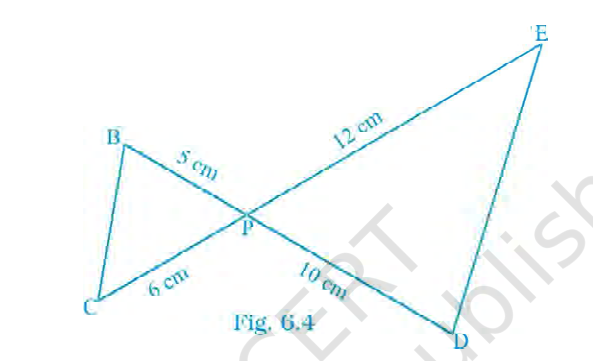
In Fig. 6.4, \(BD\) and \(CE\) intersect each other at \(P\). Is \(\triangle PBC \sim \triangle PDE\)? Why?
Answer:
Yes.
Open
Question. 5
In triangles \(PQR\) and \(MST\), \(\angle P=55^\circ,\; \angle Q=25^\circ\) and \(\angle M=100^\circ,\; \angle S=25^\circ\). Is \(\triangle QPR \sim \triangle TSM\)? Why?
Answer:
No. But \(\triangle QPR \sim \triangle STM\).
Open
Question. 6
Is the following statement true? Why?
“Two quadrilaterals are similar if their corresponding angles are equal.”
Answer:
False.
Open
Question. 7
Two sides and the perimeter of one triangle are respectively three times the corresponding sides and the perimeter of another triangle. Are the two triangles similar? Why?
Answer:
Yes.
Open
Question. 8
If in two right triangles, one of the acute angles of one triangle is equal to an acute angle of the other triangle, can you say that the two triangles will be similar? Why?
Answer:
Yes.
Open
Question. 9
The ratio of the corresponding altitudes of two similar triangles is \(\dfrac{3}{5}\). Is it correct to say that ratio of their areas is \(\dfrac{6}{5}\)? Why?
Answer:
No. The area ratio is \(\left(\dfrac{3}{5}\right)^2=\dfrac{9}{25}\).
Open
Question. 10
Point \(D\) is on side \(QR\) of \(\triangle PQR\) with \(PD\perp QR\). Is \(\triangle PQD \sim \triangle RPD\)? Why?
Answer:
No (not necessarily).
Open
Question. 11
In Fig. 6.5, if \(\angle D = \angle C\), is it true that \(\triangle ADE \sim \triangle ACB\)? Why?
Answer:
Yes.
Open
Question. 12
Is the following statement always true? “If an angle of one triangle equals an angle of another and two sides of one triangle are proportional to the corresponding two sides of the other triangle, then the triangles are similar.” Give reasons.
Answer:
Not always.
Open
Exercise 6.3
Question. 1
In \(\triangle PQR\), suppose \(PR^2 - PQ^2 = QR^2\) and \(M\) lies on \(PR\) with \(QM \perp PR\). Prove that \(QM^2 = PM \cdot MR\).
Answer:
Proved.
Open
Question. 2
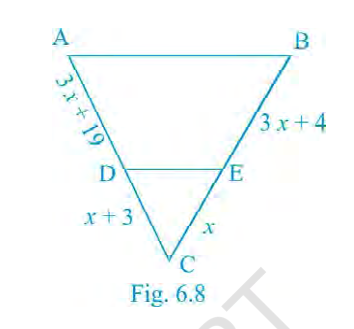
Find the value of \(x\) for which \(DE \parallel AB\) in Fig. 6.8.
Answer:
\(x=2\)
Open
Question. 3
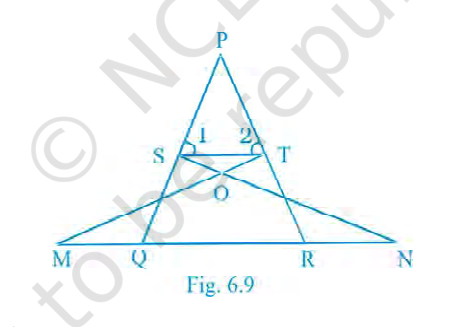
In Fig. 6.9, if \(\angle 1=\angle 2\) and \(\triangle NSQ \cong \triangle MTR\), prove that \(\triangle PTS \sim \triangle PRQ\).
Answer:
Proved.
Open
Question. 4
Diagonals of a trapezium \(PQRS\) intersect at \(O\). If \(PQ\parallel RS\) and \(PQ=3\,RS\), find \(\dfrac{\operatorname{ar}(\triangle POQ)}{\operatorname{ar}(\triangle ROS)}\).
Answer:
\(9:1\)
Open
Question. 5
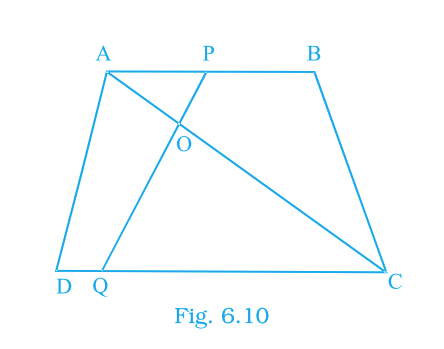
In Fig. 6.10, if \(AB\parallel DC\) and lines \(AC\) and \(PQ\) meet at \(O\), prove that \(OA\cdot CQ = OC\cdot AP\).
Answer:
Proved.
Open
Question. 6
Find the altitude of an equilateral triangle of side 8 cm.
Answer:
\(4\sqrt{3}\,\text{cm}\)
Open
Question. 7
If \(\triangle ABC \sim \triangle DEF\), with \(AB=4\,\text{cm}\), \(DE=6\,\text{cm}\), \(EF=9\,\text{cm}\) and \(FD=12\,\text{cm}\), find the perimeter of \(\triangle ABC\).
Answer:
18 cm
Open
Question. 8
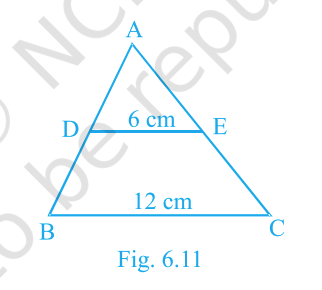
In Fig. 6.11, if \(DE\parallel BC\), find \(\operatorname{ar}(ADE):\operatorname{ar}(DECB)\).
Answer:
\(1:3\)
Open
Question. 9
In trapezium \(ABCD\) with \(AB\parallel DC\), points \(P\) and \(Q\) lie on \(AD\) and \(BC\) respectively, with \(PQ\parallel DC\). If \(PD=18\,\text{cm}\), \(BQ=35\,\text{cm}\) and \(QC=15\,\text{cm}\), find \(AD\).
Answer:
60 cm
Open
Question. 10
Corresponding sides of two similar triangles are in the ratio \(2:3\). If the area of the smaller is \(48\,\text{cm}^2\), find the area of the larger triangle.
Answer:
108 cm²
Open
Question. 11
In \(\triangle PQR\), point \(N\) lies on \(PR\) with \(QN\perp PR\). If \(PN\cdot NR = QN^2\), prove that \(\angle PQR = 90^\circ\).
Answer:
Proved.
Open
Question. 12
Areas of two similar triangles are \(36\,\text{cm}^2\) and \(100\,\text{cm}^2\). If a corresponding side of the larger is 20 cm, find the corresponding side of the smaller.
Answer:
12 cm
Open
Question. 13
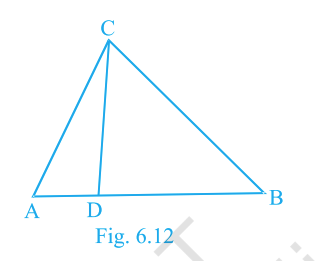
In Fig. 6.12, if \(\angle ACB = \angle CDA\), \(AC=8\,\text{cm}\) and \(AD=3\,\text{cm}\), find \(BD\).
Answer:
\(\dfrac{55}{3}\,\text{cm}\)
Open
Question. 14
A 15 m tower casts a 24 m shadow. At the same time a telephone pole casts a 16 m shadow. Find the pole’s height.
Answer:
10 m
Open
Question. 15
A 10 m ladder leans against a vertical wall with its foot 6 m from the wall. Find the height reached on the wall.
Answer:
8 m
Open
Exercise 6.4
Question. 1
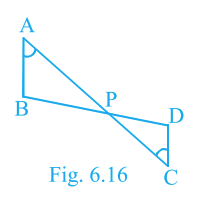
In Fig. 6.16, if \(\angle A = \angle C\), \(AB = 6\,\text{cm}\), \(BP = 15\,\text{cm}\), \(AP = 12\,\text{cm}\) and \(CP = 4\,\text{cm}\), find the lengths \(PD\) and \(CD\).
Answer:
\(PD = 5\,\text{cm},\; CD = 2\,\text{cm}.\)
Open
Question. 2
Given \(\triangle ABC \sim \triangle EDF\) with \(AB=5\,\text{cm}\), \(AC=7\,\text{cm}\), \(DE=12\,\text{cm}\), \(DF=15\,\text{cm}\). Find the remaining sides.
Answer:
\(BC=\dfrac{25}{4}\,\text{cm}=6.25\,\text{cm},\; EF=\dfrac{84}{5}\,\text{cm}=16.8\,\text{cm}.\)
Open
Question. 3
Prove: If a line is drawn parallel to one side of a triangle to meet the other two sides, then it divides those sides in the same ratio.
Answer:
Proved.
Open
Question. 4
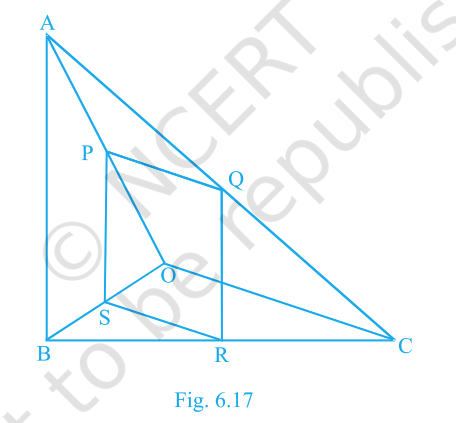
In Fig. 6.17, \(PQRS\) is a parallelogram and \(AB\parallel PS\). Prove that \(OC\parallel SR\).
Answer:
Proved.
Open
Question. 5
A 5 m ladder reaches a wall at height 4 m. If the foot is moved \(1.6\,\text{m}\) towards the wall, by how much does the top slide up?
Answer:
\(0.8\,\text{m}\)
Open
Question. 6
City route: \(AC\perp CB\), \(AC=2x\) km, \(CB=2(x+7)\) km. A direct highway \(AB=26\) km is planned. How many km are saved?
Answer:
\(8\,\text{km}\)
Open
Question. 7
A flag pole 18 m high casts a 9.6 m shadow. Find the distance from the top of the pole to the far end of the shadow.
Answer:
\(20.4\,\text{m}\)
Open
Question. 8
A lamp is on a 6 m pole. A 1.5 m woman casts a 3 m shadow. How far is she from the pole?
Answer:
\(9\,\text{m}\)
Open
Question. 9
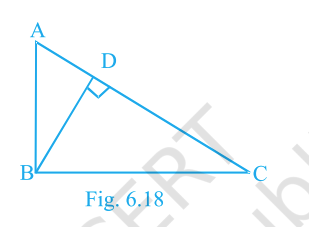
In Fig. 6.18, \(\triangle ABC\) is right-angled at \(B\) and \(BD\perp AC\). If \(AD=4\,\text{cm}\) and \(CD=5\,\text{cm}\), find \(BD\) and \(AB\).
Answer:
\(BD=2\sqrt{5}\,\text{cm},\; AB=6\,\text{cm}.\)
Open
Question. 10
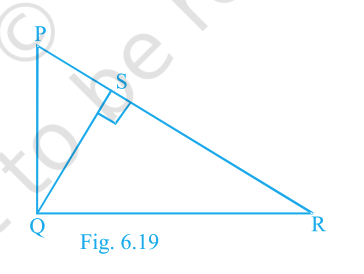
In Fig. 6.19, \(\triangle PQR\) is right-angled at \(Q\) and \(QS\perp PR\). If \(PQ=6\,\text{cm}\), \(PS=4\,\text{cm}\), find \(QS\), \(RS\) and \(QR\).
Answer:
\(QS=2\sqrt5\,\text{cm},\; RS=5\,\text{cm},\; QR=3\sqrt5\,\text{cm}.\)
Open
Question. 11
In \(\triangle PQR\), let \(PD\perp QR\) with \(D\in QR\). If \(PQ=a\), \(PR=b\), \(QD=c\) and \(DR=d\), prove
\[(a+b)(a-b)=(c+d)(c-d).\]
Answer:
Proved.
Open
Question. 12
In a quadrilateral \(ABCD\), \(\angle A+\angle D=90^\circ\). Prove that
\[AC^2+BD^2=AD^2+BC^2.\]
Answer:
Proved.
Open
Question. 13
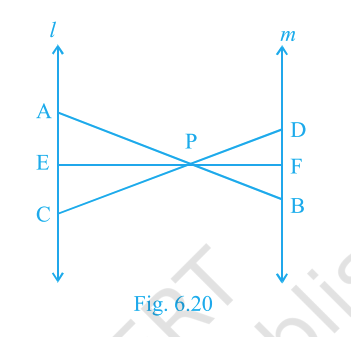
In Fig. 6.20, \(\ell\parallel m\) and the segments \(AB,\,CD,\,EF\) meet at \(P\). Prove
\[\dfrac{AE}{BF}=\dfrac{AC}{BD}=\dfrac{CE}{FD}.\]
Answer:
Proved.
Open
Question. 14
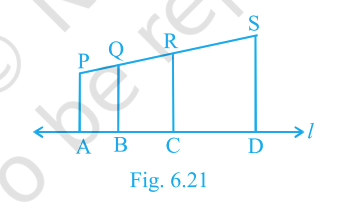
In Fig. 6.21, \(PA, QB, RC, SD\) are all perpendicular to a line \(\ell\). Given \(AB=6\,\text{cm}\), \(BC=9\,\text{cm}\), \(CD=12\,\text{cm}\) and \(SP=36\,\text{cm}\). Find \(PQ, QR, RS\).
Answer:
\(PQ=4\,\text{cm},\; QR=4\,\text{cm},\; RS=20\,\text{cm}.\)
Open
Question. 15
In a trapezium \(ABCD\) with \(AB\parallel DC\), diagonals \(AC\) and \(BD\) meet at \(O\). Through \(O\), draw \(PQ\parallel AB\) meeting \(AD\) at \(P\) and \(BC\) at \(Q\). Prove that \(PO=QO\).
Answer:
Proved.
Open
Question. 16
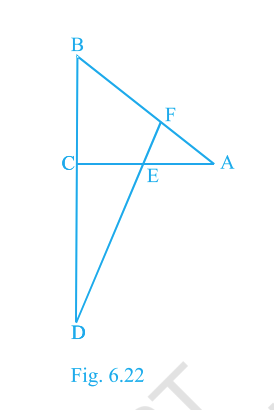
In Fig. 6.22, segment \(DF\) meets \(AC\) at \(E\) in \(\triangle ABC\), where \(E\) is the midpoint of \(CA\) and \(\angle AEF=\angle AFE\). Prove
\[\dfrac{BD}{CD}=\dfrac{BF}{CE}.\]
Answer:
Proved.
Open
Question. 17
Prove that the area of the semicircle on the hypotenuse of a right triangle equals the sum of the areas of the semicircles on the other two sides.
Answer:
Proved.
Open
Question. 18
Prove that the area of the equilateral triangle on the hypotenuse of a right triangle equals the sum of the areas of the equilateral triangles on the other two sides.
Answer:
Proved.