NCERT Exemplar Solutions
Class 10 - Mathematics - CHAPTER 8: Introduction to Trignometry and Its Applications - Exercise 8.1Question 9
Class 10 - Mathematics - CHAPTER 8: Introduction to Trignometry and Its Applications - Exercise 8.1
Question. 9
If \(\sin A+\sin^2A=1\), then the value of \(\cos^2A+\cos^4A\) is
1
\(\dfrac{1}{2}\)
2
3
Handwritten Notes
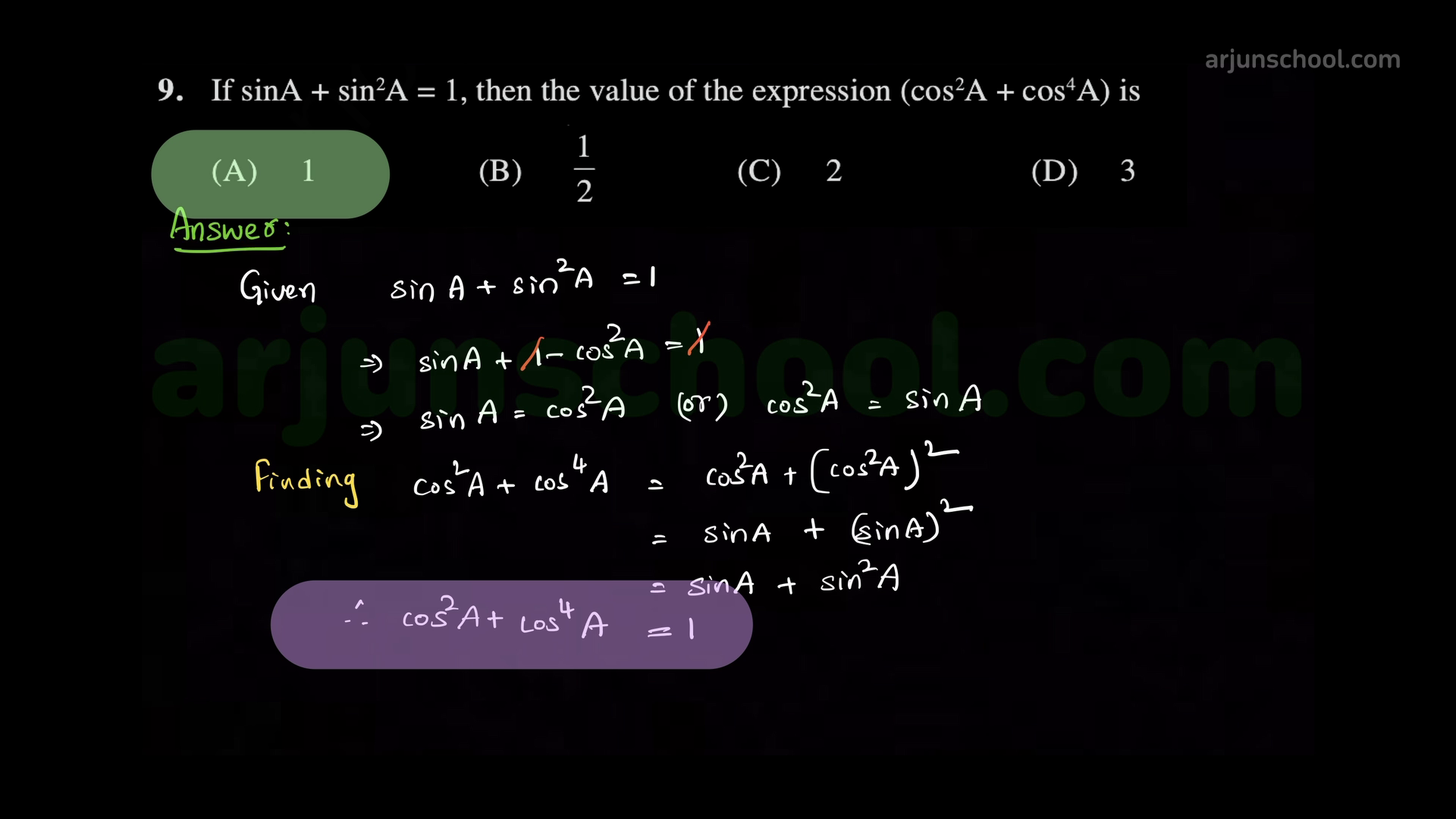
Video Explanation:
Detailed Answer with Explanation:
Step 1: We are given the equation:
\( \sin A + \sin^2 A = 1 \)
Step 2: Let us put \( \sin A = x \). Then the equation becomes:
\( x + x^2 = 1 \)
Step 3: Rearrange the equation:
\( x^2 + x - 1 = 0 \)
Step 4: Solve this quadratic equation. Using the quadratic formula: \( x = \dfrac{-1 \pm \sqrt{1 + 4}}{2} = \dfrac{-1 \pm \sqrt{5}}{2} \)
Step 5: Since \( \sin A \) must lie between \(-1\) and \(1\), only the value \( x = \dfrac{\sqrt{5} - 1}{2} \) is valid.
Step 6: Now, \( \sin^2 A = x^2 \). So, \( \cos^2 A = 1 - \sin^2 A = 1 - x^2 \).
Step 7: We need \( \cos^2 A + \cos^4 A \).
That is \( (1 - x^2) + (1 - x^2)^2 \).
Step 8: Expand:
\( (1 - x^2) + (1 - 2x^2 + x^4) = 2 - 3x^2 + x^4 \).
Step 9: But from Step 3, we know \( x^2 = 1 - x \). Substitute this into the expression:
\( 2 - 3(1 - x) + (1 - x)^2 \).
Step 10: Simplify:
\( 2 - 3 + 3x + (1 - 2x + x^2) = (0) + x^2 + x \).
Step 11: But from Step 2, \( x^2 + x = 1 \).
Final Answer: \( \cos^2 A + \cos^4 A = 1 \).