NCERT Exemplar Solutions
Class 10 - Mathematics - CHAPTER 8: Introduction to Trignometry and Its Applications - Exercise 8.1Question 14
Class 10 - Mathematics - CHAPTER 8: Introduction to Trignometry and Its Applications - Exercise 8.1
Question. 14
\(\sin(45^\circ+\theta)-\cos(45^\circ-\theta)\) equals
\(2\cos\theta\)
0
\(2\sin\theta\)
1
Handwritten Notes
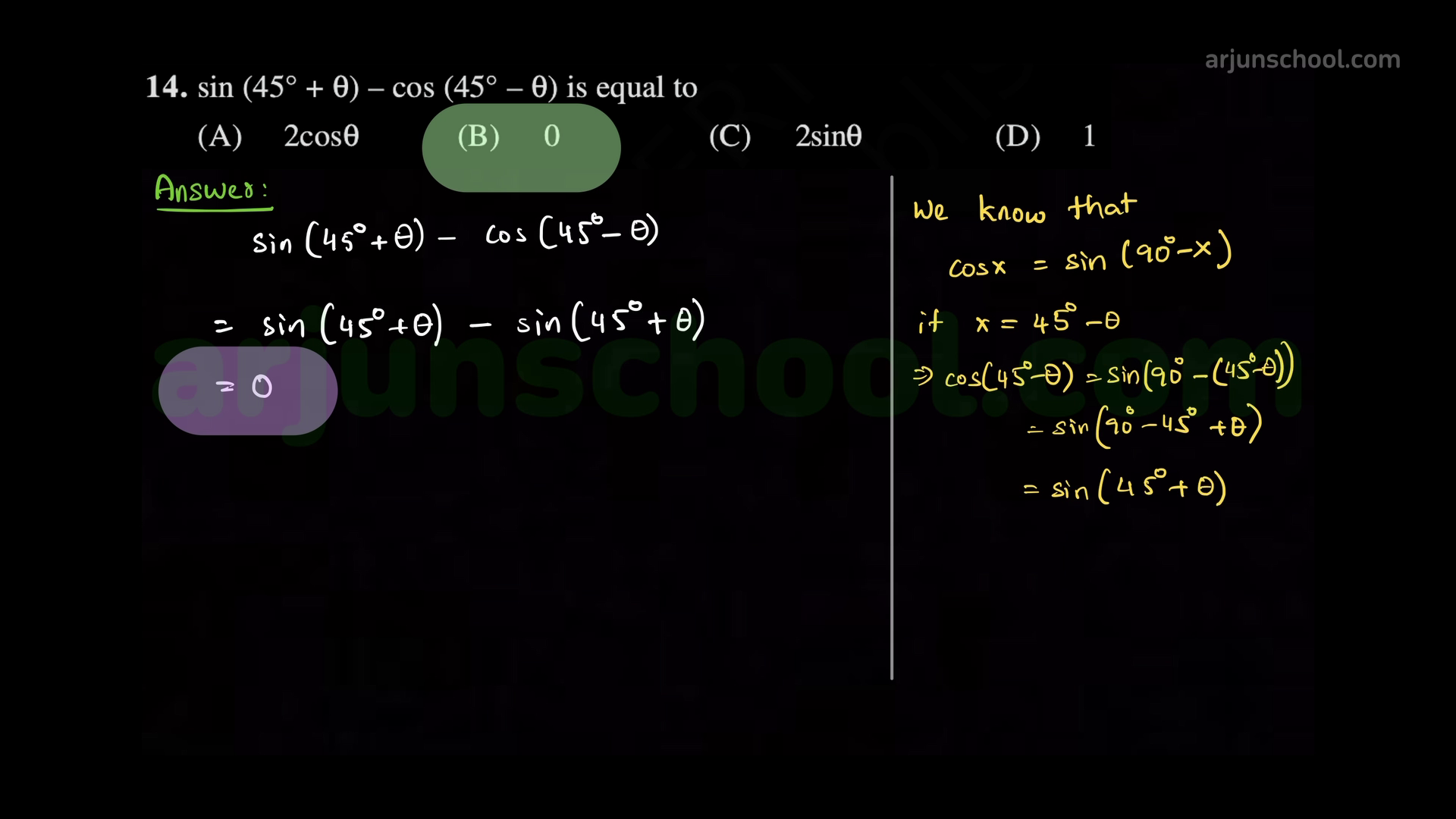
Video Explanation:
Detailed Answer with Explanation:
Let us simplify step by step:
Step 1: Recall the trigonometric expansion formulas:
- \(\sin(A+B) = \sin A \cos B + \cos A \sin B\)
- \(\cos(A-B) = \cos A \cos B + \sin A \sin B\)
Step 2: Apply these formulas one by one.
For \(\sin(45^\circ+\theta)\):
\(\sin(45^\circ+\theta) = \sin 45^\circ \cos \theta + \cos 45^\circ \sin \theta\)
Step 3: We know that \(\sin 45^\circ = \cos 45^\circ = \dfrac{1}{\sqrt{2}}\).
So, \(\sin(45^\circ+\theta) = \dfrac{1}{\sqrt{2}}(\cos \theta + \sin \theta)\).
Step 4: Now expand \(\cos(45^\circ-\theta)\):
\(\cos(45^\circ-\theta) = \cos 45^\circ \cos \theta + \sin 45^\circ \sin \theta\)
Again, \(\cos 45^\circ = \sin 45^\circ = \dfrac{1}{\sqrt{2}}\).
So, \(\cos(45^\circ-\theta) = \dfrac{1}{\sqrt{2}}(\cos \theta + \sin \theta)\).
Step 5: Now subtract the two expressions:
\(\sin(45^\circ+\theta) - \cos(45^\circ-\theta) = \dfrac{1}{\sqrt{2}}(\cos \theta + \sin \theta) - \dfrac{1}{\sqrt{2}}(\cos \theta + \sin \theta)\)
Step 6: Since both terms are exactly the same, their difference is:
\(0\).
Final Answer: Option B (0).