NCERT Exemplar Solutions
Class 10 - Mathematics - CHAPTER 8: Introduction to Trignometry and Its Applications - Exercise 8.1Question 15
Class 10 - Mathematics - CHAPTER 8: Introduction to Trignometry and Its Applications - Exercise 8.1
Question. 15
A pole 6 m high casts a shadow \(2\sqrt{3}\) m long on the ground. The Sun’s elevation is
\(60^\circ\)
\(45^\circ\)
\(30^\circ\)
\(90^\circ\)
Handwritten Notes
Video Explanation:
Detailed Answer with Explanation:
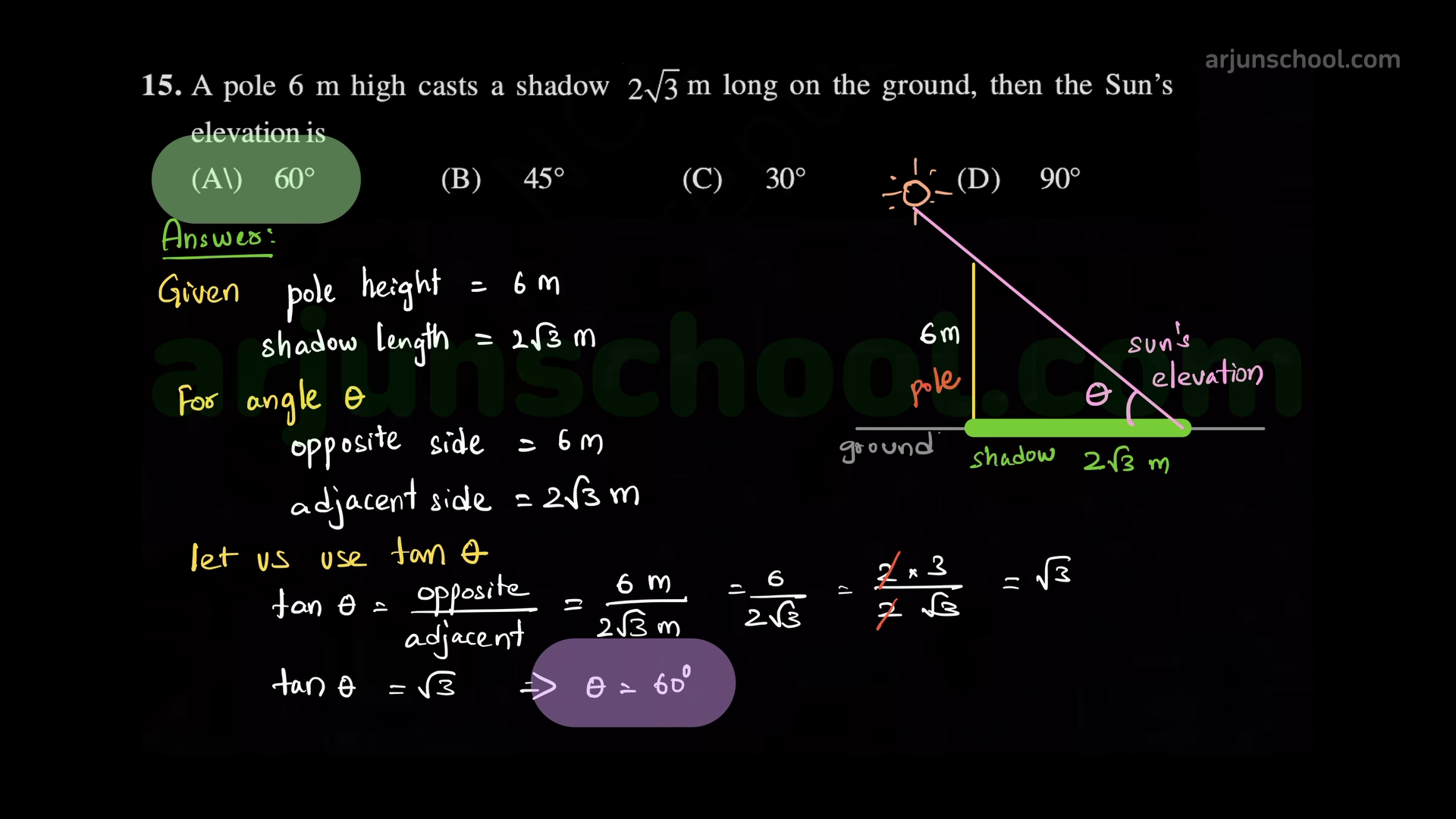
Step 1: Draw a right-angled triangle.
- The pole is the vertical side (opposite side) = \(6\,\text{m}\).
- The shadow is the horizontal side (adjacent side) = \(2\sqrt{3}\,\text{m}\).
- The angle of elevation of the Sun is \(\theta\) (the angle between the sunlight and the ground).
Step 2: Use the definition of tangent.
\( \tan\theta = \dfrac{\text{opposite side}}{\text{adjacent side}} \)
Here, opposite = height of pole = \(6\,\text{m}\), adjacent = shadow length = \(2\sqrt{3}\,\text{m}\).
Step 3: Substitute the values.
\( \tan\theta = \dfrac{6}{2\sqrt{3}} \)
Step 4: Simplify the fraction.
\( \dfrac{6}{2\sqrt{3}} = \dfrac{3}{\sqrt{3}} = \sqrt{3} \)
Step 5: Recall the trigonometric ratio.
\( \tan 60^\circ = \sqrt{3} \)
Step 6: Therefore, \( \theta = 60^\circ \).
Final Answer: The Sun’s elevation is \(60^\circ\).