NCERT Exemplar Solutions
Class 10 - Mathematics - CHAPTER 9: Circles - Exercise 9.1Question 3
Class 10 - Mathematics - CHAPTER 9: Circles - Exercise 9.1
Question. 3
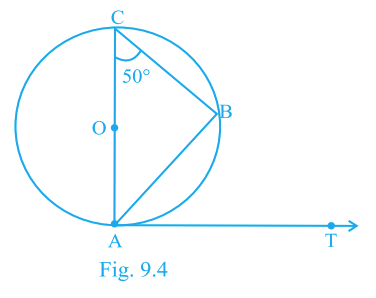
3. In Fig. 9.4, \(AB\) is a chord and \(AOC\) is a diameter with \(\angle ACB=50^\circ\). If \(AT\) is tangent at \(A\), then \(\angle BAT\) equals
\(65^\circ\)
\(60^\circ\)
\(50^\circ\)
\(40^\circ\)
Detailed Answer with Explanation:
Step 1: Recall the Tangent–Chord Theorem. It says: "The angle between a tangent and a chord through the point of contact is equal to the angle in the alternate (opposite) segment of the circle."
Step 2: Here, the tangent is \(AT\) and the chord is \(AB\). So, \(\angle BAT\) is the angle between the tangent and the chord.
Step 3: According to the theorem, \(\angle BAT\) will be equal to the angle made by the chord \(AB\) in the opposite arc. That opposite angle is \(\angle ACB\).
Step 4: From the question, \(\angle ACB = 50^\circ\).
Step 5: Therefore, \(\angle BAT = \angle ACB = 50^\circ\).
Final Answer: \(\angle BAT = 50^\circ\).