NCERT Exemplar Solutions
Class 10 - Mathematics - CHAPTER 7: Coordinate Geometry - Exercise 7.1Question 10
Class 10 - Mathematics - CHAPTER 7: Coordinate Geometry - Exercise 7.1
Question. 10
The point which lies on the perpendicular bisector of the line segment joining the points \(A(-2,-5)\) and \(B(2,5)\) is
(0, 0)
(0, 2)
(2, 0)
(-2, 0)
Handwritten Notes
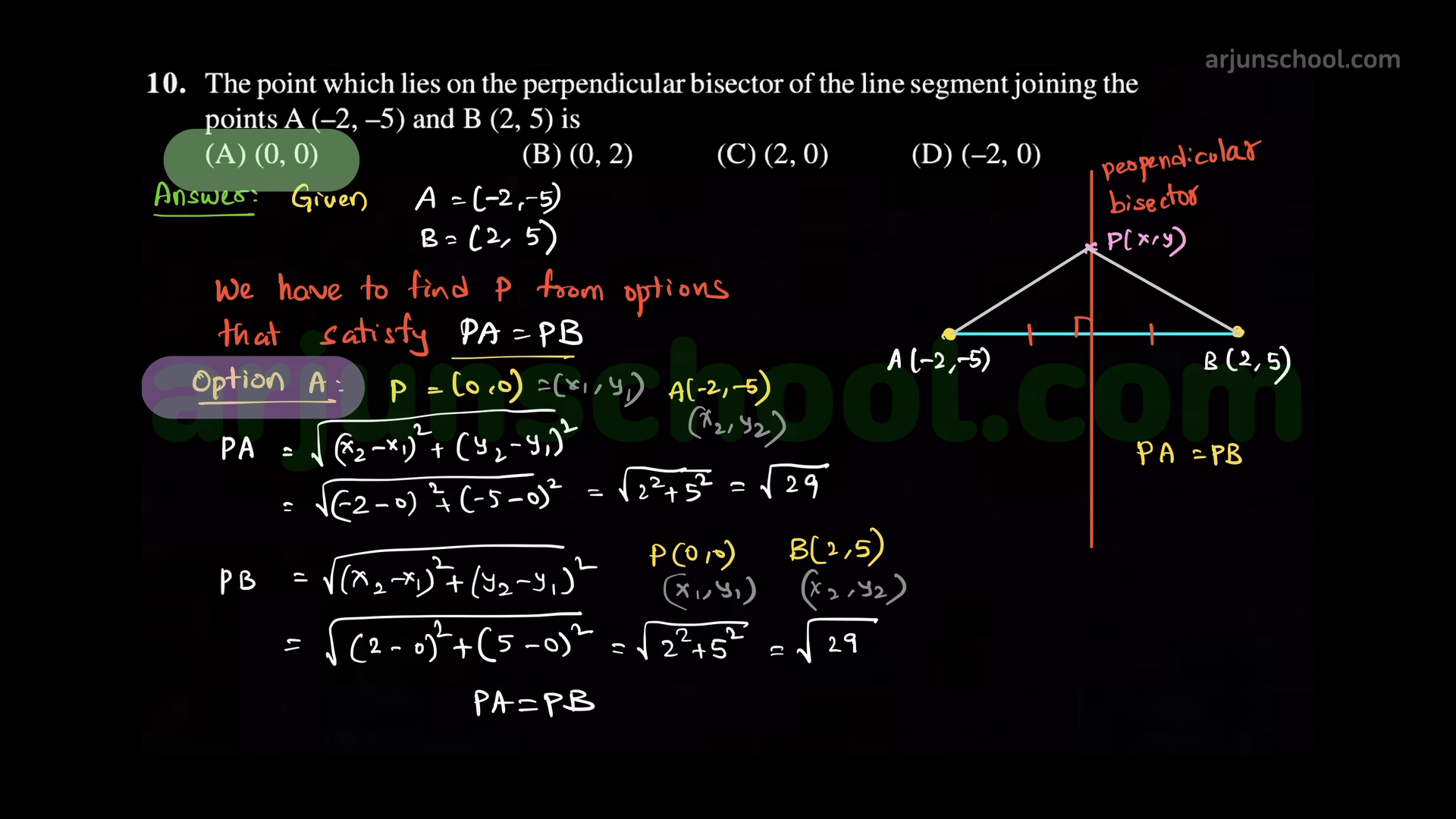
Video Explanation:
Detailed Answer with Explanation:
Step 1: Recall the property of the perpendicular bisector.
Any point on the perpendicular bisector of a line segment is equidistant from the two endpoints.
Step 2: Endpoints of the segment are given:
\(A(-2, -5)\) and \(B(2, 5)\).
Step 3: Check each option by finding the distance from the point to both A and B.
Distance formula:
\[
d = \sqrt{(x_2 - x_1)^2 + (y_2 - y_1)^2}
\]
(This is the standard Euclidean distance in the coordinate plane.)
Step 4: Try Option A \((0, 0)\).
Distance to A:
\[
d(A, (0,0)) = \sqrt{(0 - (-2))^2 + (0 - (-5))^2} = \sqrt{(2)^2 + (5)^2} = \sqrt{4 + 25} = \sqrt{29}
\]
Distance to B:
\[
d(B, (0,0)) = \sqrt{(0 - 2)^2 + (0 - 5)^2} = \sqrt{(-2)^2 + (-5)^2} = \sqrt{4 + 25} = \sqrt{29}
\]
Step 5: Since both distances are equal (\(\sqrt{29}\)), point \((0,0)\) is equidistant from A and B. Hence, \((0,0)\) lies on the perpendicular bisector.
Step 6: The correct answer is Option A: (0,0).