NCERT Exemplar Solutions
Class 10 - Mathematics - CHAPTER 7: Coordinate Geometry - Exercise 7.1Question 11
Class 10 - Mathematics - CHAPTER 7: Coordinate Geometry - Exercise 7.1
Question. 11
The fourth vertex \(D\) of a parallelogram \(ABCD\) whose three vertices are \(A(-2,3),\ B(6,7)\) and \(C(8,3)\) is
(0, 1)
(0, -1)
(-1, 0)
(1, 0)
Handwritten Notes
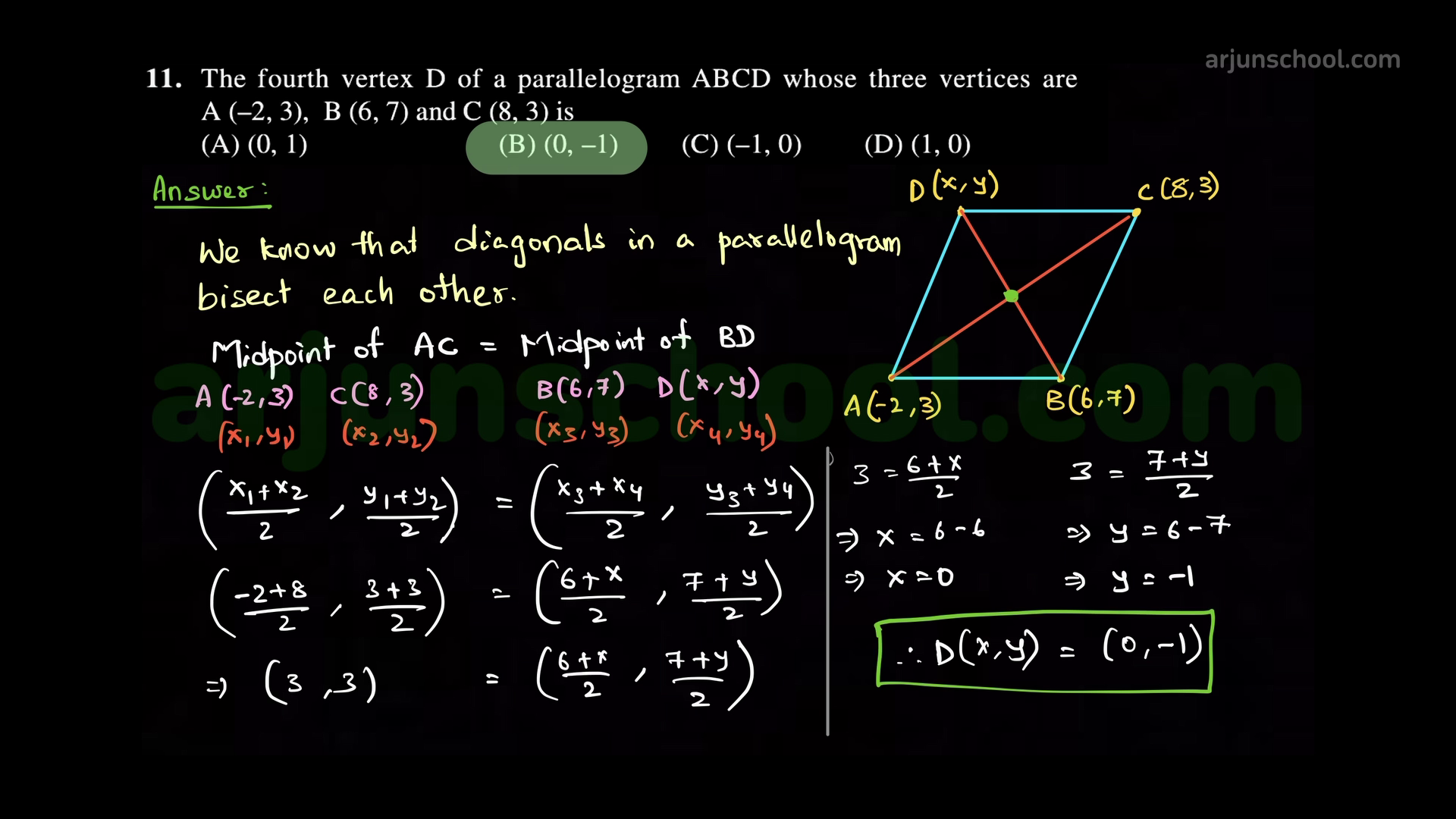
Video Explanation:
Detailed Answer with Explanation:
Step 1: Recall the property of a parallelogram.
In a parallelogram, the two diagonals bisect each other. That means the midpoint of diagonal \(AC\) is the same as the midpoint of diagonal \(BD\).
Step 2: Write the coordinates of the given vertices.
\(A(-2, 3),\ B(6, 7),\ C(8, 3)\).
Step 3: Use the formula for midpoint of two points.
If two points are \((x_1,y_1)\) and \((x_2,y_2)\), then Midpoint = \(\Big(\tfrac{x_1+x_2}{2}, \tfrac{y_1+y_2}{2}\Big)\).
Step 4: Find midpoint of diagonal \(AC\).
Coordinates of \(A = (-2, 3), C = (8, 3)\).
Midpoint of AC = \(\Big(\tfrac{-2+8}{2}, \tfrac{3+3}{2}\Big) = (3, 3)\).
Step 5: Midpoint of diagonal \(BD\) must also be (3, 3).
Coordinates of \(B = (6, 7), D = (x, y)\) (unknown).
Midpoint of BD = \(\Big(\tfrac{6+x}{2}, \tfrac{7+y}{2}\Big)\).
Step 6: Equating midpoints.
\(\tfrac{6+x}{2} = 3 \quad \Rightarrow \quad 6+x = 6 \quad \Rightarrow \quad x = 0.\)
\(\tfrac{7+y}{2} = 3 \quad \Rightarrow \quad 7+y = 6 \quad \Rightarrow \quad y = -1.\)
Step 7: Therefore, coordinates of D are \((0,-1)\).
Final Answer: Option B \((0, -1)\).