NCERT Exemplar Solutions
Class 10 - Mathematics - CHAPTER 7: Coordinate Geometry - Exercise 7.1Question 12
Class 10 - Mathematics - CHAPTER 7: Coordinate Geometry - Exercise 7.1
Question. 12
If the point \(P(2,1)\) lies on the line segment joining points \(A(4,2)\) and \(B(8,4)\), then
\(AP=\dfrac{1}{3}\,AB\)
\(AP=PB\)
\(PB=\dfrac{1}{3}\,AB\)
\(AP=\dfrac{1}{2}\,AB\)
Handwritten Notes
Video Explanation:
Detailed Answer with Explanation:
Step 1: Recall the distance formula.
The distance between two points \((x_1,y_1)\) and \((x_2,y_2)\) is given by:
\[ d = \sqrt{(x_2 - x_1)^2 + (y_2 - y_1)^2} \]
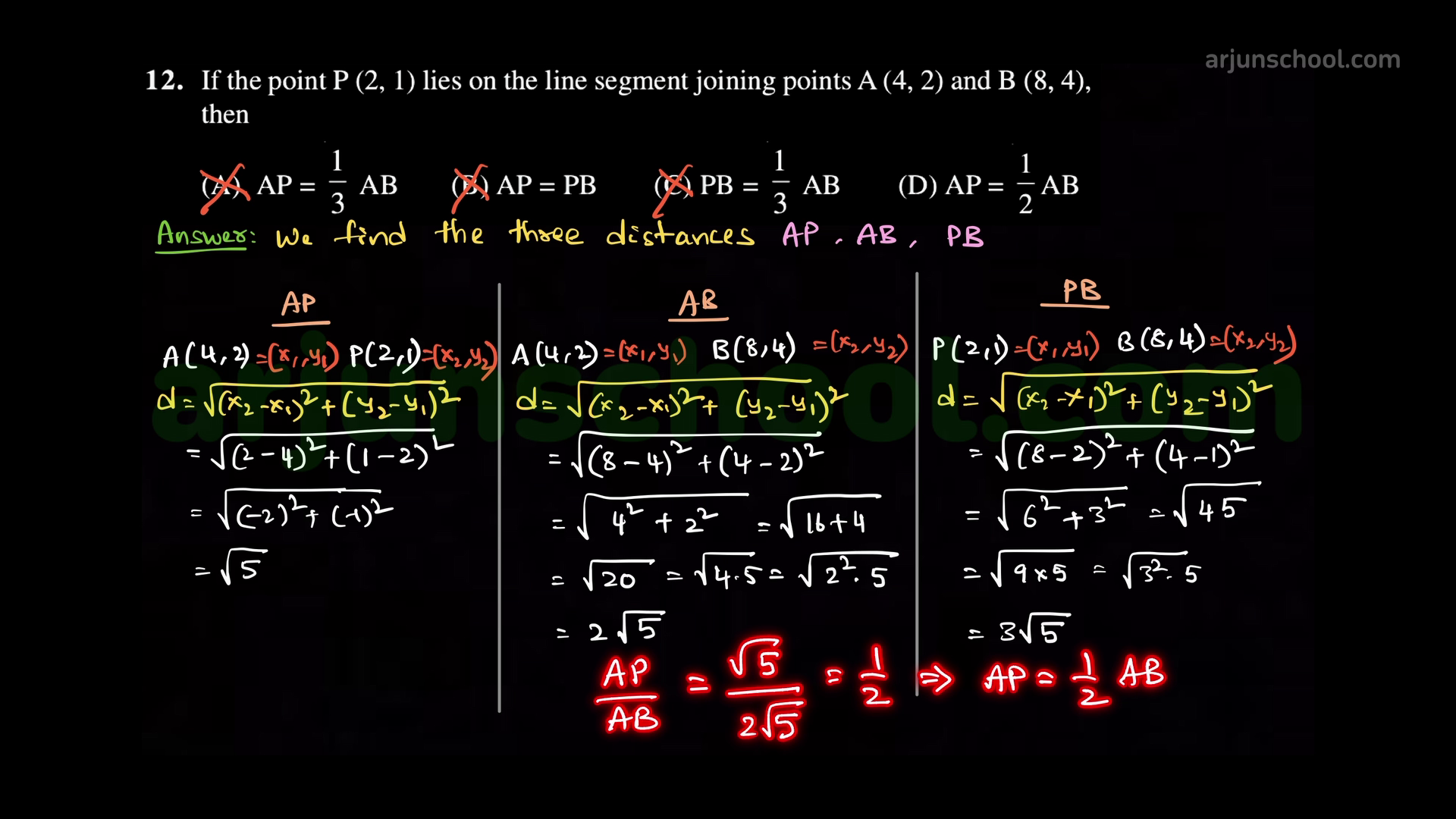
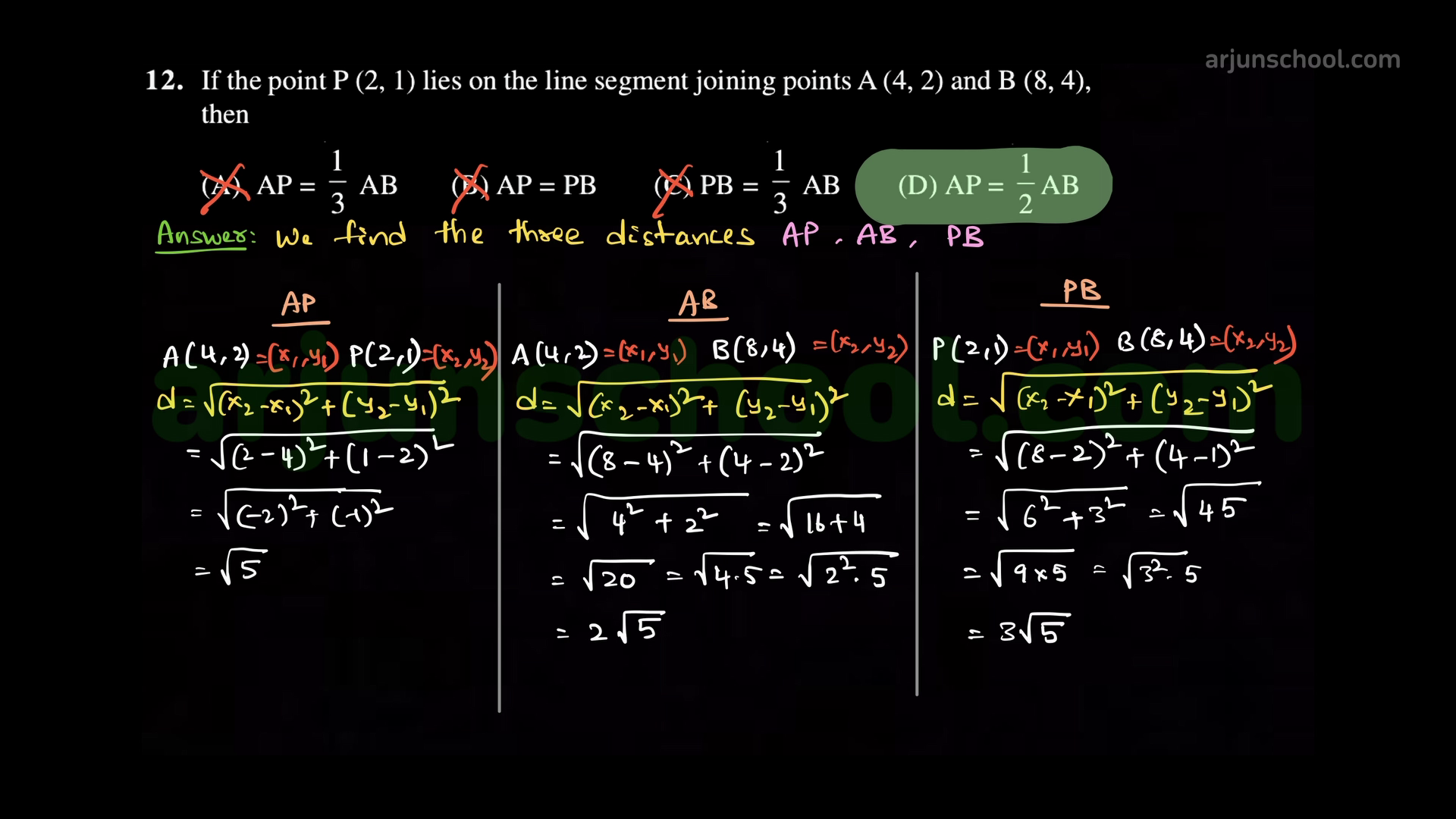
Step 2: Find the length of \(AB\).
Coordinates of \(A(4,2)\), \(B(8,4)\).
\[ AB = \sqrt{(8 - 4)^2 + (4 - 2)^2} \]
\[ AB = \sqrt{4^2 + 2^2} = \sqrt{16 + 4} = \sqrt{20} = 2\sqrt{5} \; \text{units} \]
Step 3: Find the length of \(AP\).
Coordinates of \(A(4,2)\), \(P(2,1)\).
\[ AP = \sqrt{(2 - 4)^2 + (1 - 2)^2} \]
\[ AP = \sqrt{(-2)^2 + (-1)^2} = \sqrt{4 + 1} = \sqrt{5} \; \text{units} \]
Step 4: Compare \(AP\) with \(AB\).
\[ AB = 2\sqrt{5}, \quad AP = \sqrt{5} \]
This shows that:
\[ AP = \dfrac{1}{2} AB \]
Final Answer: Option D (\(AP = \tfrac{1}{2} AB\)).