NCERT Exemplar Solutions
Class 10 - Mathematics - CHAPTER 7: Coordinate Geometry - Exercise 7.1Question 13
Class 10 - Mathematics - CHAPTER 7: Coordinate Geometry - Exercise 7.1
Question. 13
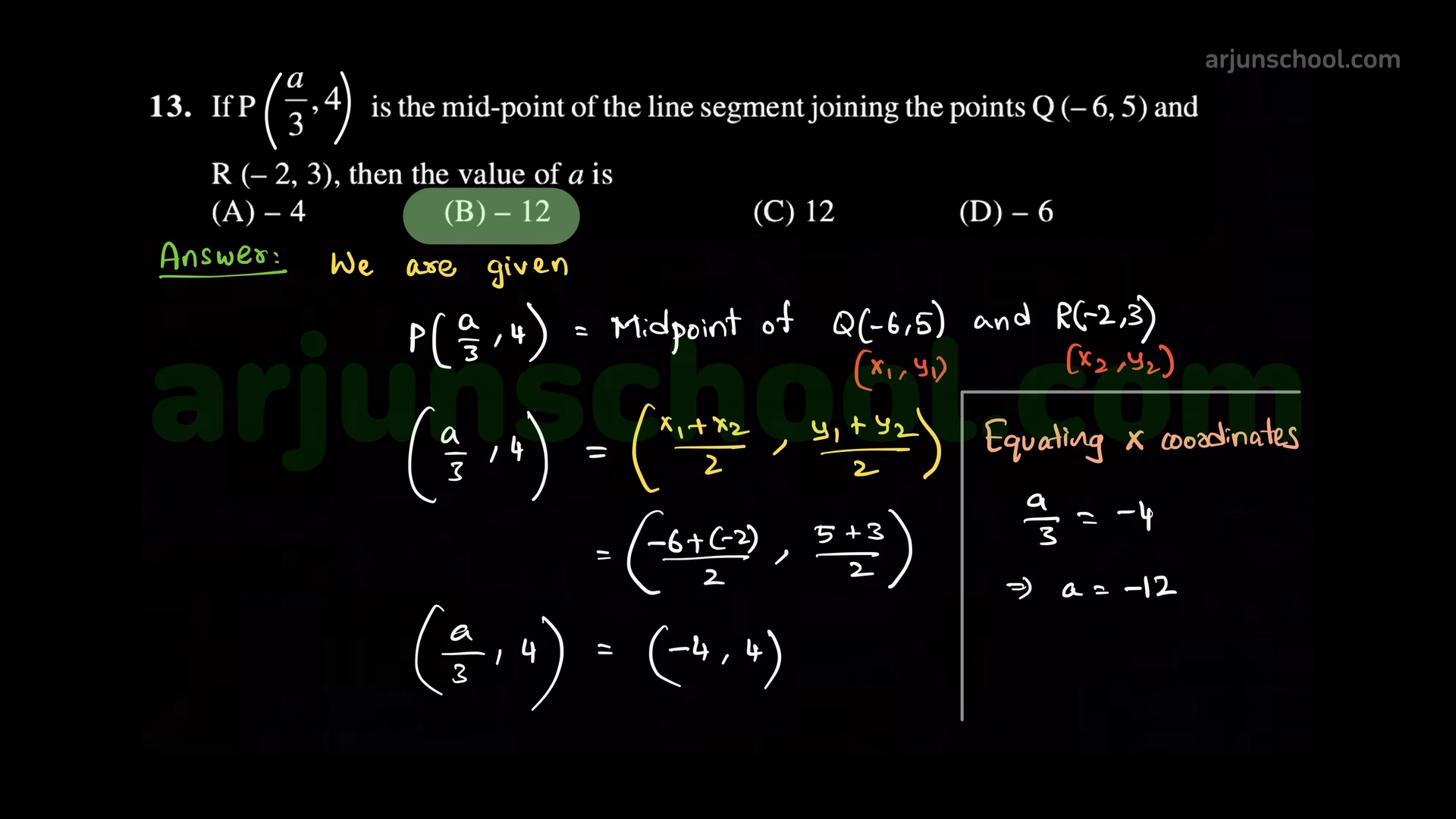
If \(P\big(\dfrac{a}{3},4\big)\) is the mid-point of the line segment joining the points \(Q(-6,5)\) and \(R(-2,3)\), then the value of \(a\) is
-4
-12
12
-6
Handwritten Notes
Video Explanation:
Detailed Answer with Explanation:
Step 1: Recall the midpoint formula.
The midpoint of two points \((x_1, y_1)\) and \((x_2, y_2)\) is:
\[ M = \,\left( \dfrac{x_1 + x_2}{2}, \; \dfrac{y_1 + y_2}{2} \right) \]
Step 2: Identify the given points.
Point Q = \((-6, 5)\), Point R = \((-2, 3)\).
Step 3: Find the midpoint of Q and R using the formula.
For the x-coordinate: \(\dfrac{-6 + (-2)}{2} = \dfrac{-8}{2} = -4\).
For the y-coordinate: \(\dfrac{5 + 3}{2} = \dfrac{8}{2} = 4\).
So, midpoint of Q and R = \((-4, 4)\).
Step 4: Compare this midpoint with the given midpoint P.
P is given as \((\dfrac{a}{3}, 4)\).
So, we must have:
\(\dfrac{a}{3} = -4\) and y = 4 (which already matches).
Step 5: Solve for \(a\).
\(\dfrac{a}{3} = -4 \Rightarrow a = -4 \times 3 = -12\).
Final Answer: The value of \(a\) is -12.