NCERT Exemplar Solutions
Class 10 - Mathematics - CHAPTER 7: Coordinate Geometry - Exercise 7.1Question 14
Class 10 - Mathematics - CHAPTER 7: Coordinate Geometry - Exercise 7.1
Question. 14
The perpendicular bisector of the line segment joining the points \(A(1,5)\) and \(B(4,6)\) cuts the y-axis at
(0, 13)
(0, -13)
(0, 12)
(13, 0)
Handwritten Notes
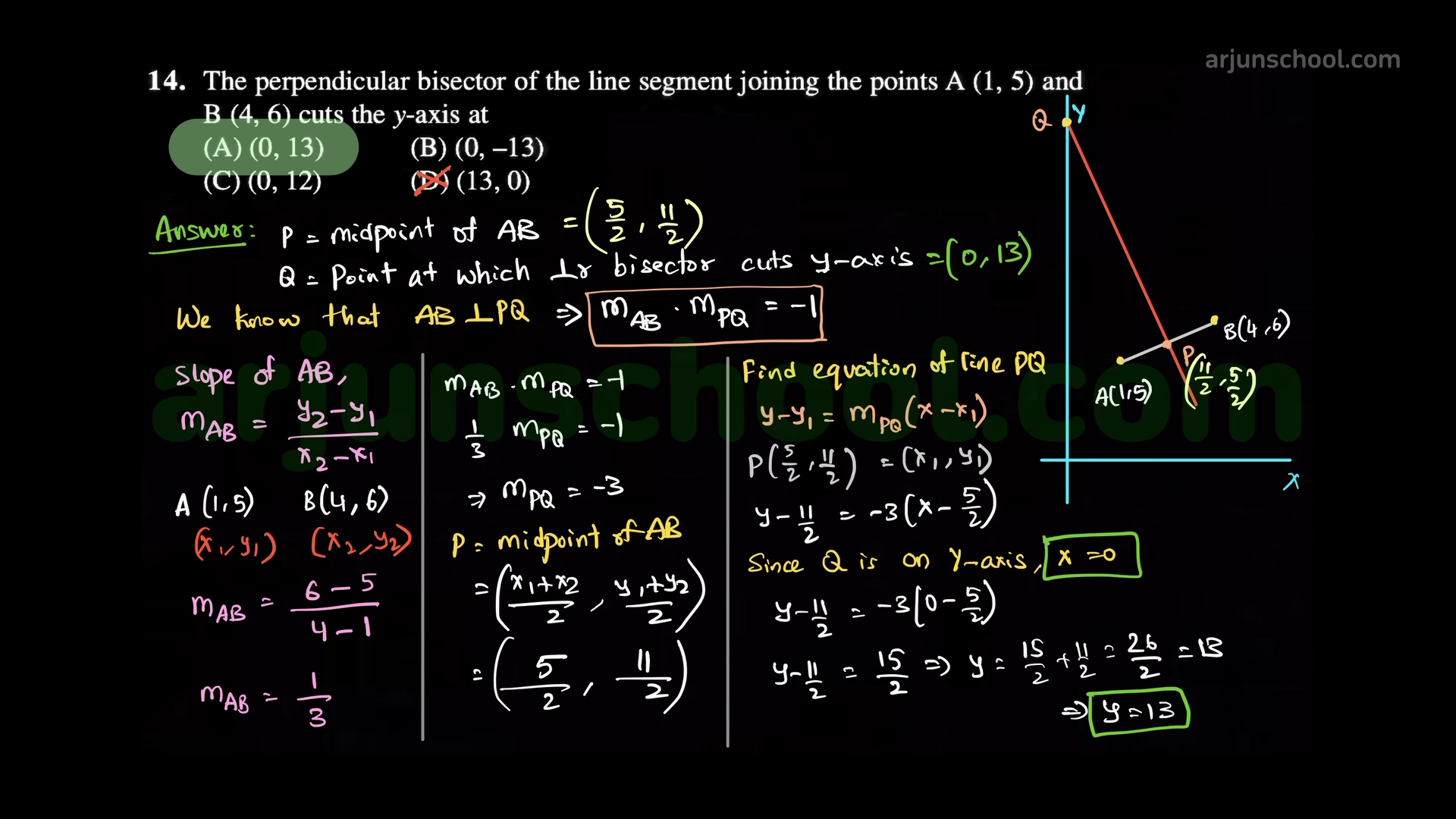
Video Explanation:
Detailed Answer with Explanation:
Step 1: Find the midpoint of AB
The midpoint \(M\) of two points \((x_1,y_1)\) and \((x_2,y_2)\) is
\[ M = \left( \dfrac{x_1 + x_2}{2}, \; \dfrac{y_1 + y_2}{2} \right) \]
Here, \(A(1,5)\) and \(B(4,6)\).
\[ M = \left( \dfrac{1+4}{2}, \; \dfrac{5+6}{2} \right) = \left( \dfrac{5}{2}, \; \dfrac{11}{2} \right) \]
So the midpoint is \(M(2.5, 5.5)\).
Step 2: Find the slope of AB
Slope formula: \[ m = \dfrac{y_2 - y_1}{x_2 - x_1} \]
\[ m_{AB} = \dfrac{6 - 5}{4 - 1} = \dfrac{1}{3} \]
Step 3: Slope of the perpendicular bisector
The slope of a line perpendicular to another line is the negative reciprocal.
So, \[ m_\perp = -\dfrac{1}{m_{AB}} = -\dfrac{1}{\tfrac{1}{3}} = -3 \]
Step 4: Equation of the perpendicular bisector
The perpendicular bisector passes through midpoint \(M(2.5, 5.5)\) with slope \(-3\).
Equation of line: \[ y - y_1 = m(x - x_1) \]
\[ y - 5.5 = -3(x - 2.5) \]
\[ y - 5.5 = -3x + 7.5 \]
\[ y = -3x + 13 \]
Step 5: Find the point where it cuts the y-axis
On the y-axis, \(x = 0\).
Substitute \(x=0\) in \(y = -3x + 13\):
\[ y = -3(0) + 13 = 13 \]
So the point is \((0,13)\).
Final Answer: The perpendicular bisector cuts the y-axis at (0, 13).