NCERT Exemplar Solutions
Class 10 - Mathematics - CHAPTER 7: Coordinate Geometry - Exercise 7.1Question 19
Class 10 - Mathematics - CHAPTER 7: Coordinate Geometry - Exercise 7.1
Question. 19
If the distance between the points \((4,p)\) and \((1,0)\) is 5, then the value of \(p\) is
4 only
\(\pm 4\)
-4 only
0
Handwritten Notes
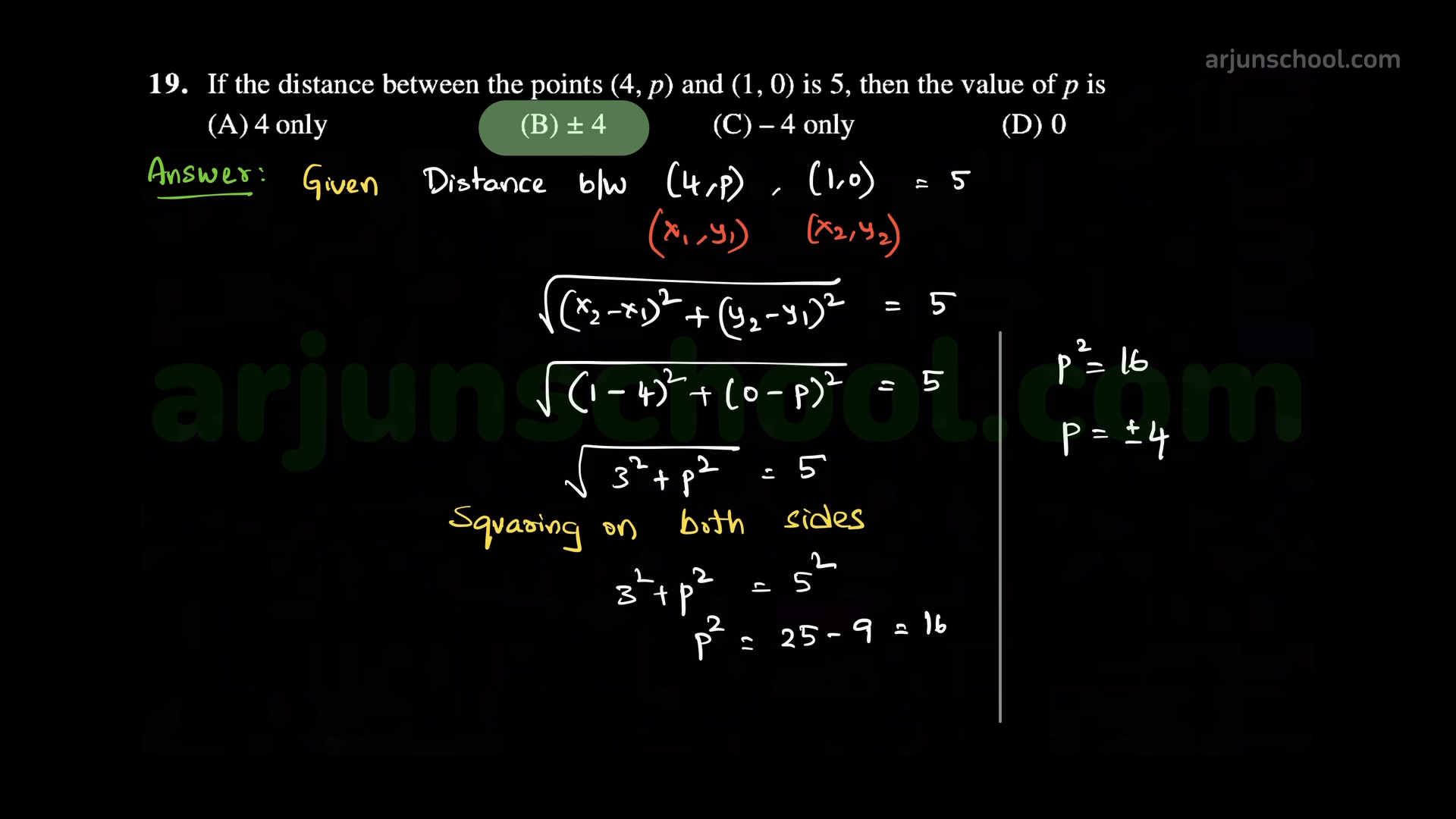
Video Explanation:
Detailed Answer with Explanation:
Step 1: Recall the distance formula between two points \((x_1,y_1)\) and \((x_2,y_2)\):
\[ d = \sqrt{(x_2 - x_1)^2 + (y_2 - y_1)^2} \]
Step 2: Here the two points are \((4,p)\) and \((1,0)\). So, \(x_1 = 4, y_1 = p, x_2 = 1, y_2 = 0\).
Step 3: Substitute into the formula:
\[ d = \sqrt{(1 - 4)^2 + (0 - p)^2} \]
Step 4: Simplify the terms: \((1 - 4)^2 = (-3)^2 = 9\) \((0 - p)^2 = (-p)^2 = p^2\)
So, \[ d = \sqrt{9 + p^2} \]
Step 5: The distance is given as 5. Therefore, \(\sqrt{9 + p^2} = 5\).
Step 6: Square both sides to remove the square root:
\[ 9 + p^2 = 25 \]
Step 7: Subtract 9 from both sides:
\[ p^2 = 25 - 9 = 16 \]
Step 8: Take square root on both sides:
\[ p = \pm 4 \]
Final Answer: The value of \(p\) is \(\pm 4\). So the correct option is B.