NCERT Exemplar Solutions
Class 10 - Mathematics - CHAPTER 7: Coordinate Geometry - Exercise 7.1Question 18
Class 10 - Mathematics - CHAPTER 7: Coordinate Geometry - Exercise 7.1
Question. 18
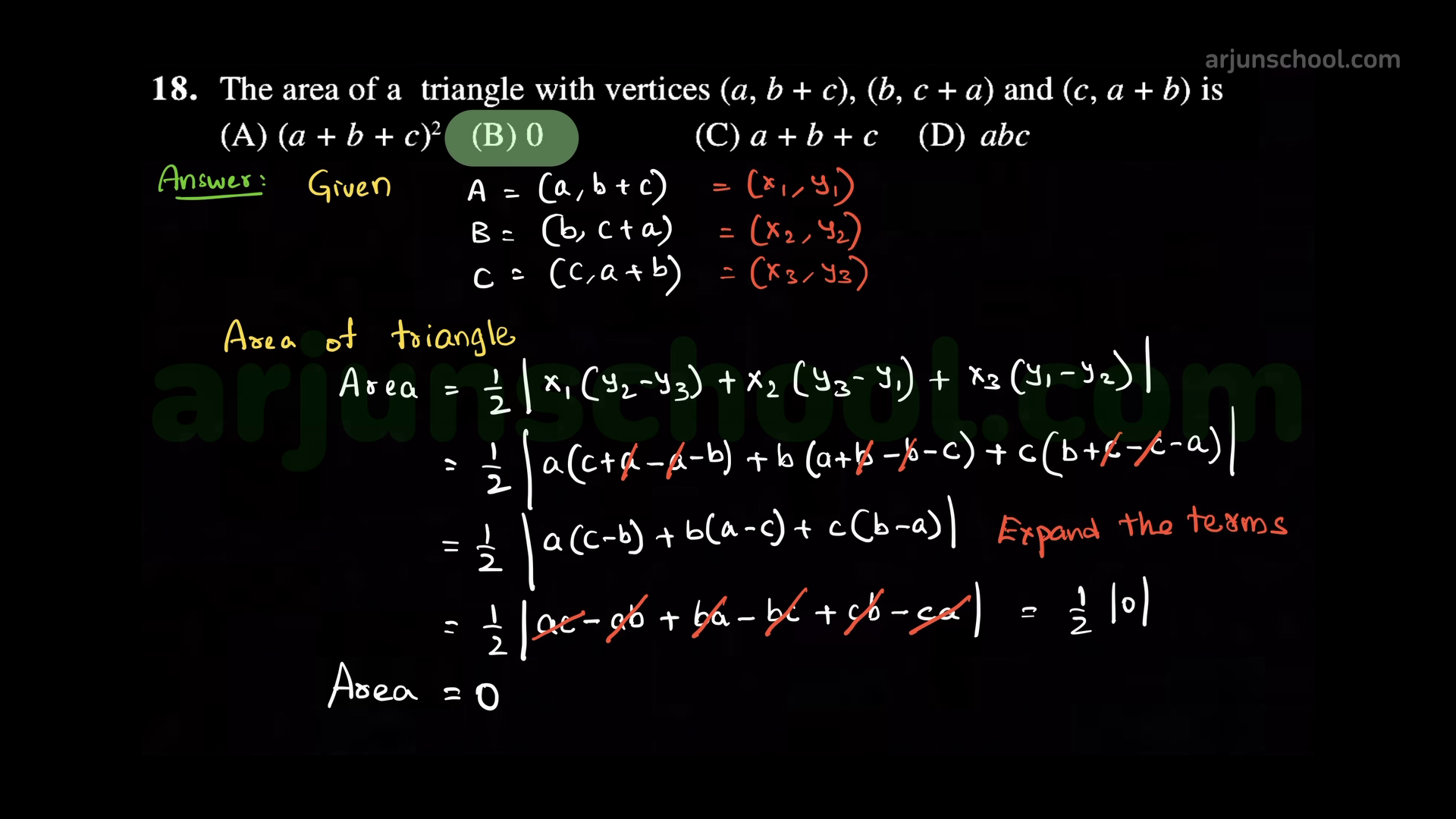
The area of a triangle with vertices \((a,b+c)\), \((b,c+a)\) and \((c,a+b)\) is
\((a+b+c)^2\)
0
\(a+b+c\)
\(abc\)
Handwritten Notes
Video Explanation:
Detailed Answer with Explanation:
Step 1: Recall the formula for the area of a triangle with vertices \((x_1,y_1)\), \((x_2,y_2)\), \((x_3,y_3)\):
\[ \text{Area} = \tfrac{1}{2} \begin{vmatrix} x_1 & y_1 & 1 \\ x_2 & y_2 & 1 \\ x_3 & y_3 & 1 \end{vmatrix} \]
Step 2: Here, the vertices are:
- \((x_1,y_1) = (a, b+c)\)
- \((x_2,y_2) = (b, c+a)\)
- \((x_3,y_3) = (c, a+b)\)
Step 3: Substitute these into the determinant:
\[ \text{Area} = \tfrac{1}{2} \begin{vmatrix} a & b+c & 1 \\ b & c+a & 1 \\ c & a+b & 1 \end{vmatrix} \]
Step 4: Expand the determinant. After simplification, all the terms cancel out.
\[ \text{Area} = \tfrac{1}{2}(0) = 0 \]
Step 5: When the area is zero, it means the three points lie on the same straight line (they are collinear).
Final Answer: \(0\) (Option B).