NCERT Exemplar Solutions
Class 10 - Mathematics - CHAPTER 7: Coordinate Geometry - Exercise 7.1Question 17
Class 10 - Mathematics - CHAPTER 7: Coordinate Geometry - Exercise 7.1
Question. 17
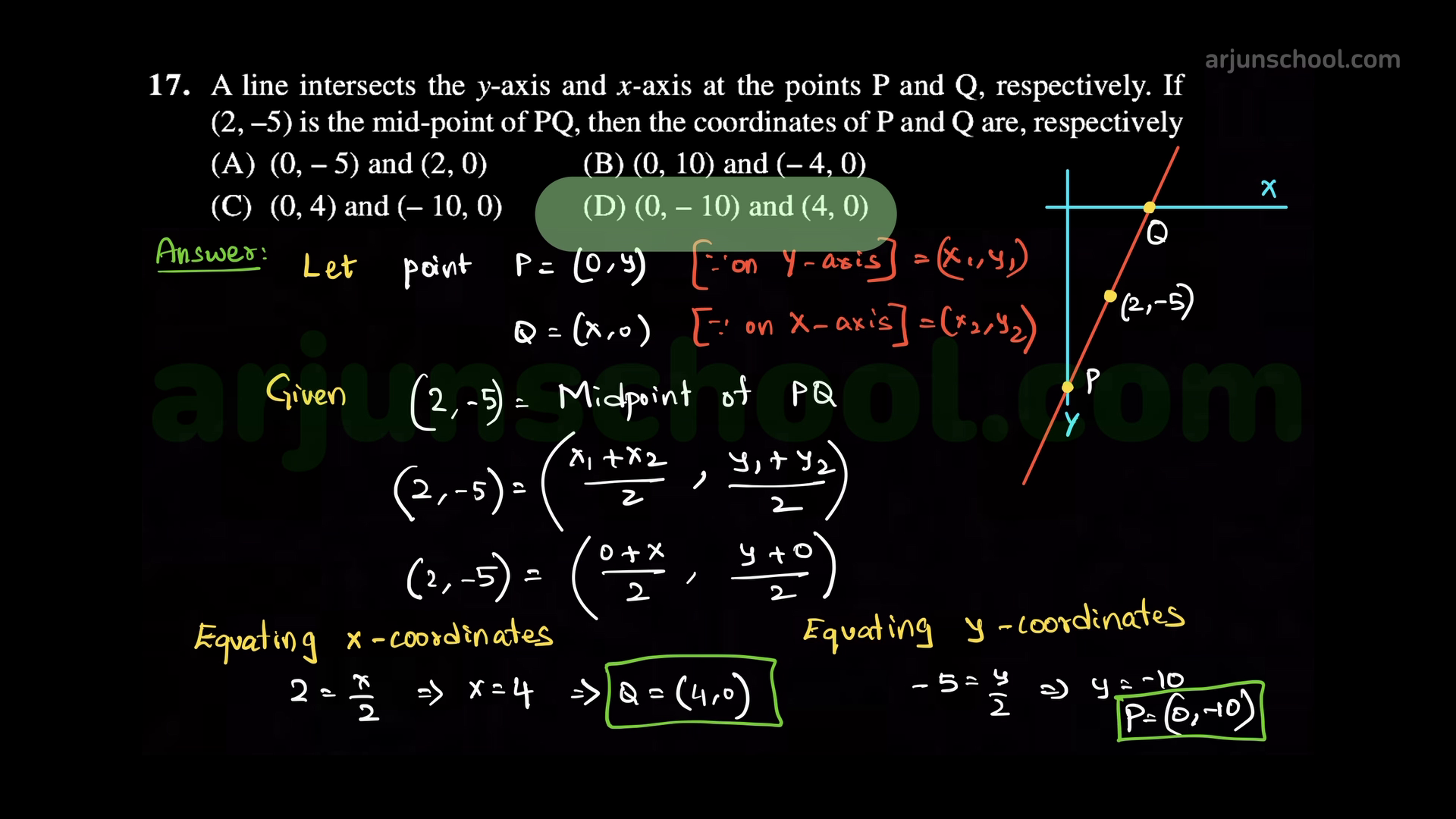
A line intersects the y-axis and x-axis at the points \(P\) and \(Q\), respectively. If \((2,-5)\) is the mid-point of \(PQ\), then the coordinates of \(P\) and \(Q\) are, respectively
(0, -5) and (2, 0)
(0, 10) and (-4, 0)
(0, 4) and (-10, 0)
(0, -10) and (4, 0)
Handwritten Notes
Video Explanation:
Detailed Answer with Explanation:
Step 1: A point on the y-axis always has the form \((0, p)\), because the x-coordinate is 0.
So let the coordinates of \(P\) be \((0, p)\).
Step 2: A point on the x-axis always has the form \((q, 0)\), because the y-coordinate is 0.
So let the coordinates of \(Q\) be \((q, 0)\).
Step 3: The formula for the midpoint of a line joining two points \((x_1, y_1)\) and \((x_2, y_2)\) is:
\[ M = \left( \dfrac{x_1 + x_2}{2}, \dfrac{y_1 + y_2}{2} \right) \]
Step 4: Substituting \(P(0, p)\) and \(Q(q, 0)\):
Midpoint = \( \Big( \dfrac{0+q}{2}, \dfrac{p+0}{2} \Big) = \Big( \dfrac{q}{2}, \dfrac{p}{2} \Big) \)
Step 5: We are told that the midpoint is \((2, -5)\). So we can write the equations:
- \( \dfrac{q}{2} = 2 \Rightarrow q = 4 \)
- \( \dfrac{p}{2} = -5 \Rightarrow p = -10 \)
Step 6: Therefore, \(P = (0, -10)\) and \(Q = (4, 0)\).
Final Answer: Option D.