NCERT Exemplar Solutions
Class 10 - Mathematics - CHAPTER 7: Coordinate Geometry - Exercise 7.1Question 16
Class 10 - Mathematics - CHAPTER 7: Coordinate Geometry - Exercise 7.1
Question. 16
A circle drawn with origin as the centre passes through \(\big(\dfrac{13}{2},0\big)\). The point which does not lie in the interior of the circle is
\(\big(-\dfrac{3}{4},1\big)\)
\(\big(2,\dfrac{7}{3}\big)\)
\(\big(5,-\dfrac{1}{2}\big)\)
\(\big(-6,\dfrac{5}{2}\big)\)
Handwritten Notes
Video Explanation:
Detailed Answer with Explanation:
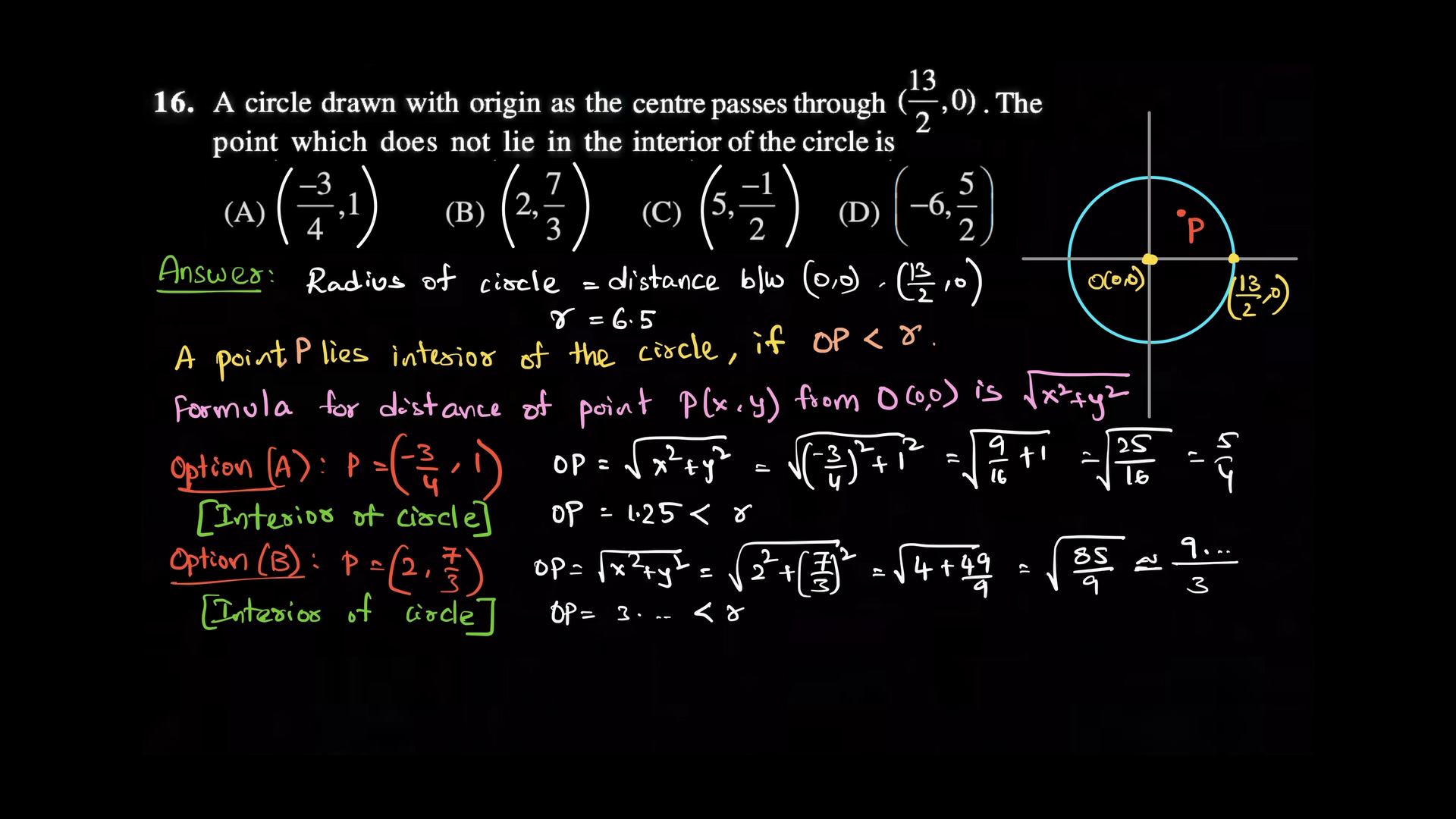
Step 1: A circle is defined by its centre and radius. Here, the centre is the origin \((0,0)\).
Step 2: The circle passes through the point \(\left(\dfrac{13}{2},0\right)\). The distance from the centre to this point is the radius.
Step 3: Distance formula is \[d = \sqrt{(x_2 - x_1)^2 + (y_2 - y_1)^2}.\] For centre \((0,0)\) and point \((\tfrac{13}{2},0)\): \[r = \sqrt{\left(\tfrac{13}{2} - 0\right)^2 + (0-0)^2} = \sqrt{\left(\tfrac{13}{2}\right)^2} = \tfrac{13}{2} = 6.5.\] So, radius = 6.5 units.
Step 4: To check whether a point lies inside, on, or outside the circle: - Find the distance of the point from the centre. - If distance < radius → inside the circle. - If distance = radius → on the circle (not interior). - If distance > radius → outside the circle.
Step 5: Now check each option:
- Option A: Point \((-\tfrac{3}{4},1)\). Distance = \(\sqrt{(-0.75)^2 + (1)^2} = \sqrt{0.5625 + 1} = \sqrt{1.5625} \approx 1.25.\) Since 1.25 < 6.5, point is inside.
- Option B: Point \((2, \tfrac{7}{3})\). Distance = \(\sqrt{(2)^2 + (2.33)^2} = \sqrt{4 + 5.44} = \sqrt{9.44} \approx 3.07.\) Since 3.07 < 6.5, point is inside.
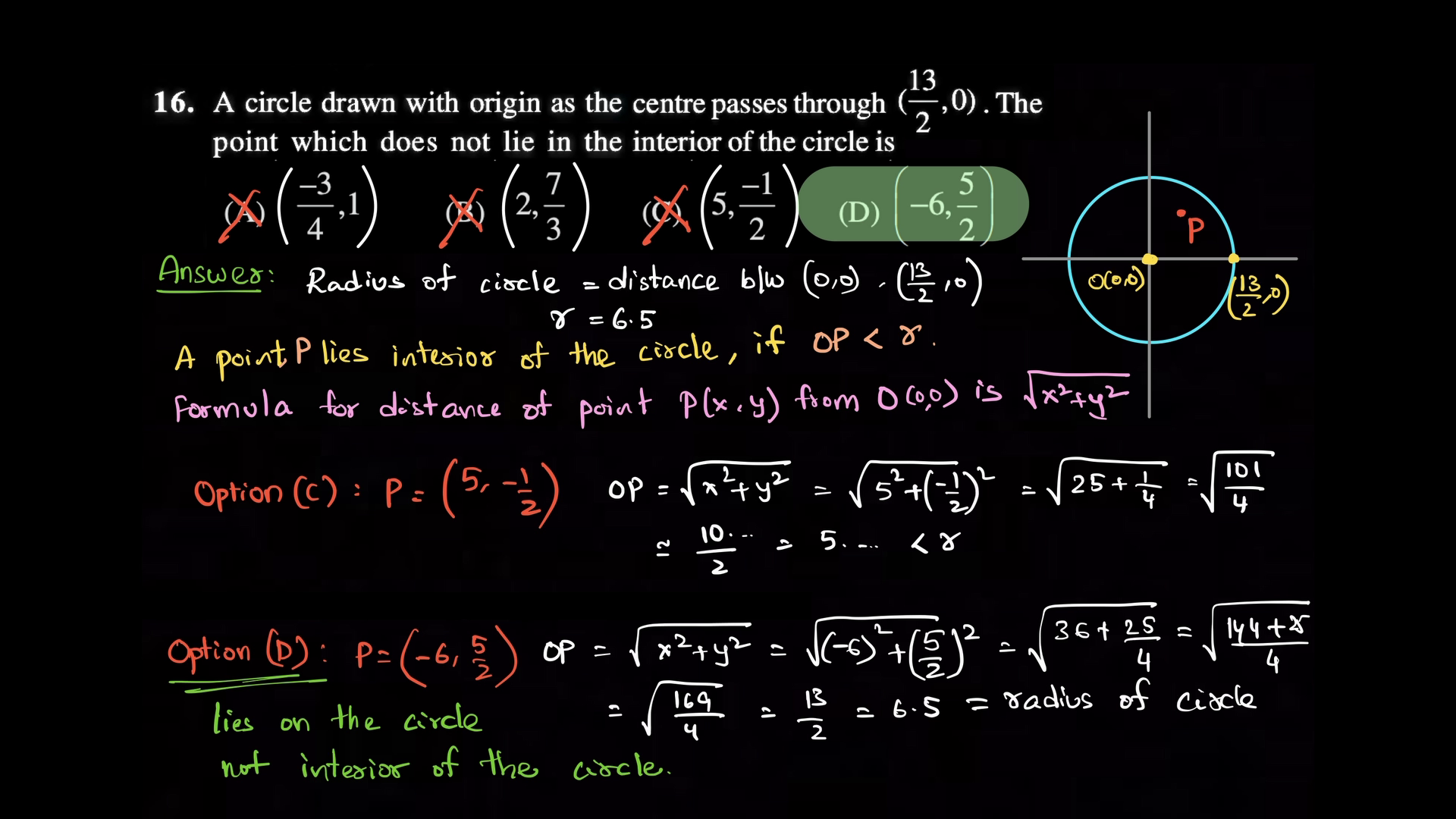
- Option C: Point \((5, -\tfrac{1}{2})\). Distance = \(\sqrt{(5)^2 + (-0.5)^2} = \sqrt{25 + 0.25} = \sqrt{25.25} \approx 5.02.\) Since 5.02 < 6.5, point is inside.
- Option D: Point \((-6, \tfrac{5}{2})\). Distance = \(\sqrt{(-6)^2 + (2.5)^2} = \sqrt{36 + 6.25} = \sqrt{42.25} = 6.5.\) Distance = radius, so this point lies on the circle, not in the interior.
Final Answer: Option D \(\big(-6, \tfrac{5}{2}\big)\) does not lie in the interior.