NCERT Exemplar Solutions
Class 10 - Mathematics - CHAPTER 8: Introduction to Trignometry and Its Applications - Exercise 8.1Question 1
Class 10 - Mathematics - CHAPTER 8: Introduction to Trignometry and Its Applications - Exercise 8.1
Question. 1
If \(\cos A = \dfrac{4}{5}\), then the value of \(\tan A\) is
\(\dfrac{3}{5}\)
\(\dfrac{3}{4}\)
\(\dfrac{4}{3}\)
\(\dfrac{5}{3}\)
Handwritten Notes
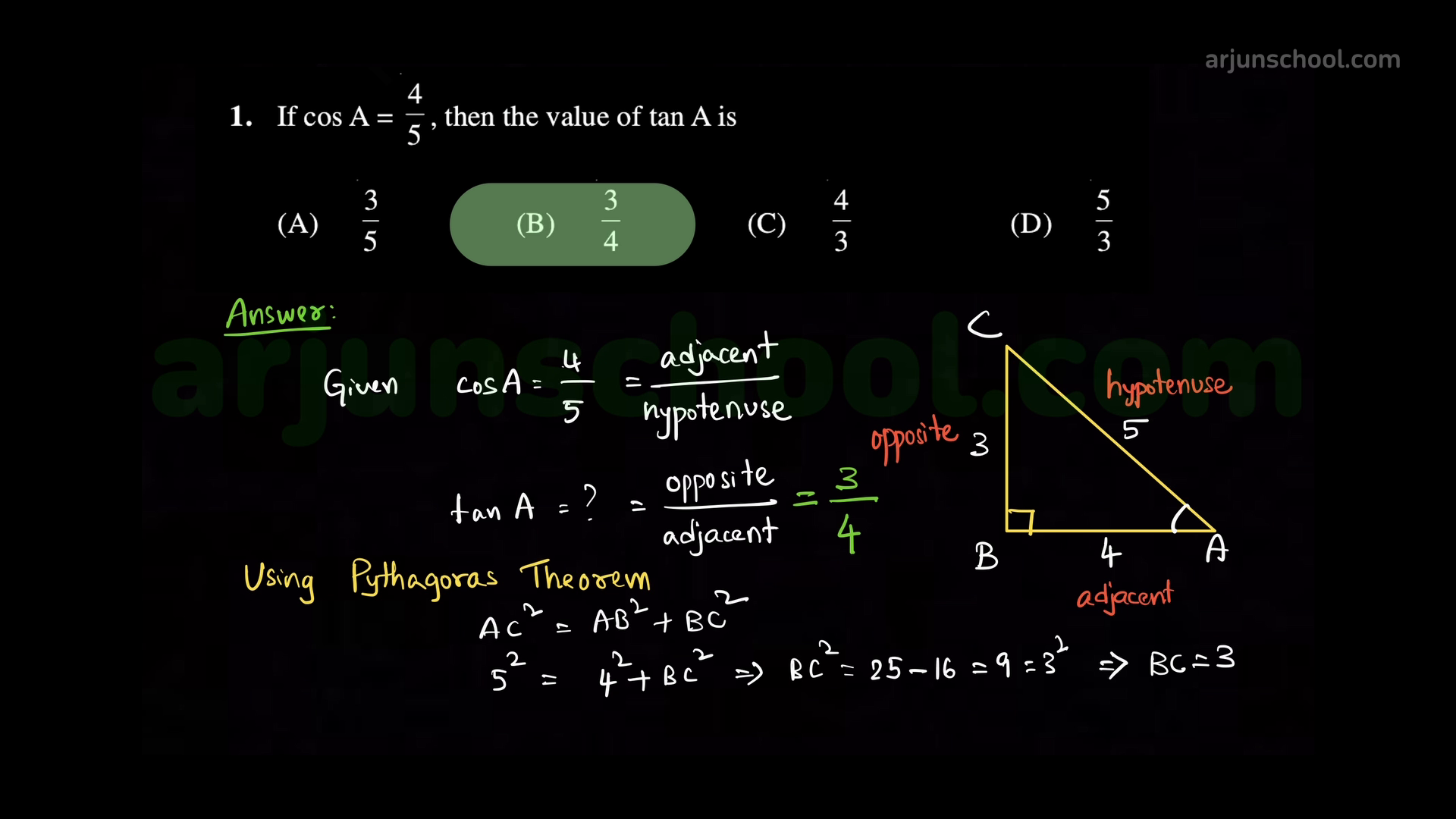
Video Explanation:
Detailed Answer with Explanation:
Step 1: Recall the definition of cosine in a right triangle.
\(\cos A = \dfrac{\text{Base}}{\text{Hypotenuse}}\)
Here, \(\cos A = \dfrac{4}{5}\).
This means Base = 4 units, Hypotenuse = 5 units.
Step 2: Find the third side (Perpendicular) using Pythagoras theorem.
\( \text{Hypotenuse}^2 = \text{Base}^2 + \text{Perpendicular}^2 \)
\( 5^2 = 4^2 + \text{Perpendicular}^2 \)
\( 25 = 16 + \text{Perpendicular}^2 \)
\( \text{Perpendicular}^2 = 25 - 16 = 9 \)
\( \text{Perpendicular} = 3 \)
Step 3: Recall the definition of tangent.
\( \tan A = \dfrac{\text{Perpendicular}}{\text{Base}} \)
\( \tan A = \dfrac{3}{4} \)
Final Answer: \(\dfrac{3}{4}\) (Option B).