NCERT Exemplar Solutions
Class 10 - Mathematics - CHAPTER 8: Introduction to Trignometry and Its Applications - Exercise 8.1Question 12
Class 10 - Mathematics - CHAPTER 8: Introduction to Trignometry and Its Applications - Exercise 8.1
Question. 12
If \(4\tan\theta=3\), then \(\dfrac{4\sin\theta-\cos\theta}{4\sin\theta+\cos\theta}\) equals
\(\dfrac{2}{3}\)
\(\dfrac{1}{3}\)
\(\dfrac{1}{2}\)
\(\dfrac{3}{4}\)
Handwritten Notes
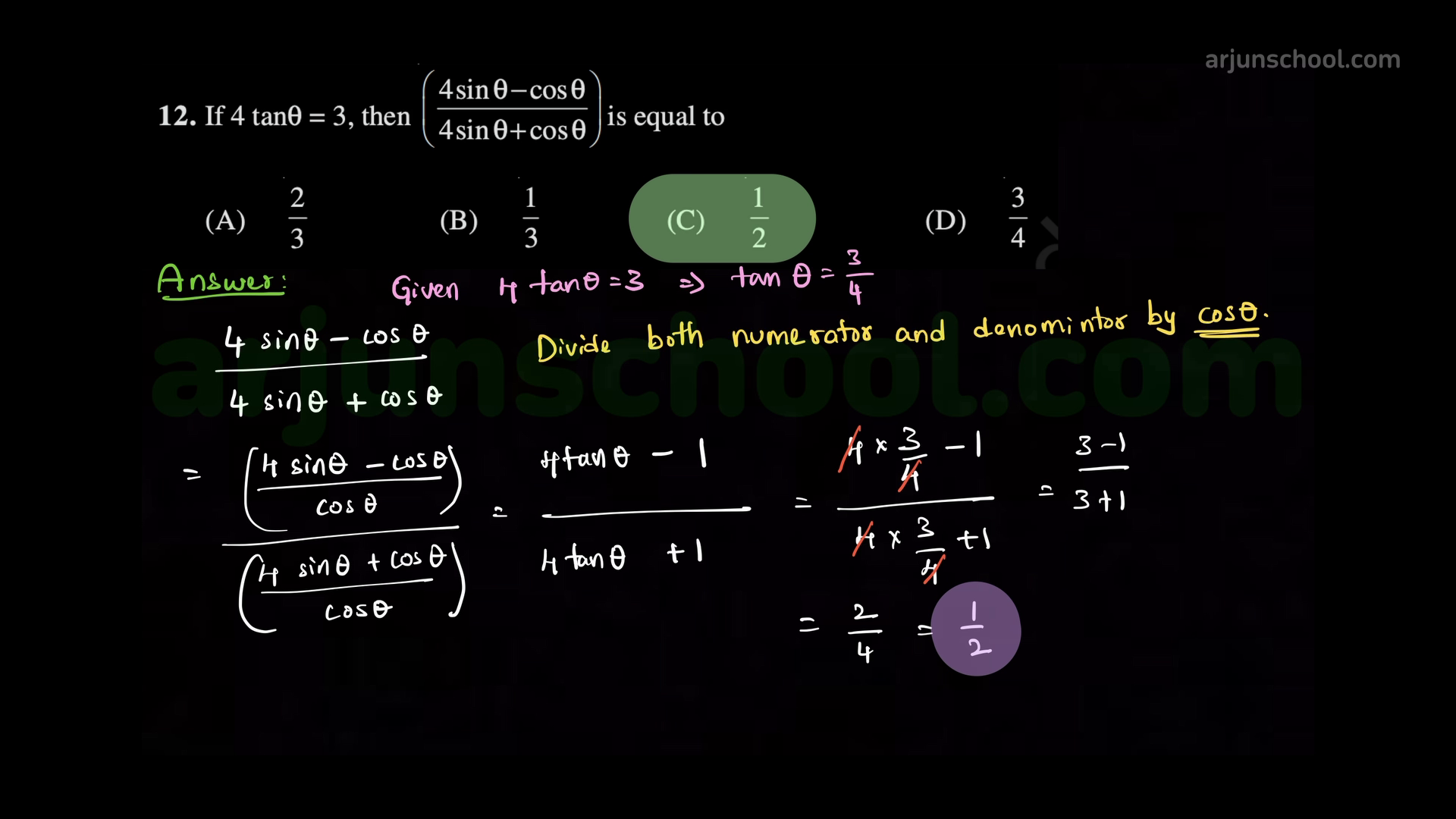
Video Explanation:
Detailed Answer with Explanation:
Step 1: We are given \(4 \tan\theta = 3\).
So, \(\tan\theta = \dfrac{3}{4}\).
Step 2: Recall that \(\tan\theta = \dfrac{\sin\theta}{\cos\theta}\).
This means we can imagine a right-angled triangle where:
- Opposite side (to angle \(\theta\)) = 3
- Adjacent side (to angle \(\theta\)) = 4
Step 3: Now find the hypotenuse using Pythagoras theorem:
\(\text{Hypotenuse} = \sqrt{3^2 + 4^2} = \sqrt{9+16} = \sqrt{25} = 5.\)
Step 4: From the triangle:
- \(\sin\theta = \dfrac{\text{Opposite}}{\text{Hypotenuse}} = \dfrac{3}{5}\)
- \(\cos\theta = \dfrac{\text{Adjacent}}{\text{Hypotenuse}} = \dfrac{4}{5}\)
Step 5: Substitute these values into the given expression:
\(\dfrac{4\sin\theta - \cos\theta}{4\sin\theta + \cos\theta} = \dfrac{4\times \dfrac{3}{5} - \dfrac{4}{5}}{4\times \dfrac{3}{5} + \dfrac{4}{5}}\)
Step 6: Simplify numerator and denominator:
Numerator = \(\dfrac{12}{5} - \dfrac{4}{5} = \dfrac{8}{5}\)
Denominator = \(\dfrac{12}{5} + \dfrac{4}{5} = \dfrac{16}{5}\)
Step 7: Ratio = \(\dfrac{\tfrac{8}{5}}{\tfrac{16}{5}} = \dfrac{8}{16} = \dfrac{1}{2}\).
Final Answer: Option C (\(\dfrac{1}{2}\)).