NCERT Exemplar Solutions
Class 10 - Mathematics - CHAPTER 8: Introduction to Trignometry and Its Applications - Exercise 8.1Question 4
Class 10 - Mathematics - CHAPTER 8: Introduction to Trignometry and Its Applications - Exercise 8.1
Question. 4
Given that \(\sin\theta=\dfrac{a}{b}\), then \(\cos\theta\) equals
\(\dfrac{b}{\sqrt{b^2-a^2}}\)
\(\dfrac{b}{a}\)
\(\dfrac{\sqrt{b^2-a^2}}{b}\)
\(\dfrac{a}{\sqrt{b^2-a^2}}\)
Handwritten Notes
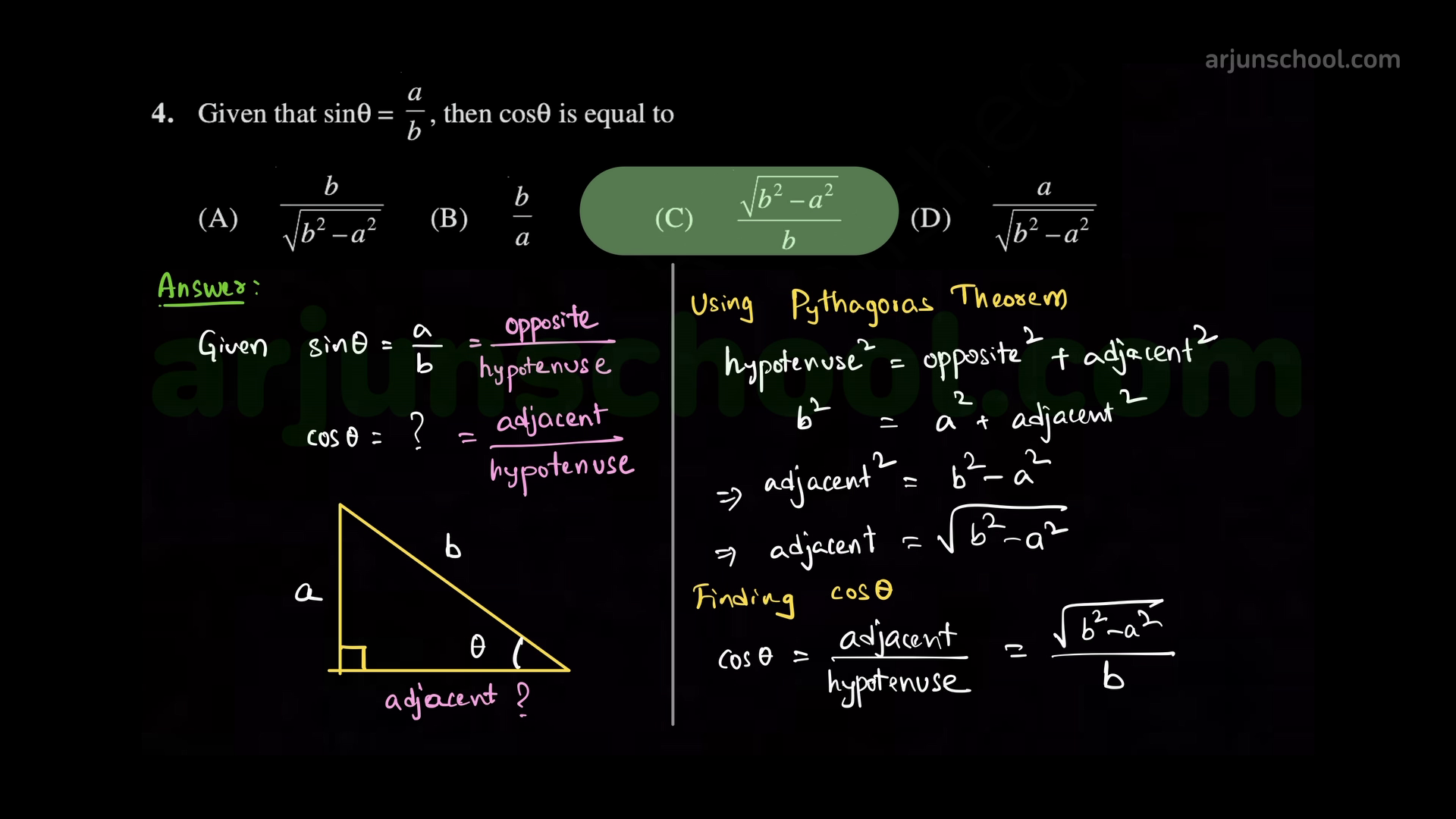
Video Explanation:
Detailed Answer with Explanation:
We are given: \(\sin\theta = \dfrac{a}{b}\).
Step 1: Recall the Pythagorean identity of trigonometry:
\[ \sin^2\theta + \cos^2\theta = 1 \]
Step 2: Substitute the value of \(\sin\theta\):
\[ \left(\dfrac{a}{b}\right)^2 + \cos^2\theta = 1 \]
Step 3: Simplify the square:
\[ \dfrac{a^2}{b^2} + \cos^2\theta = 1 \]
Step 4: Move \(\dfrac{a^2}{b^2}\) to the right side:
\[ \cos^2\theta = 1 - \dfrac{a^2}{b^2} \]
Step 5: Write with a common denominator:
\[ \cos^2\theta = \dfrac{b^2}{b^2} - \dfrac{a^2}{b^2} = \dfrac{b^2 - a^2}{b^2} \]
Step 6: Take the square root on both sides:
\[ \cos\theta = \dfrac{\sqrt{b^2 - a^2}}{b} \]
Note: Since \(\theta\) is an acute angle (between \(0^\circ\) and \(90^\circ\)), cosine is positive. So we take only the positive root.
Final Answer: \(\cos\theta = \dfrac{\sqrt{b^2 - a^2}}{b}\) → Option C.