NCERT Exemplar Solutions
Class 10 - Mathematics - CHAPTER 8: Introduction to Trignometry and Its Applications - Exercise 8.1Question 5
Class 10 - Mathematics - CHAPTER 8: Introduction to Trignometry and Its Applications - Exercise 8.1
Question. 5
If \(\cos(\alpha+\beta)=0\), then \(\sin(\alpha-\beta)\) can be reduced to
\(\cos\beta\)
\(\cos 2\beta\)
\(\sin\alpha\)
\(\sin 2\alpha\)
Handwritten Notes
Video Explanation:
Detailed Answer with Explanation:
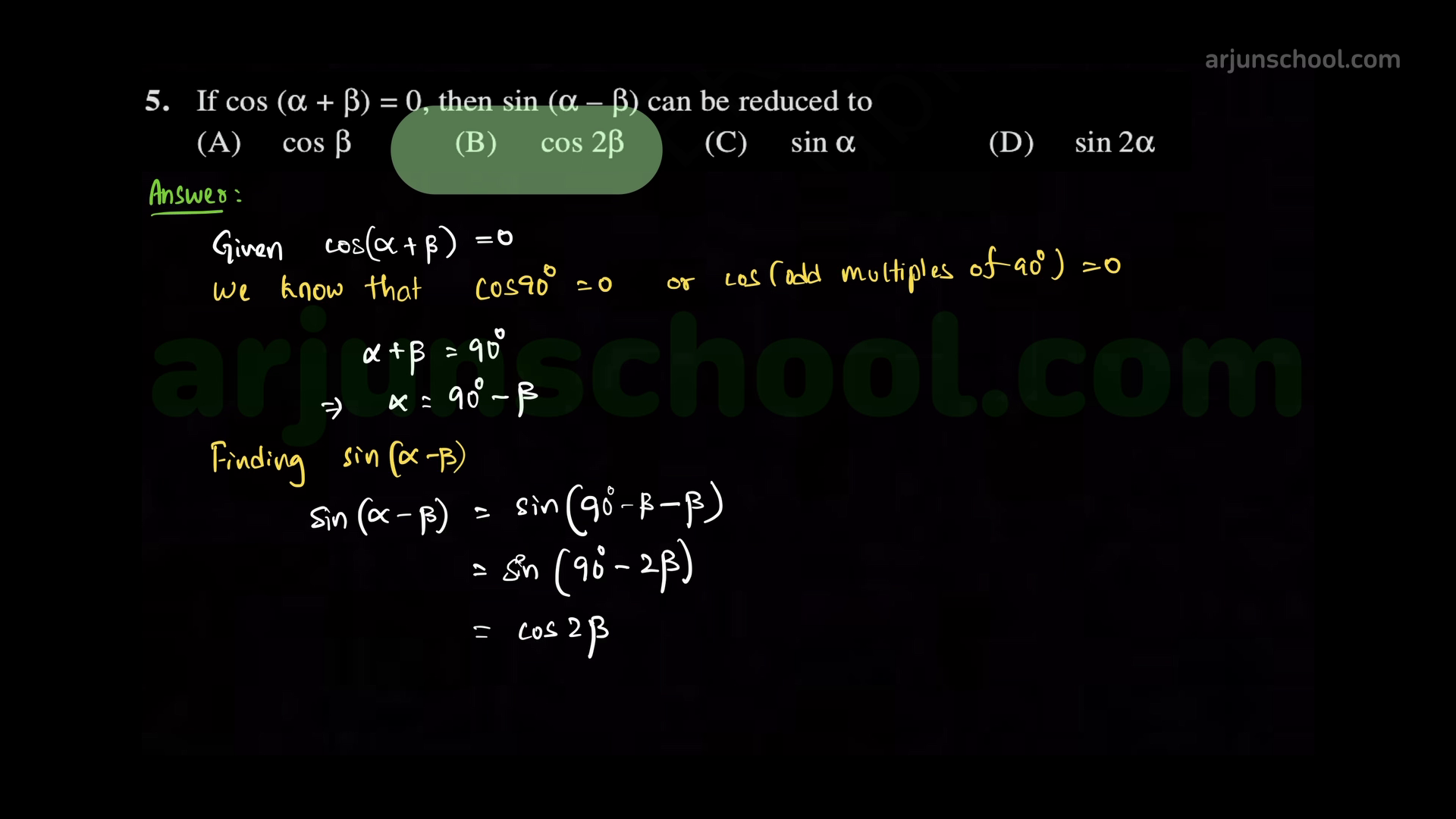
Step 1: We are given that \(\cos(\alpha + \beta) = 0\).
Step 2: Recall that \(\cos 90^\circ = 0\). So, for the cosine function to be zero, the angle must be \(90^\circ\) (or an odd multiple of it). For simplicity, take: \[ \alpha + \beta = 90^\circ \]
Step 3: From this, we can write: \[ \alpha = 90^\circ - \beta \]
Step 4: Now we want to reduce \(\sin(\alpha - \beta)\). Substitute the value of \(\alpha\): \[ \sin(\alpha - \beta) = \sin((90^\circ - \beta) - \beta) \]
Step 5: Simplify inside the bracket: \[ (90^\circ - \beta) - \beta = 90^\circ - 2\beta \]
Step 6: So, \[ \sin(\alpha - \beta) = \sin(90^\circ - 2\beta) \]
Step 7: Use the identity: \(\sin(90^\circ - \theta) = \cos\theta\). Here, \(\theta = 2\beta\). Therefore, \[ \sin(90^\circ - 2\beta) = \cos(2\beta) \]
Final Answer: \[ \sin(\alpha - \beta) = \cos 2\beta \]