NCERT Exemplar Solutions
Class 10 - Mathematics - CHAPTER 6: Triangles - Exercise 6.3Question 3
Class 10 - Mathematics - CHAPTER 6: Triangles - Exercise 6.3
Question. 3
In Fig. 6.9, if \(\angle 1=\angle 2\) and \(\triangle NSQ \cong \triangle MTR\), prove that \(\triangle PTS \sim \triangle PRQ\).
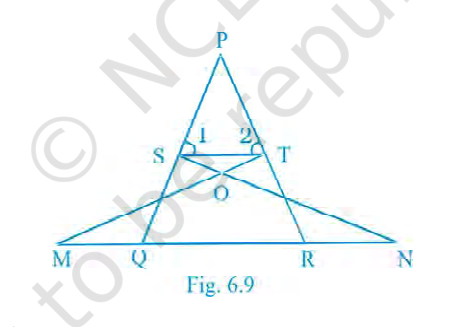
Answer:
Proved.
Detailed Answer with Explanation:
Step 1: It is given that \(\triangle NSQ \cong \triangle MTR\).
From congruence, we know that corresponding angles and sides are equal. So, \(\angle SQN = \angle TRM\) and \(SQ = TR\).
Step 2: Points \(M, Q, R, N\) are collinear (they lie on a straight line). Using this and the equal angles \(\angle SQN = \angle TRM\), we can say that line segment \(QS \parallel RT\).
Step 3: It is also given that \(\angle 1 = \angle 2\). These are the angles at point \(P\), so we can write: \(\angle SPT = \angle QPR\).
Step 4: Because \(QS \parallel RT\):
- \(\angle PST = \angle PRQ\) (alternate interior angles)
- \(\angle PTS = \angle PQR\) (corresponding angles)
Step 5: Now compare triangles \(PTS\) and \(PRQ\):
- \(\angle SPT = \angle QPR\)
- \(\angle PST = \angle PRQ\)
So, two pairs of corresponding angles are equal.
Step 6: By the AA similarity criterion, if two angles of one triangle are equal to two angles of another triangle, then the triangles are similar.
Therefore, \(\triangle PTS \sim \triangle PRQ\).