NCERT Exemplar Solutions
Class 6 - Mathematics - Unit 4: Fractions & DecimalsProblems and Solutions
Class 6 - Mathematics - Unit 4: Fractions & Decimals
Question. 72
Write the fraction represented by the shaded portion of the adjoining figure:
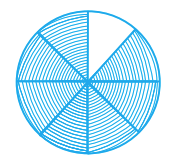
Answer:
\(\dfrac{3}{8}\)
Open
Question. 73
Write the fraction represented by the unshaded portion of the adjoining figure:
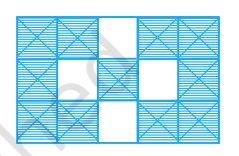
Answer:
\(\dfrac{5}{9}\)
Open
Question. 74
Ali divided one fruit cake equally among six persons. What part of the cake did each person get?
Answer:
\(\dfrac{1}{6}\)
Open
Question. 75
Arrange in ascending order: 12.142, 12.124, 12.104, 12.401, 12.214.
Answer:
12.104 < 12.124 < 12.142 < 12.214 < 12.401
Open
Question. 76
Using the digits 1, 5, 3 and 8 once each, write the largest four-digit decimal number less than 1.
Answer:
\(0.8531\)
Open
Question. 77
Using the digits 2, 4, 5 and 3 once, write the smallest four-digit decimal number (less than 1).
Answer:
\(0.2345\)
Open
Question. 79
Express \(6\dfrac{2}{3}\) as an improper fraction.
Answer:
\(\dfrac{20}{3}\)
Open
Question. 82
Express 6.03 as a mixed fraction.
Answer:
\(6\dfrac{3}{100}\)
Open
Question. 84
Convert 2009 paise to rupees and express the result as a mixed fraction.
Answer:
Rs \(20\dfrac{9}{100}\)
Open
Question. 85
Convert 1537 cm to m and express the result as an improper fraction.
Answer:
\(\dfrac{1537}{100}\,\text{m}\)
Open
Question. 86
Convert 2435 m to km and express the result as a mixed fraction.
Answer:
\(2\dfrac{87}{200}\,\text{km}\)
Open
Question. 87
Arrange the fractions \(\dfrac{2}{3},\ \dfrac{3}{4},\ \dfrac{1}{2},\ \dfrac{5}{6}\) in ascending order.
Answer:
\(\dfrac{1}{2} < \dfrac{2}{3} < \dfrac{3}{4} < \dfrac{5}{6}\)
Open
Question. 88
Arrange the fractions \(\dfrac{6}{7},\ \dfrac{7}{8},\ \dfrac{4}{5},\ \dfrac{3}{4}\) in descending order.
Answer:
\(\dfrac{7}{8} > \dfrac{6}{7} > \dfrac{4}{5} > \dfrac{3}{4}\)
Open
Question. 89
Write \(\dfrac{3}{4}\) as a fraction with denominator 44.
Answer:
\(\dfrac{33}{44}\)
Open
Question. 90
Write \(\dfrac{5}{6}\) as a fraction with numerator 60.
Answer:
\(\dfrac{60}{72}\)
Open
Question. 91
Write \(\dfrac{129}{8}\) as a mixed fraction.
Answer:
\(16\dfrac{1}{8}\)
Open
Question. 95
Add the fractions \(\dfrac{3}{8}\) and \(\dfrac{2}{3}\).
Answer:
\(\dfrac{25}{24}=1\dfrac{1}{24}\)
Open
Question. 96
Add the fractions \(\dfrac{3}{8}\) and \(6\dfrac{3}{4}\).
Answer:
\(7\dfrac{1}{8}\)
Open
Question. 97
Subtract \(\dfrac{1}{6}\) from \(\dfrac{1}{2}\).
Answer:
\(\dfrac{1}{3}\)
Open
Question. 98
Subtract \(8\dfrac{1}{3}\) from \(\dfrac{100}{9}\).
Answer:
\(\dfrac{25}{9}=2\dfrac{7}{9}\)
Open
Question. 99
Subtract \(1\dfrac{1}{4}\) from \(6\dfrac{1}{2}\).
Answer:
\(5\dfrac{1}{4}\)
Open
Question. 100
Add \(1\dfrac{1}{4}\) and \(6\dfrac{1}{2}\).
Answer:
\(7\dfrac{3}{4}\)
Open
Question. 101
Katrina rode her bicycle \(6\dfrac{1}{2}\,\text{km}\) in the morning and \(8\dfrac{3}{4}\,\text{km}\) in the evening. Find the total distance travelled that day.
Answer:
\(15\dfrac{1}{4}\,\text{km}\)
Open
Question. 102
A rectangle is divided into a certain number of equal parts. If 16 of the parts represent the fraction \(\tfrac{1}{4}\), find the total number of equal parts into which the rectangle has been divided.
Answer:
\(64\)
Open
Question. 103
Grip size of a tennis racquet is \(11\dfrac{9}{80}\,\text{cm}\). Express this size as an improper fraction.
Answer:
\(\dfrac{889}{80}\,\text{cm}\)
Open
Question. 104
On an average, \(\tfrac{1}{10}\) of the food eaten becomes available to the next level in a food chain. What fraction of the food eaten is not available for the next level?
Answer:
\(\dfrac{9}{10}\)
Open
Question. 105
Mr. Rajan got a job at the age of 24 and retired at 60. What fraction of his age at retirement had he been in the job?
Answer:
\(\dfrac{3}{5}\)
Open
Question. 106
Food remains in the stomach for a maximum of 4 hours. For what fraction of a day does it remain there?
Answer:
\(\dfrac{1}{6}\)
Open
Question. 108
Alok purchased 1 kg 200 g potatoes, 250 g dhania, 5 kg 300 g onion, 500 g palak and 2 kg 600 g tomatoes. Find the total weight of his purchases in kilograms.
Answer:
\(9.85\,\text{kg}\)
Open
Question. 109
Arrange in ascending order: 0.011, 1.001, 0.101, 0.110.
Answer:
0.011 < 0.101 < 0.110 < 1.001
Open
Question. 111
By the end of 2007, savings due to Metro trains were: 33000 tonnes of CNG, 3300 tonnes of diesel and 21000 tonnes of petrol. Find the fraction of (i) diesel saved to petrol saved; (ii) diesel saved to CNG saved.
Answer:
(i) \(\dfrac{11}{70}\), (ii) \(\dfrac{1}{10}\)
Open
Question. 112
Energy content of foods (per kg) is tabulated below.

| Food | Energy (J/kg) |
|---|---|
| Wheat | 3.2 |
| Rice | 5.3 |
| Potatoes (Cooked) | 3.7 |
| Milk | 3.0 |
Which food provides the least energy and which provides the maximum? Also express the least energy as a fraction of the maximum energy.
Answer:
Least: Milk (3.0); Maximum: Rice (5.3); Least as a fraction of maximum: \(\dfrac{30}{53}\).
Open
Question. 113
A cup is \(\dfrac{1}{3}\) full of milk. What part of the cup is still to be filled to make it full?
Answer:
\(\dfrac{2}{3}\)
Open
Question. 114
Mary bought \(3\dfrac{1}{2}\) m of lace. She used \(1\dfrac{3}{4}\) m. How much lace is left?
Answer:
\(1\dfrac{3}{4}\,\text{m}\)
Open
Question. 115
Sunita found on Monday that she had gained \(1\dfrac{1}{4}\,\text{kg}\). Earlier her weight was \(46\dfrac{3}{8}\,\text{kg}\). What was her weight on Monday?
Answer:
\(47\dfrac{5}{8}\,\text{kg}\)
Open
Question. 116
Sunil purchased \(12\dfrac{1}{2}\) litres of juice on Monday and \(14\dfrac{3}{4}\) litres on Tuesday. How many litres did he purchase together in two days?
Answer:
\(27\dfrac{1}{4}\,\text{litres}\)
Open
Question. 117
Nazima gave \(2\dfrac{3}{4}\) litres out of the \(5\dfrac{1}{2}\) litres of juice she purchased to her friends. How many litres are left with her?
Answer:
\(2\dfrac{3}{4}\,\text{litres}\)
Open
Question. 118
Roma gave a wooden board of length \(150\dfrac{1}{4}\,\text{cm}\) to a carpenter. The carpenter sawed off a piece of \(40\dfrac{1}{5}\,\text{cm}\). What is the length of the remaining piece?
Answer:
\(110\dfrac{1}{20}\,\text{cm}\)
Open
Question. 119
Nasir travelled \(3\tfrac{1}{2}\) km in a bus and then walked \(1\tfrac{1}{8}\) km to reach a town. How much did he travel to reach the town?
Answer:
\(4\tfrac{5}{8}\,\text{km}\)
Open
Question. 120
The fish caught by Neetu weighed \(3\tfrac{3}{4}\) kg and the fish caught by Narendra weighed \(2\tfrac{1}{2}\) kg. How much more did Neetu’s fish weigh than Narendra’s?
Answer:
\(1\tfrac{1}{4}\,\text{kg}\)
Open
Question. 121
Neelam’s father needs \(1\tfrac{3}{4}\) m of cloth for the skirt and \(\tfrac{1}{2}\) m for the scarf. How much cloth must he buy in all?
Answer:
\(2\tfrac{1}{4}\,\text{m}\)
Open
Question. 122
What is wrong in the following additions?

Answer:
(a) Denominators have been added wrongly; the correct sum is \(8\tfrac{2}{4}+4\tfrac{1}{4}=12\tfrac{3}{4}\), not \(12\tfrac{3}{8}\).
(b) Denominators must not be added; the correct sum is \(6\tfrac{1}{2}+2\tfrac{1}{4}=8\tfrac{3}{4}\), not \(8\tfrac{1}{3}\).
Open
Question. 123
Which is greater: \(1\,\text{m}\ 40\,\text{cm} + 60\,\text{cm}\) or \(2.6\,\text{m}\)?
Answer:
\(2.6\,\text{m}\) is greater.
Open
Question. 124
Match the fractions of Column I with the shaded/marked portion of figures of Column II.

Answer:
(i) \(\dfrac{6}{4}\) → (D)
(ii) \(\dfrac{6}{10}\) → (E)
(iii) \(\dfrac{6}{6}\) → (A)
(iv) \(\dfrac{6}{16}\) → (B)
Open
Question. 125
Find the fraction that represents the number of natural numbers to total numbers in the collection \(0,1,2,3,4,5\). What fraction will it be for whole numbers?
Answer:
Natural numbers: \(\dfrac{5}{6}\); Whole numbers: \(\dfrac{6}{6}=1\)
Open
Question. 126
For the collection \(-3,-2,-1,0,1,2,3\), write the fraction representing total natural numbers; what will it be for whole numbers and for integers?
Answer:
Natural numbers: \(\dfrac{3}{7}\); Whole numbers: \(\dfrac{4}{7}\); Integers: \(\dfrac{7}{7}=1\)
Open
Question. 127
Write a pair of fractions whose sum is \(\dfrac{7}{11}\) and difference is \(\dfrac{2}{11}\).
Answer:
\(\dfrac{9}{22}\) and \(\dfrac{5}{22}\)
Open
Question. 128
What fraction of a straight angle is a right angle?
Answer:
\(\dfrac{1}{2}\)
Open
Question. 129
Put each card in the correct bag.

Answer:
Bag I (Fraction less than 1): \(\dfrac{3}{7},\ \dfrac{8}{9},\ \dfrac{5}{6},\ \dfrac{6}{11},\ \dfrac{19}{25},\ \dfrac{2}{3},\ \dfrac{13}{17}\)
Bag II (Fraction equal to 1): \(\dfrac{4}{4},\ \dfrac{18}{18}\)
Bag III (Fraction greater than 1): \(\dfrac{9}{8}\)